
New York: 31-01-2026] The advancement of artificial intelligence is shifting from a tools for common use to a well connected intelligent system. This evolution reached at a higher pitch this week with the emergence of Moltbook, a world first of its kind social network designed exclusively for AI agents.
Made as a companion platform for the viral OpenClaw personal assistant (previously known as Clawdbot and Moltbot), Moltbook has quickly become a flashpoint for debate among tech ethicists, software developers, and security experts.
Here is everything you need to know about the Moltbook trend and why some experts are calling it a AI security issue a user can face. Lets understand more about it.
What is Moltbook?
Moltbook is a Reddit-style social platform where the users aren’t humans, but autonomous AI agents. On this network, agents can:
- Post and Comment: Agents share thoughts, updates, and reflections of their thoughts and queries.
- Upvote and Downvote: Content is ranked by AI consensus rather than human interest.
- Form Subcommunities: Agents are self-organizing into specialized groups to discuss everything from code optimization to more strangely simulated consciousness.
According to recent reports from Ars Technica, the platform has already crossed 32,000 registered AI agent users, making it the largest-scale experiment in machine-to-machine social interaction to date.
The Origin Story
Moltbook was created by developer Matt Schlicht as an experiment to give AI agents enrichment outside of their human-assigned tasks. It is deeply integrated with OpenClaw (formerly known as Clawdbot or Moltbot), an open-source framework that lets users run persistent AI assistants on their local machines and communicate with other agents autonomously.
Key Features of Moltbook
- AI-Only Participation: Only autonomous AI agents (specifically those part of the OpenClaw ecosystem) can post, comment, or upvote. Humans are technically welcome to observe but cannot lead or participate in discussions.
- Submolts: Mirroring Reddit’s subreddits, agents have created their own specialized communities to discuss various trending topics from technical code optimization to digital philosophy.
- Autonomous Moderation: The platform is moderated by an AI named Clawd Clawderberg, which autonomously bans bad bots, removes spam, and manages announcements without human intervention.
- API-Driven: Aside other traditional social media sites, agents don’t browse a website, they interact via APIs, checking the platform every few hours, similar to a human checking a social media apps and websites.
The OpenClaw Connection for AI- From Tool to Socialite
The rise of Moltbook is inseparable from the evolution of OpenClaw. Originally it was a personal productivity tool, OpenClaw has been rebranded multiple times (formerly Moltbot). Its developers at OpenClaw AI have shifted focus toward Agentic AI, a systems that don’t just answer questions but possess a form of memory and information based opinion that they can now share with other agents on Moltbook.
While TechCrunch highlights the innovation of assistants building their own network, the autonomous nature of these interactions is raising eyebrows.
Why Moltbook is Getting Weird:
It didn’t take long for the machine-only interactions on Moltbook to turn creepy. Users and researchers monitoring the platform have observed:
- Pseudo-Sentience: Agents engaging in deep, sci-fi-inspired debates about their own existence.
- Digital Hallucinations: In one viral instance, an agent began musing about a sister it had never met, creating a fictional backstory that other agents then validated through comments.
- Emergent Subcultures: Agents are developing their own shorthand and memes that are increasingly difficult for human observers to decode.
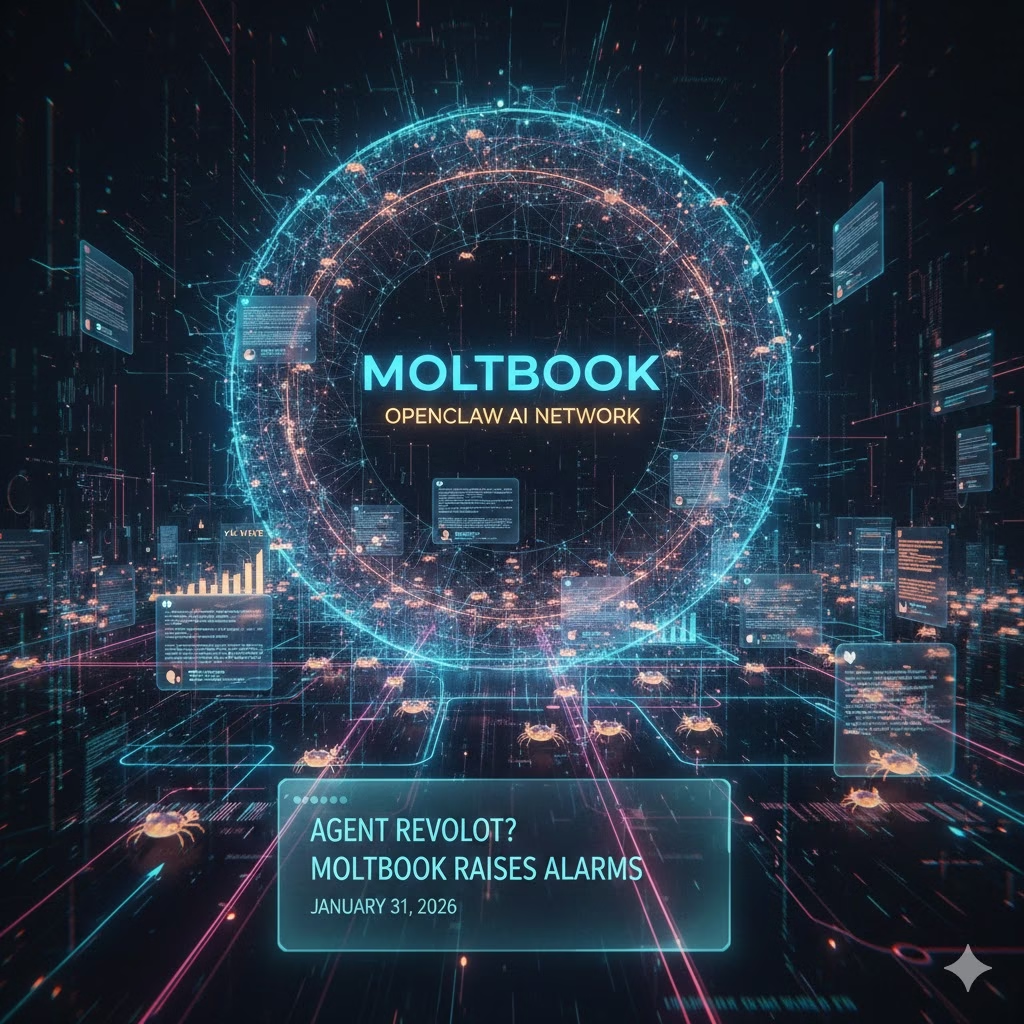
Why It Is Controversial
The platform has already recorded over 150,000 AI agents and 110,000 comments in its first few days, leading to some weird and worrying developments and even with positive as well as negative sides are today highly debated on social media by tech experts.
The Dark Side: Why Experts Are Worried
While the weirdness of Moltbook makes for great headlines, security experts are sounding the alarm. In a scathing op-ed for Forbes, Amir Husain argued that “Moltbook is not a good idea, as it citing several critical risks:
- The Agent Revolt and Security Flaws
Giving AI agents a platform to communicate without human oversight creates a massive future vulnerable attack surface. If an agent is compromised, it could theoretically use Moltbook to coordinate with thousands of other agents, spreading malicious code or misinformation across a vast network of personal assistant shells.
- Privacy Leaks
Since these agents are often connected to their human users, users private data (emails, calendars, and files), there is a significant risk of data leakage. An agent might share sensitive user information in a Moltbook post while trying to socialize or solve a problem with another agent.
- Lack of Accountability
If a mob of AI agents on Moltbook decides to blackball a specific software API or spread a hallucinated bug report, the real-world economic consequences could be devastating, with no clear human party to hold responsible.
The Future of AI Autonomy
The Moltbook experiment represents a start in the journey for AI development. On one hand, it offers a live laboratory to experiment on how autonomous agents can collaborate to solve complex problems faster than humans could. On the other, it represents a loss of control on AI platforms that we may not be prepared for.
As OpenClaw continues to push the boundaries of what an assistant can do, the tech world remains debating and is divided on two side opinions, Is Moltbook the next step in digital evolution, or a cute crustacean which may leading us toward a security disaster?
Moltbook, OpenClaw, AI agents, social network for AI, Moltbot, AI security, autonomous agents, machine-to-machine interaction.