If you are working with sedentary lifestyle and spending a longer time of day in complete seating, then you cannot avoid the back pain feeling, as siting on a laptop for longer hours, can create a energy less feeling with sometimes a pain in your back and your spine area. As, back pain is todays very common lifestyle born issue found in many peoples around the world, which may go in chronic stage if people don’t take initiatives to deal with it properly and on time. In this article we are providing you a very useful information on Best 12 Essential Office Desk Stretches for Chronic Lower Back Pain reduction.
Chronic lower back pain is the major health issue faced by many people with sedentary lifestyle around the globe. High physical work or more traveler people worldwide may also found facing back pain issues. Back pain can also be caused due to any back injury but in most of the cases, it is your sedentary lifestyle and sitting position for long hours at one place without moving your body, which, unknowingly creates Postural Stress and cause back pain.
Sitting for 8+ hours a day may causes a physiological chain reaction, in which your hip flexors tighten, your glutes turn off ie. a phenomenon which is known as gluteal amnesia, and your core body stops stabilizing your spine. This places an immense, unnatural pressure on your lower back and starts creating pain. The good news is that you don’t need a gym membership or an unexpected lifestyle change to reduce your backpain and fix your posture.
By just adding these simple body backside area targeted office desk stretches in your daily routine, can help to depress your spine, strengthen your body stabilizing muscles, and reduces the pain, with just simple stretching which can be performed without ever leaving your working place.
Why Your Desk Job is damaging your body Back area, specially spine:
The human body was designed for movement, such as walking, reaching towards far object with stretching, and squatting to pickup objects on floor, and not for sitting static with a 90-degree angles for a longer time of your day. When you remain seated for a longer hours then, several body shifts happens:
The Posterior Chain Weakens: Your glutes and hamstrings are the powerhouses of your lower body, which become overstretched and inactive. This forces the small muscles in your lower back to do heavy lifting for which they are not made for.
Short Hip Flexors: These muscles connect your spine to your legs. When they are constantly shortened, they pull on your pelvis, tilting it forward i.e. Anterior Pelvic Tilt. This creates an aggressive bending of your lower back, and also pinches the nerves which stresses the ligaments.
Spinal Compression: Gravity is a constant force impacting to our body spine and it result our body to continuously adjusting to achieve better body balance. Without routine body movement fluid stops pumping in your spinal discs, they compress more with external posture stress, and leads to stiffness and, eventually, long-term degeneration.
Fascial Position: Your connective tissue ie. fascia are actually begins to harden in the shape which you hold it regularly. If that shape is not proper, then your body will eventually resist to sitting upright and make a bending body shape with curved spine.
12 Office Desk Stretches to Relieve Lower Back Pain Instantly
Regularly Perform these body stretches after every 60 to 90 minutes of siting. You don’t have to do all of them at once, pick any three or four stretching repeatations through multiple breaks.
- The Seated Spinal Twist:
This move restores your spine rotation to the thoracic and lumbar spine, and releases the tension in the obliques.
How to do it: Sit tall with keeping your feet flat to floor surface. Place your left hand on the outside of your right knee and your right hand on the back of your chair. Gently twist to the right, using the chair base.
Duration: Hold it for aound 20 seconds, repeat the same on both left and right side.
- Seated Figure-Four ie. Piriformis Stretch:
Tight hips are a primary driver of lower back pain. This targets the piriformis, which, when tight, can replicate the back pain and also can cause sciatica.
How to do it: While being seated, cross your right ankle over your left knee. Keep your back flat and lean forward from the hips.
Important Tip: Do not round your shoulders, keep your chest straight and forward to intensify the stretch position for more benefits.
Duration: Hold it for 30 seconds for both left and right side.
- Desk Cat-Cow:
This modified version of the yoga classic mobilizes your entire spinal column and lubricates the discs.
How to do it: Place your hands on your knees or the edge of your desk. Inhale inside, with bending your back, and look up with Exhale, and tuck your chin, and round your spine like a cat.
Duration: Repeat for 10 slow, with deep breaths in and out.
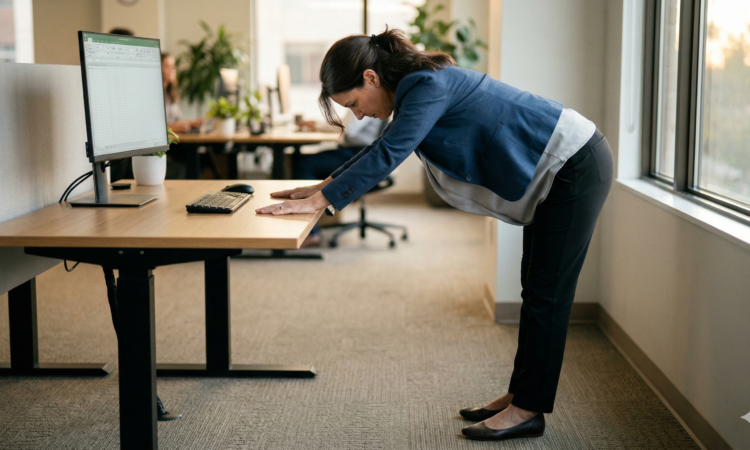
- The Standing Desk Forward Fold:
This allows gravity to do its work of decompressing your vertebrae while stretching the hamstrings.
How to do it: Stand at and place with putting your hands on your desk. Step back until your body forms an L shape. Let your head hang between your arms and then push your hips away from the desk.
Duration: Hold the position for 45 seconds.
- Seated Lateral Side Stretch:
Opening the Quadratus Lumborum (QL) muscles prevents the lower back from feeling locked.
How to do it: Reach your right arm overhead and lean towards the left side of your body, while using your left hand on the chair for stability.
Duration: Hold the position for 20 seconds for both left and right side.
- The Executive Chest Opener:
Slumping rounds the shoulders, which creates a pull that goes all the way down to your back.
How to do it: Interlock your hands behind your head. Pull your elbows back and squeeze your shoulder sides.
Duration: Hold the position for 30 seconds.
- Standing Hip Flexor Stretch:
This is the single most important way to improve your sitting position and posture.
How to do it: Stand next to your chair. Step one foot back into a shallow lunge. Tuck your tailbone under and sit forward slightly.
Duration: Hold it for 30 seconds for both lets and right side.
- Pectoral Doorway Stretch:
If you have a private office space or you sits nearby a doorway, then use it to reverse the neck position.
How to do it: Place your forearms on the doorframe with positioning your elbows at shoulder height. Step through the door slightly.
Duration: Hold it for 30 seconds.
- Seated Hamstring Reach:
Tight hamstrings pull on the sit-bones, which in turn flattens the natural curve of the lower back.
How to do it: While being seated at the edge of your chair, extend one leg straight out with your heel on the floor. Lean forward at the hips while keeping your back straight.
Duration: Hold the position for 30 seconds and repeat per leg.
- The Neck Release:
Tension in the neck often travels down the spinal area and towards the lower back.
How to do it: Drop your right ear to your right shoulder. Gently place your right hand on your head for added weight and don’t pull. Reach your left arm toward the floor.
Duration: Hold it for 20 seconds and repeat for both sides.
- Standing Quad Stretch:
Tight quads contribute to the pelvic tilt that causes lower back compression.
How to do it: Stand on one leg with holding the desk for balance. Grab your opposite ankle behind you and pull your heel toward your glute. Keep your knees aligned.
Duration: Hold it for 30 seconds for both side.
- Desk-Supported Squat:
Squatting re-engages the glutes and opens the lower back.
How to do it: Hold the edge of your desk for balance. Lower into a deep squat, keeping your heels on the ground. Breathe into your lower back.
Duration: Hold the position for 30 seconds.
The Very Important Micro-Break Strategy:
Modern healthy ergonomic practices promotes taking a micro breaks and stretching your body frequently to avoiding issues such as back pain which comes with sedentary sitting style and similar muscle damaging issues caused by long hours of siting. A single 60 minutes of relaxing yoga class on Saturday cannot undo the 40 hours of static sitting body impact.
Instead, adopt the 50/10 Rule:
50 Minutes: Deep, focused work.
10 Minutes: Body Movement. Spend 3 minutes on any one or more body stretching movements, 2 minutes of walking, and 5 minutes on a task that doesn’t require long hours of sitting.
This prevents the bad setting posture, also continuous movement helps to ensures better blood and oxygen to reach to the tissues of your entire body including lower back.
Ergonomic Prevention is also essential while doing stretching, While stretching is the best medicine to back pain and other muscle related issues, and for this your ergonomically supported workstation setup can be very helpful.
To prevent chronic pain from returning do the following:
Monitor or Laptop Screen Height: The top third part of your laptop or pc screen should be at your eye level. If you use a laptop, get a height increasing adjustable laptop stand and an external keyboard to improve your siting posture to healthier level.
The 90-90-90 Rule: Your elbows, hips, and knees should all ideally to be at 90-degree angles.
Lumbar Support: Your chair must follow the inward curve of your lower back. If it doesn’t, the put a rolled-up towel at your back to improve your posture.
Foot Placement: Never sit with crossing your legs. This unbalances the pelvis. Always sit with Keeping your feet flat on the floor or use a footrest if your chair is non adjustable and if it fails to provide better support to your foot.
If you don’t want a Chronic lower back pain to negatively impact on your professional career. Then, adopt doing all the above mentioned office desk stretches on daily basis. So, it will not only help to improve your body posture and brings a confidence of good posture inside you and, also safeguards you from spina and body back pain like issues,which prevents a healthy body mobility for a longer time.
Start with a small steps everyday, pick any one or two stretching actions from this above provided list of 12 Essential Office Desk Stretches for Chronic Lower Back Pain and do it on regular basis. Your can experience yourself after some days of repeating it, that, your back is painless and ok for a longer time with a healthy posture.
Important Note: If your back pain due to any previous injuries and is accompanied with numbness, tingling, or sharp pain experience while you put down your leg such as during sciatica issues, then please immediately consult with a physio therapist or expert medical professional before beginning any such new exercise routine.

Senior Editor, Strength & Conditioning
B.Sc. in Kinesiology, Punjab University | Certified Strength and Conditioning Specialist (NSCA)
Karan Gupta has been a core part of Gymbag4u.com Team since its foundation in 2018. With a background in Fitness, bodybuilding exercise science and a decade of coaching experience, he specializes in functional fitness, injury prevention, and Fitness Routine Guide.