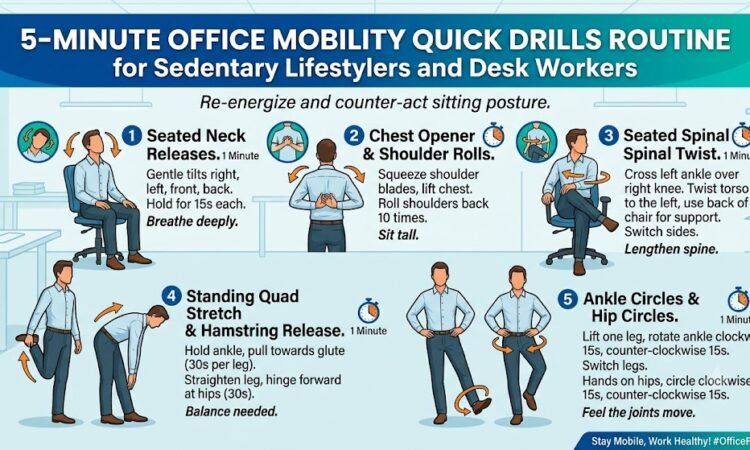
If you found yourself of facing Stiff back or tight hips from sitting all day Long? Then, you must Try these below 5 quick Office Mobility Quick Drills Routine, which is desk-friendly and supports people with long hours of sitting desk jobs to experience relief from posture pain and improved body mobility within very less time.
Why Sitting All Day Can Causes Posture Pain
Modern desk setups force our human body into a fixed holding pattern for longer hours with rounded shoulders, shortened hip flexors, a stiff upper back (thoracic spine), and forward head posture. Over the time, remaining in a sedentary position may leads to following postural issues.
- Spine Stiffness: The upper back rounds forward, restricting natural rotation and extension.
- Shortened Hip Flexors: Sitting keeps the hips bent at a 90 degrees angle, which starts causing the hip flexors and quads to tighten periodically.
- Glute Inactivation: Long time continuous pressure on the gluteal muscles can reduce the neuromuscular activation which is referred to as “glute amnesia”.
- Cervical & Scapular Stress: Forward head posture overburden on the upper trapezius muscles and deep neck extensors.
Adopting a targeted such small mobility drills throughout your day helps to restores your joint capability of easy motion, improves body fluid circulation, and corrects body posture-related discomfort, without requiring any intensive workout, workout clothes or leaving your work desk area.
5 Desk Mobility Drills to do Under 5 Minutes:
These zero-equipment small exercises target to the five most common trouble spots which can be caused by prolonged sitting.
1.Seated Thoracic Extensions with Primary Focus on Upper Back & Chest Mobility.
Why it works: Reverses bended posture by extending the thoracic spine and opening up tightens our chest muscles.
- Sit tall at the edge of your office chair with keeping your feet touching flat on the floor.
- Interlock your fingers behind your head to support your neck.
- Inhale once, and then press your elbows back slightly, and arch your upper back over the top of your chair’s backrest.
- Pause ion same position for 2 seconds at the top position without stressing extra on your lower back.
- Exhale and return to the upright starting position.
Repetitions: Do its 8 to 10 controlled repetition until you feel comfort by yourself.
2.Standing Hip Flexor Stretch with Overhead Reach with Primary Focus on Hip Flexor & Pelvic Alignment.
Why it works: Lengthens shortened hip flexors and counteracts anterior pelvic tilt.
- Stand up and step your right foot back into a shallow split-position lunge.
- Keep your back heel elevated and gently tuck your pelvis under by squeezing your right glute.
- Reach your right arm straight overhead and lean slightly to the left side until you feel a gentle stretch along the front of your right hip.
- Hold the position for 3 seconds, and then relax.
Repetitions: Do 5 holds per side with repeating it for 20 seconds per side.
- Wall Angels with Primary Focus on Shoulder Mobility & Postural Muscle Activation.
Why it works: It helps to strengthens weak upper back postural muscles while improving shoulder rotation and chest opening. - Stand with your upper back, head, and glutes keeping flat against a wall.
- Bring your arms against the wall in a “goalkeeping” position with elbows bent at 90 degrees.
- Slowly slide your arms upwards while keeping your elbows, wrists, and lower back in contact with the wall.
- Slide back down to the begining position with ease and under control.
Repetitions: Do it for 8 to 10 times in slow motion and with controlled repetitions.
- Chair Figure-4 Stretch with Primary Focus on Glute & Piriformis Relief.
Why it works: It helps to provide relief form deep hip tightness, releases the piriformis, and reduces lower back tension. - Sit tall in your chair and cross your right ankle over your left knee.
- Flex your right foot slightly to protect the knee joint.
- Keeping your back flat, inhale and bend forward from your hips until you feel a stretch in your right glute.
- Hold the position for 20 to 30 seconds while breathing deeply in your abdomen, then switch to another sides.
Repetitions: Do it for minimum 2 sets of stretch per side for better results.
- Chin Tucks & Neck Retractions with Primary Focus on Cervical Spine & Forward Head Posture.
Why it works: It helps to strengthen your deep cervical flexors and reduces stress at the base of the skull which is generally caused by computer screens usage for long hours. - Sit or stand upright by looking straight ahead.
- Without tilting your head down, pull your chin straight back as if making a “double chin.”
- Hold the end position for 3 seconds.
- Release slowly and come back to a neutral position.
Repetitions: Do its 10 repetitions per day for better results.
Practical Tips for improving Daily Office Mobility
- Implement a Deliberate Body Movement Habits: Combined with your mobility drills with daily routine habits provide more benefits to your posture and body mobility. For example, perform chin tucks after every video call or do the standing hip flexor stretch whenever you stand up and go to refill your water bottle.
- Move With Pain-Free Movements: Mobility work should generate low intensity level of tension and relief to nerves, and never generrate sharp joint pain, which makes it considerably safer than other workouts.
- Prioritize Hydration: Regular fluid intake and drinking enough water throughout the day helps to keep your entire body and spinal discs well hydrated and encourages you to take natural body movement breaks throughout the day.
Disclaimer: This article is for informational purposes only and does not constitute medical advice. Consult with a licensed physical therapist or healthcare professional before beginning any new mobility workout and body movement routine if you have existing injuries or chronic back pain.
Frequently Asked Questions (FAQ)
How often should the office workers can do mobility drills?
Doing the 1 to 2 short mobility drills for every 60 to 90 minutes on daily basis, is more effective for reducing the postural stiffness than doing a single session of entire body movements activities at the end of the day.
Can mobility drills replace regular physical exercise?
No, While office mobility drills reduce daily stiffness and improve Body joint’s area of movement, they should only additionaly support to your health, and it cannot not replace the regular cardiovascular exercise and full-body strength training.
What is the difference between stretching and mobility work?
Stretching focuses primarily on lengthening of body muscle tissue, whereas mobility work combines muscle flexibility with active joint control throughout a various full range of body motion.
We hope you like the above article, and it will definitely help our readers in adopting a perfect short workout during their busy day, and improve their body posture and spine and joint health.

Editor of Segment – Men’s Health & Active Lifestyle
B.A. in Sports Science, University of Michigan | Certified Wellness Specialist (NWI)
David Brooks joined Gymbag4u.com in 2019, bringing a strong focus on men’s health, motivation, and active aging. With a background in sports science and years of coaching men in fitness, lifestyle change, and injury recovery, David’s content speaks directly to readers navigating modern work-life stress.