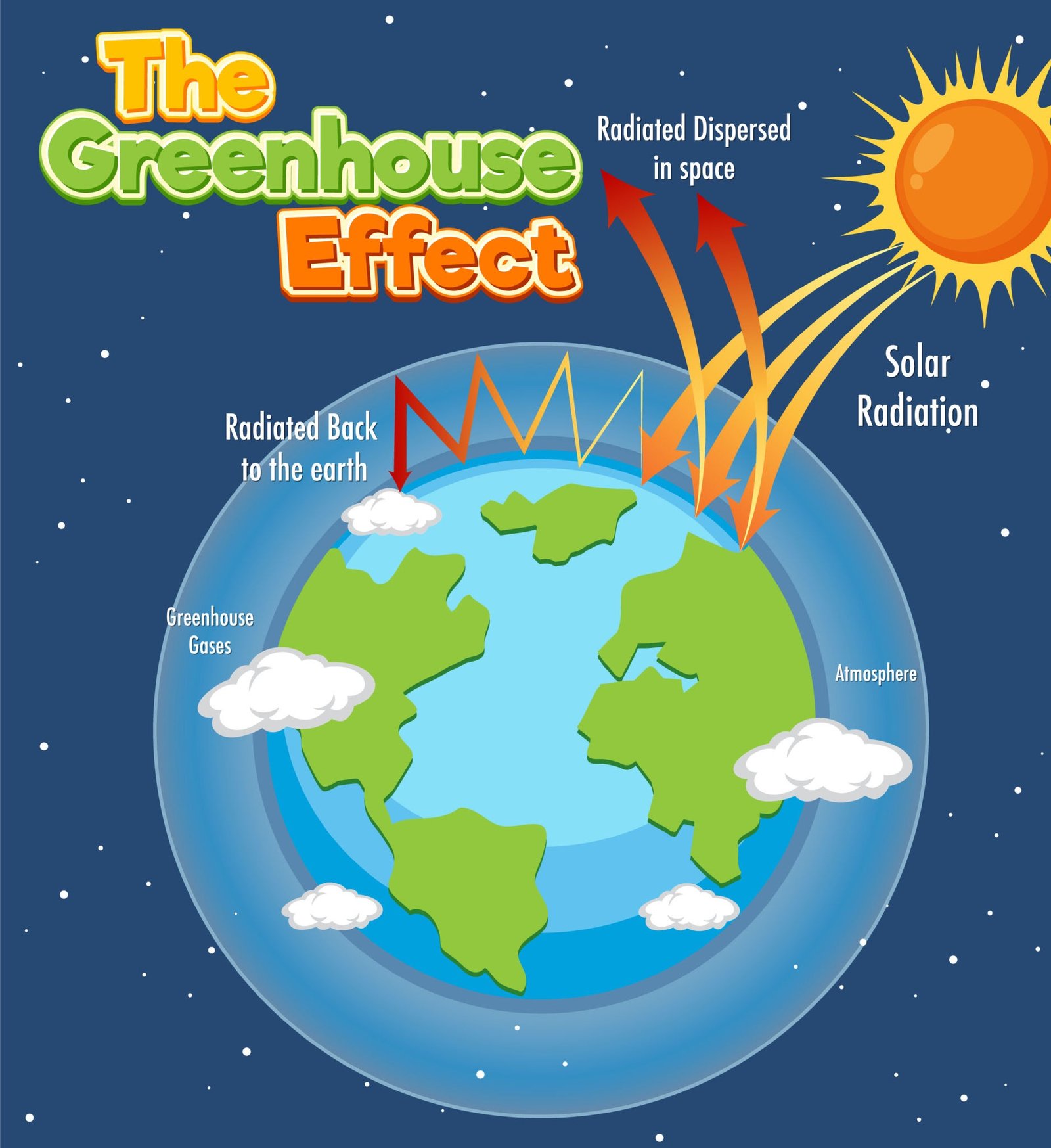
Greenhouse and its effect is driven by the interaction between the Earth’s atmosphere and incoming solar radiation. While it is a natural process, but human routine activity has significantly increased it, which leads to modern global warming.
What Causes the Greenhouse Effect?
The process begins when solar energy speificlly its short-wave radiation passes through the earth’s atmosphere ot hiher level and warms up the Earth’s surface. The Earth then attempts to cool down itself by radiating this energy back toward space as infrared radiation which is alsoc alled as a long-wave thermal energy.
The effect occurs because o few important molecules in our atmosphere, known as Greenhouse Gases (GHGs), allows to absorb this outgoing infrared energy. Instead of escaping into space, the heat is trapped inside earth atmosphere and re-emitted in all directions, including going towards the earths surface.
The Most Impacting Factors:
When evaluating what has the most impact, scientists look at two different metrics,
- The natural abundance of the gas
- Human-driven activities which are causing climate change.
- Water Vapor – H2O(g):
In terms of the total natural greenhouse effect, water vapour is the most impacting object, which gives a major greenhouse effect to our earth. It is responsible for roughly 36% to 70% of the greenhouse effect. However, water vapour acts as a result of the radiation rather than a direct cause of earth’s warming, as the planet warms due to other gases, creates more water evaporates and again traps even more heat.
- Carbon Dioxide (CO2): The Main Cause that drives Climate Change
When discussing about the increasing greenhouse effect which is also called as global warming, Carbon Dioxide is the most significant factor. Even though it is less potent molecule for molecule than methane, it is the primary concern for many reasons:
- High Volume: Humans emit billions of tons of CO2 annually through the burning of fossil fuels (coal, oil, and gas) and deforestation and animal husbandry.
- Persistence: Apart from water vapor, which leaves the atmosphere in days via rain, CO2 remains in the atmosphere for hundreds thousands of years and creates the harmful impact.
- Methane (CH4): The High-Intensity Impact causing element
Methane is the second most important greenhouse gas contributed by humans. While it is low available in the atmosphere than CO2, it is much more effective in trapping heat. Over a 20-year period, methane is roughly 80 times more harmful than CO2.
Comparison of Key Greenhouse Gases and their impacts
- Gas: Carbon Dioxide, Main Source: Fossil fuel combustion, Land clearing, Atmospheric Lifetime: 100–1,000+ years, Warming Potency (GWP): 1 (Baseline)
- Gas: Methane, Main Source: Agriculture (livestock), Landfills, Gas leaks, Atmospheric Lifetime: 12 years, Warming Potency (GWP): 28–36 (over 100 years)
- Gas: Nitrous Oxide, Main Source: Fertilisers, Industrial processes, Atmospheric Lifetime: 114 years, Warming Potency (GWP): 265–298
The greenhouse effect is driven by the interaction between the Earth’s atmosphere and incoming solar radiation. While it is a natural process, but due to human human activity this has leading the modern global warming impact.
How to lower the greenhouse and its effect:
To lower the greenhouse effect, specifically the enhanced greenhouse effect driving global warming, the focus must be on reducing the generation of greenhouse gases in the atmosphere. This can be achieved through two main ways, Mitigation ie. reducing the emissions and segregation of harmful gases i.e. Doing efforts to removing existing gases.
- Transition to Clean Energy
The burning of fossil fuels (coal, oil, and gas) is the largest source of CO2 emissions.
- Renewable: Shifting power generation from traditional fossil fuel based grids to clean solar, wind, geothermal, and hydroelectric power which reduces CO2 Emission.
- Nuclear Power: Using the carbon-free nuclear energy with safety to reduce the load of the fossil fuel based grid.
- Energy Efficiency: Upgrading to LED lighting, high-efficiency HVAC systems, and better building insulation to reduce the total power consumption which also helps in carbon emission. promoting wise usage of electricity to common public also helps to reduce electricity consumption on mass level.
- Decarbonizing Transportation
Passenger and Goods Transportation is a massive contributor to increasing the environmental CO2 and nitrous oxide levels.
- Electric Vehicles (EVs): EV’s helps to promote the use of Fossil based internal combustion engines to more clean non-carbon emission transport such as Electric busses and Metros.
- Public Transit: Investing in high-speed rail, electric buses, and bike friendly urban planning which helps to reduce the carbon emission.
- Sustainable Aviation: Developing bio-fuels and hydrogen-powered aircraft to tackle the long-distance travel carbon emissions.
- Protecting and Restoring Nature (Sequestration)
Nature is the most efficient technology we have available for automatically removing excess CO2 from the air.
- Reforestation: Planting trees in the areas where forests have been lost helps in reducing co2 from environment and provide cooling effect to earth atmosphere.
- Creating forestation: Creating new forests where there is a non-forest zone, helps to restore the environmental balance in the region.
- Blue Carbon: Protecting coastal ecosystems including mangroves, salt marshes, and seagrasses, which is capable of storing higher level of carbon than the regular land forests.
- Reforming Agriculture and Diet
Agriculture is a primary source of emission of harmful methane (CH4) and nitrous oxide (N2O) which causes greenhouse impact.
- Regenerative Farming: Techniques such as no-till farming a revolutionary agricultural technique for growing crops without disturbing the existing soil through plowing or soil turning, promotes in leaving previous crop residue etc. on the surface and locks the soil gas. During this farming it helps in soil covering for a longer time and keep carbon trapped in the soil.
- Methane Reduction: Livestock is the main reason of major methane emitting in atmosphere. Changing livestock feed such as adding seaweed can helps to reduce the methane produced by the cattle.
- Waste Management: Effective waste management including proper segregating wet, metal and dry waste effectively and avoid waste burning in rural as well as in urban area is very important. By reducing and even capturing the methane from landfills and using it as a fuel source including cooking and industrial use, instead of letting it escape into the atmosphere helps.
- Industrial Innovation
- Carbon Capture and Storage (CCS): Capturing CO2 at the source including manufacturing facilities and power plants, and pumping it underground storage so it cant escape in environment and create greenhouse effect.
- Green Steel and Cement: Developing new green chemical processes for heavy industry that do not promote carbon emitting by traditional methods including fossil fuel burning etc.
Action vs. Impact on Green House Gas Emission
- Action: Solar/Wind Power, Primary Gas Targeted: Carbon Dioxide (CO2), Scale of Impact: Very High
- Action: Protecting Rainforests, Primary Gas Targeted: Carbon Dioxide (CO2), Scale of Impact: High
- Action: Reducing Meat Consumption, Primary Gas Targeted: Methane (CH4), Scale of Impact: High
- Action: Smart Fertilizing, Primary Gas Targeted: Nitrous Oxide (N2O), Scale of Impact: Medium
How a common man can help in reducing the Greenhouse gas effects:
- Better waste segregation helps in better waste management and reduces the methane emission.
- Using electricity wisely and switching off lights and fans when not use, and reducing use of lifts and air conditions can help to reduce electricity consumption.
- Smart, Without harmful fertilisers and chemicals usage and natural method farming helps in reducing carbon and methane emission and reduces the green house gas effects.
- Planting more trees, creating a good home garden and helping community drives in tree plantation helps in improving number of trees which reduces CO2 from environment and provide cooling effect to surroundings and reduce worming.
- Promoting use of Public transport and green mobility such as EV helps in reducing carbon emission and reduce green house effects.
There are many small things which we do in our day to day routine which will help in reducing the greenhouse gas emission and make the environment more safe for we humans. We hope above article will help our readers to understand the impact of Greenhouse emission, and how you can contribute to reduce it and contribute in safeguarding our mother earth.

Prashant is a Blogger at Gymbag4u.com, He is a Social Media Journalist, Financial Professional & Fitness Enthusiast associated with Gymbag4u.com since 2018,