With digital transformation in health sectors, popularity of using smart rings, advanced laboratory testing, and complex biometric tracking, is become easy to take self control of your own health data. Many fitness enthusiasts spend more time in analyzing digital health reading data of their health gadgets, than actually making progress. When you are balancing a busy lifestyle, where one don’t need a medical degree or hours of free time to monitor your body health readings. You need simple, actionable device with accurate data readings which automatically comparing with an ideal and necessary health readings.
The truth is, that tracking your own physical health and structural strength does not require expensive technology. By just shifting your focus towards a few high-yield, low-effort gadgets, by which you can accurately measure your cardiovascular wellness, nervous system recovery, and functional muscle power.
Here is an evidence-based guide on how to track health and physical strength using the most straightforward, practical methods available today.
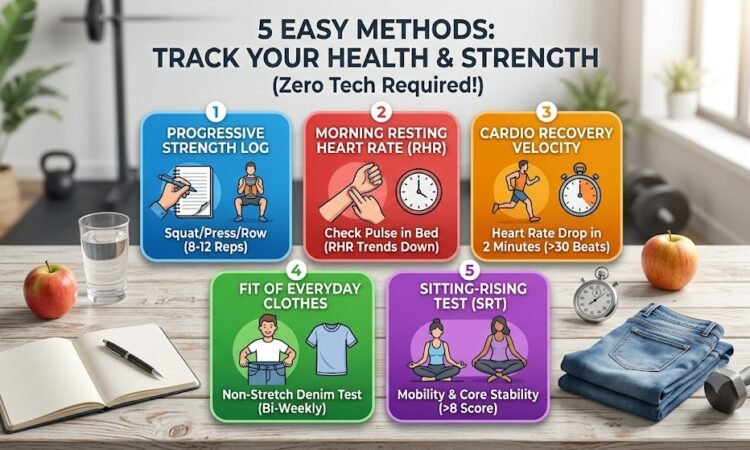
- Track Functional Power with The Big 3 Repetition with Progression
The most reliable symptoms, which shows that you are strengthening your body skeletal muscle mass is a stable by just knowing your routine activity and body stress, this simple measuring is the best possible reading of your muscular health.
Pick three foundational, compound exercises that mirror everyday movements, a squat variation (lower body), a press variation (pushing), and a row or pulldown variation (pulling).
- The Method: Rather than attempting a risky one-repetition with maximum lift, track your 8 to 12 repetition in progression. Write down the exact weight you lifted and the number of easy repetitions you completed in a simple notebook or a note app on your smartphone.
- What Progress Looks Like: If you can perform 8 repetitions of a goblet squat with a 30-pound dumbbell this week, and 11 repetitions with the exact same weight next week, you have successfully applied progressive overload. Your muscles are adapting and growing stronger.
- Monitor Nervous System Recovery with Morning Resting Heart Rate (RHR)
Your heart rate is a direct window into the state of your autonomic nervous system. Tracking your Resting Heart Rate (RHR) helps you determine whether your body has fully recovered from your last intense workout or if you are running on empty.
- The Method: You do not need a high-tech wearable gadgets for this. The moment you wake up naturally, while still lying flat in bed, place two fingers on your radial pulse (your wrist) or carotid artery (your neck). Count the beats for exactly 60 seconds. Alternatively, if you wear a basic fitness tracker, simply check your baseline morning average.
- What Progress Looks Like: As your cardiovascular strength and heart health improve, your baseline RHR which will gradually shows down trend (typically settling between 60 and 70 beats per minute for average adults, or lower for trained individuals). If your morning RHR suddenly spikes 5 to 10 beats above your typical average, it is a clear warning sign that your body is fighting off stress, poor sleep, or localized inflammation, signaling that it is a perfect day for a low-intensity active muscle recovery session.
- Assess True Heart Health with Cardio Recovery Velocity
How quickly your heart returns to a normal rhythm after intense workout or physical work exertion, is also one of the strongest clinical tracking indicators of cardiovascular strength and athletic performance.
- The Method: At the very end of a demanding cardio workout or an intense weight lifting session, check your heart rate by using a digital device or by counting your pulse for 15 seconds and multiplying pulse count by 4). Stop moving entirely, sit down, and rest quietly for two minutes. And then measure your heart rate again to see the results.
- What Progress Looks Like: Deduct the second number from the first number to calculate your recovery timeline. A drop of 30 beats or more during just a two-minute’s of rest, shows a highly efficient, responsive cardiovascular system. If your heart rate struggles to reduce by at least 20 beats, then your aerobic base requires more consistent work.
- Use The Test of Everyday Clothes Over the Scale
Relying entirely on a standard weight scale is one of the biggest psychological traps in fitness world. A weighing scale cannot tell the difference between body water retention, muscle gain, and true body weight. If you are lifting weights and eating a high-protein diet, your weight might stay similar even as your body undergoes through a massive, healthy transformation.
- The Method: Select a specific pair of non-stretch denim pants or a structured button-down shirt from your closet. Try them on once every two weeks under the exact same conditions, ideally do this first thing in the morning.
- What Progress Looks Like: Notice how the fabric sits across your waist, shoulders, and hips. If your weighing scale shows the stable weight, but your pants feel noticeably loose around the body midsection and your shirt fits tighter across your upper back, then it proves that you are successfully dropping fat and building structural & muscular strength.
- Evaluate Structural Longevity with The Sitting-Rising Test (SRT)
Physical strength is not just about how much weight you can push in a gym, but, it is about how safely your body moves through space. The Sitting-Rising Test (SRT) is a popular clinical strength testing tool used by physicians to measure the agility, balance, core stability, and lower-body skeletal power.
- The Method: Stand barefoot on a flat floor. Without leaning against a wall or using furniture for assistance, cross your feet and lower yourself completely down into a seated, cross-legged position on the floor. Then, attempt to stand back up to a full upright position.
- The Scoring: Start with a perfect score of 10 points. Subtract 1 point every time you are forced to use a hand, knee, forearm, or the side of your leg to support your weight or push yourself up. Deduct half a point if you temporarily lose your balance.
- What Progress Looks Like: Achieving a score of 8 points or higher indicates better functional musculoskeletal health. If you struggle or requires hand assistance initially, then tracking your score over the time provides an easy measures to see your body’s mobility and core strength improvement.
The Simplified Tracking Framework
To keep your health tracking consistent without letting it take over your life, categorize your metrics into a clean, monthly schedule:
- Tracking Marker: Workout Progression Log, Metric Evaluated: Muscular Strength & Progressive Overload, Frequency: Every workout session, Effort Level: Very Low (2 minutes)
- Tracking Marker: Morning Pulse Check, Metric Evaluated: Central Nervous System Recovery, Frequency: 2 to 3 times per week, Effort Level: Very Low (1 minute)
- Tracking Marker: Cardio Recovery Rate, Metric Evaluated: Heart Health & Aerobic Conditioning, Frequency: Once per week, Effort Level: Low (2 minutes)
- Tracking Marker: The Clothes Test, Metric Evaluated: True Body Composition Shifts, Frequency: Bi-weekly, Effort Level: Very Low (3 minutes)
- Tracking Marker: Sitting-Rising Test, Metric Evaluated: Mobility, Balance & Core Stability, Frequency: Once per month, Effort Level: Low (2 minutes)
Consistency in your routine will always beat the complexity. You do not need to turn your health journey into a second hard work as you are already in busy in your daily routine chaos. Pick two or three of these easy tracking methods, keep a prompt log of your health readings, and focus on regular, long-term improvement.
how to track health and physical strength, easy fitness tracking methods, monitoring muscle strength, track health without smartwatch, simple cardiovascular tests, progressive overload log basics.

Senior Editor, Functional Fitness & Everyday Strength
Qualified B.S. in Exercise Physiology, University of Colorado Boulder | Certified Personal Trainer (ACE)
Jake has been a founding editor at Gymbag since 2018. With over 12 years of coaching experience and a degree in physiology, he specializes in fitness that fits into real life.