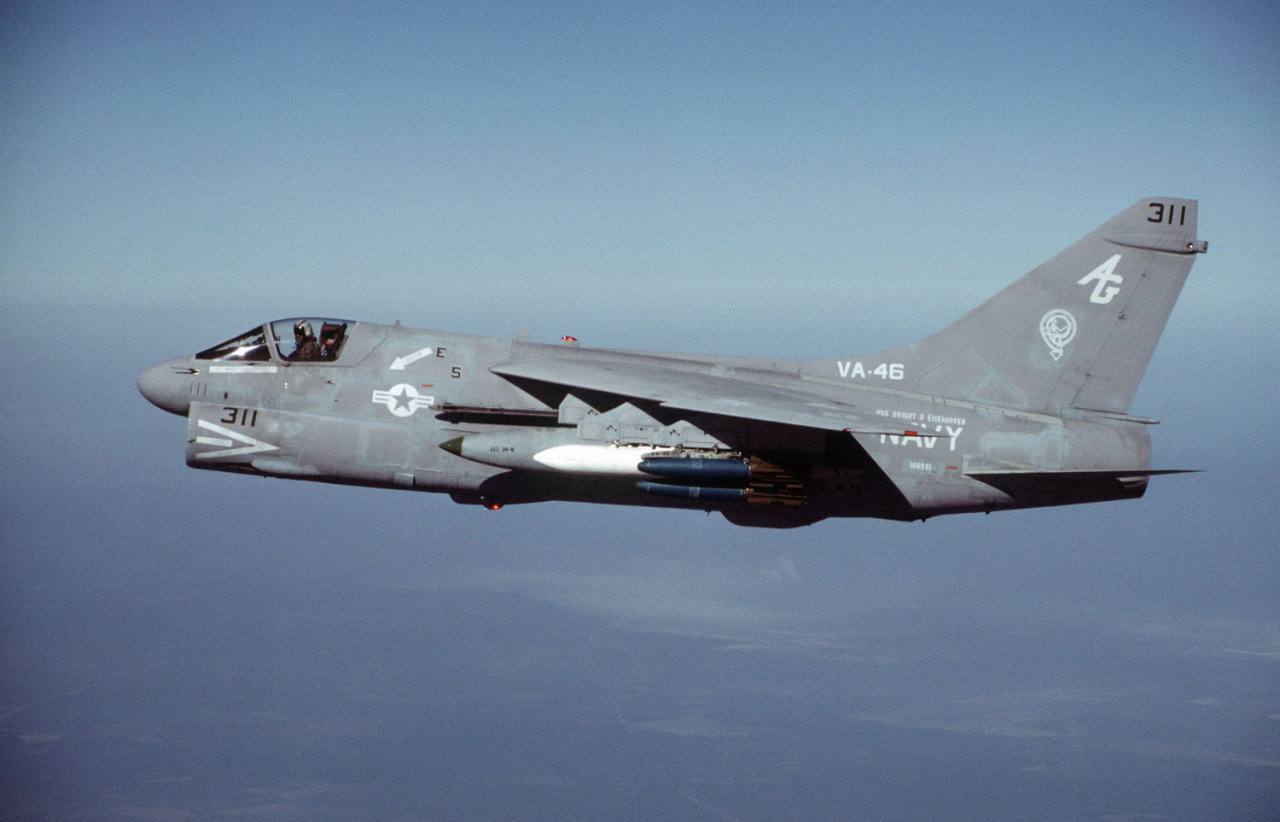

In the 1960s, when flight appeared to be all about speed and altitude, a low profile subsonic strike fighter humbly defined its own class. The A-7 Corsair II did not get to draw attention with best performance, but it gained respect for being a solid, practical, and strong aircraft, and was once the backbone of U.S. air operations for over 25 years.

The A-7 drama started when the Navy ran into the cost and sophistication of newer jets. The productive attack plane A-4 Skyhawk required a replacement that had greater range, could carry heavier weapons, and had to be a easy and cost effective service. In 1963, the Navy requested a new aircraft with the requirement that it utilize an existing air crafts body frames in an effort to save time and money.

Vought Aircraft, producers of the World War II legend F4U Corsair, came to the rescue. John Russell “Russ” Clark and his engineers took the F-8 Crusader as a primary development point, shortening the fuselage by some ten feet, reducing the variable-incidence wing, and replacing the after-burning engine with a more efficient turbofan. The resulting aircraft was a tiny fighter in appearance but take off best beyond expectation.

What distinguished the A-7 was its state-of-the-art design. It was the first American aircraft featuring a heads-up display (HUD) for pilots, enabling them to monitor critical flight and target data without looking down from window. Its avionics, such as the AN/APQ-116 radar and subsequent upgrades, permitted accurate strikes even in bad weather. Its digital bombing computer delivered unmatched accuracy, a new standard for U.S. strike aircraft.

The Air Force A-7D variant used the Allison TF41-A-1 engine, a Rolls-Royce Spey Engine under license, with aerodynamic modifications such as increased wingspan to produce more lift and easy handling.

Featuring a combat radius of more than 1,200 miles and being capable of carrying more than 15,000 pounds of munitions on eight wing pylons, the Corsair II could carry and attack with everything of routine bombs and cluster bombs to TV-guided Walleye bombs and Maverick missiles.

Although slow by supersonic standards, pilots enjoyed the A-7’s stable flight characteristics. The plane was simple to handle, responsive, and strong, these qualities above speed in its missions during Vietnam war. Its better armoured cockpit, backup systems, and ruggedness enabled pilots to carry every difficult missions very effectively and return safe.

The aircraft’s reliability was best, Navy and Marine A-7s flew over 97,000 combat sorties with only 54 losses, and Air Force A-7Ds flew nearly 13,000 sorties with only six losses. Overseas, the Corsair II was tested in Grenada, Panama, Lebanon, Libya, and the Gulf War. Its dual capability of close air support and combat, with precision bombing, made it a precious weapon in multiple wars.

The A-7 continued to evolve throughout its career. The early A-7A models were replaced by later improved models like the A-7B and A-7C, while the Air Force’s A-7D received a new engine, improved navigation equipment, and the M61 Vulcan cannon. The Navy’s A-7E received advanced avionics and smart bombs, and the aircraft even served in the air forces of Greece, Portugal, and Thailand, extending the Corsair II into the 21st century.

Affordability was what made it so popular. It cost less than $1 million an airplane in the 1960s, the A-7, which was less than even the F-4 Phantom jets. It had a less fuel-consuming non-after burning engine, and ground crews can easily observes its strong & easy operating panels and tech. Servicing its engine took very less time, maintenance was easier, and its parts were stronger than earlier available aircraft.

In a broad view, the A-7 Corsair II is a tribute to realistic combat flight. It demonstrated that battlefield effectiveness did not originate from its swift speed or bold designs. Even after following many years of its retirement from U.S. service in 1991 and its last flight in Greece in 2014, the Corsair II is still praised for its better efficiency, durability, and endurance of combat strike flight.