
The .41 Remington Magnum does not necessarily come to mind in every discussion between shooters, yet it has gained respect quietly behind the scenes with those who care about handguns. It never had the common fame of the .357 Magnum, nor the publicized notoriety of the .44 Magnum. Rather, it has always held a special place in the middle, and that is precisely why it is so attractive. For the balance-conscious, the .41 finds its sweet spot that few other rounds can hope to match.

The .41 Magnum came into existence during the 1960s, when visionaries such as Elmer Keith and Bill Jordan identified a gap in the market. They were looking for an alternative that offered more stopping power than the .357 but less brutal recoil than that of the .44. Their answer was conceptually simple but courageous in practice: a .41-caliber round intended for both police officers and hunters. The thought was to produce a highly functional round that would do well out in the field but remain safe and controllable during everyday use.

With Remington and Smith & Wesson behind it, the cartridge was produced in two variations. There was a heavier, more powerful load for the outdoorsman, and a lighter load for police work. Officers nationwide would hopefully adopt it as their new sidearm, offering power, penetration, and recoil that was decidedly lighter than the .44. It would be the best of both worlds.

Performance-wise, the .41 Magnum is a fine balance. Its 210-grain .410-inch bullet is heavier than a .357 but short of the sheer brute power of a .44. Standard loads will usually shoot a 210-grain bullet at velocities between 1,200 and 1,500 feet per second, providing ample stopping power with a flatter trajectory than most revolver loads. For most shooters, it’s just the attraction: enough bite to accomplish the task without beating up the wrist. Veteran shooters will observe that while there is recoil, it’s much easier to handle in a full-size revolver than in some of its larger siblings.

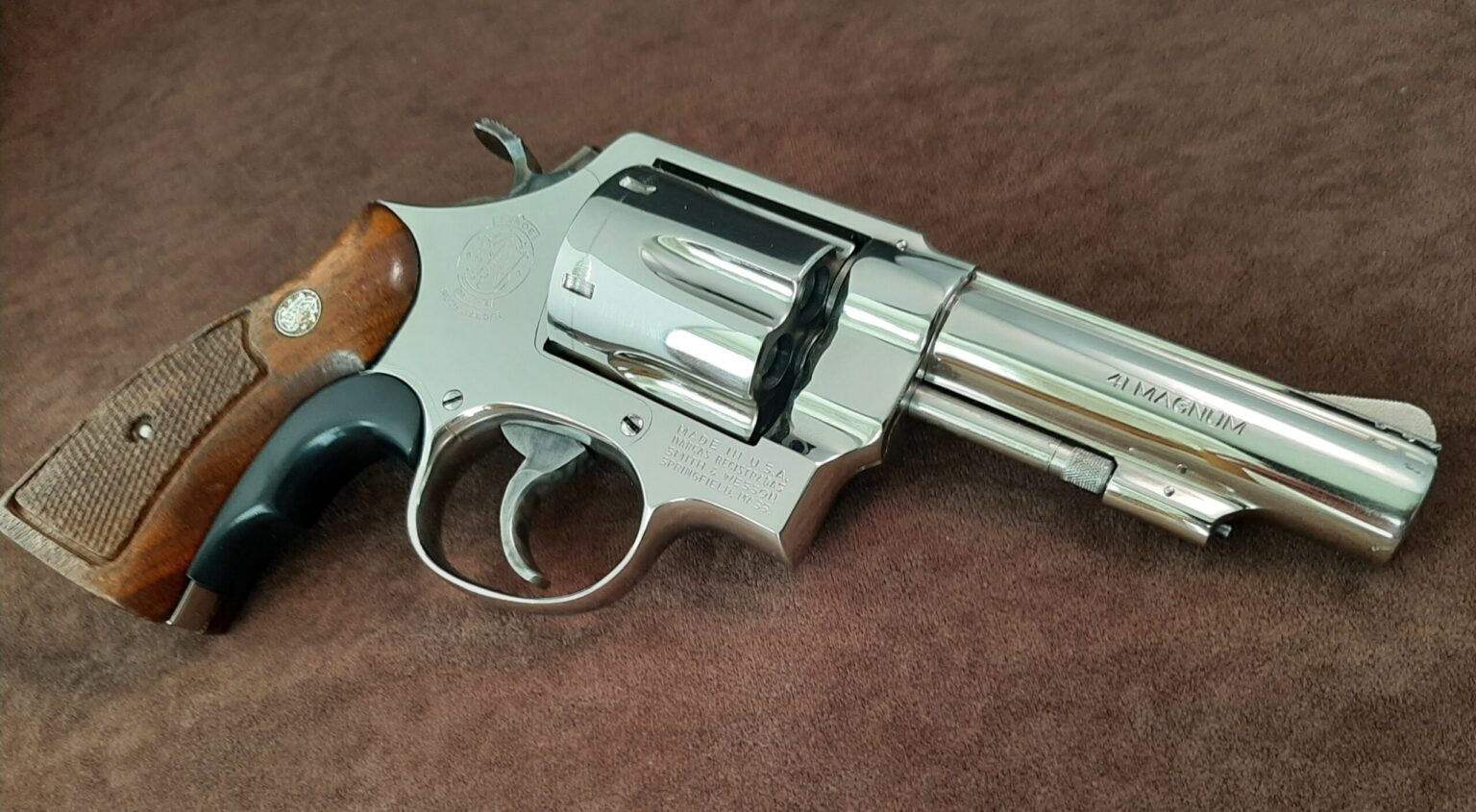
The .41 Magnum never gained favor as a mainstay for police duty. The revolvers manufactured for it, such as the Smith & Wesson Models 57 and 58, were big, heavy, and unpleasant to wear daily. Even the lighter police load kicked harder than officers were used to, so adoption was less desirable. By the time semi-automatic pistols with larger capacities and softer handling had become the standard, the .41 had been practically forgotten. It’s time as a possible favorite of lawmen slipped by unnoticed.

As the world of police passed it by, the .41 became a niche weapon for hunters and collectors who valued its special strengths. It is particularly good at delivering accurate, hard-hitting performance whether on deer, hogs, or black bear. The round enters deep, flies flatter, and brings a level of performance equivalent to a .44 Magnum with considerably less pain for the shooter. For anyone looking for a revolver that combines power and manageability, the .41 is frequently the perfect firearm.

For decades, the .41 Magnum has acquired a loyal following. Its users who shoot it regularly commend not only its performance but also the cartridge’s handling in the hand and on the range. Accuracy, dependability, and versatility make it a shooter’s favorite when it comes to trying out various loads. Handloaders especially like the cartridge’s versatility, with bullet weights from 170 to 250 grains and configurations for hunting, self-defense, and target shooting.

Although it is no longer at the forefront, the .41 Magnum is not anywhere to be forgotten. Smith & Wesson continues to make the Model 57, and Ruger has the Blackhawk and Redhawk in .41 caliber. Used revolvers from companies such as Dan Wesson and Taurus continue to be very available.

Ammunition has become more available, with big corporations making rounds ranging from mild to full magnum loads, so that shooters of all types can still get their enjoyment out of this formerly neglected cartridge.

In the end, the .41 Remington Magnum never had to be the largest name to be important. It found a lasting place among hunters, handloaders, and anyone looking for a revolver that finds the ideal middle ground between light and heavy.

Usually referred to as the “Goldilocks” magnum, it’s not too anemic, not too brutal—just right. More than sixty years since its introduction, the .41 remains to be respected by those who shoot it, quietly holding on to its place as an outstanding, underrated jewel in the realm of revolver cartridges.