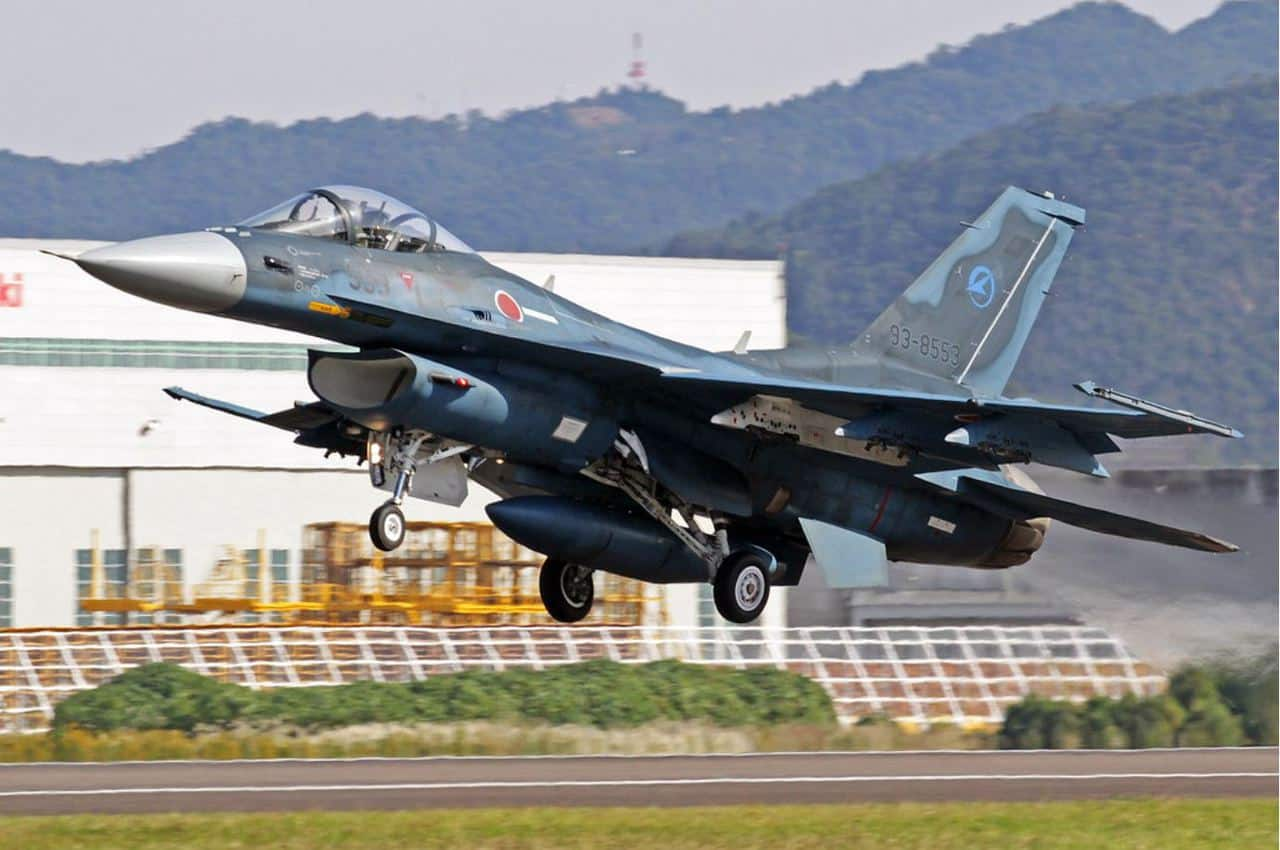

The Mitsubishi F-2 does not have global popularity like the F-16 or F-35, but it does occupy a unique place in Japan’s air defense stance. Designed through a mix of native zeal and overseas cooperation, the F-2 is Japan’s quest for technological independence with the added benefit of accessing fundamental U.S. knowledge. The outcome is a multirole fighter that brings stunning performance to a multitude of contemporary combat missions.

The F-2 was begun in the early 1980s through the FS-X program by Japan’s Technical Research and Development Institute (TRDI). The objective was to produce a fighter that is specifically tailored to meet Japan’s unique defense requirements with a focus on range, maneuverability, and area defenses.

It was a challenge and costly to develop an all-native plane, so Japan allied with America and Lockheed Martin to manufacture an advanced version of the F-16C Block 40. It was as close as the two countries had ever come to co-producing their fighters.

Despite its roots in the F-16, the FS-X, which was later redesignated as F-2, is a plane in its own right. Mitsubishi Heavy Industries spearheaded the development of Japan, redesigning large sections of the airframe.

The wings were lengthened by approximately 25 percent for additional lift, payload, and low-speed maneuverability. Japan’s advanced AESA radar was accommodated by rearranging the nose, and also the intake and tailplane were changed. Even the software to fly it was developed in-country, a sign of the faith Japan had in terms of technology.

One of the primary objectives for the F-2 was maritime strike. Japan needed a fighter that could deliver and fire four anti-ship missiles, an essential role in defending its long coastline. This resulted in a heavy airframe and large wings capable of heavy payloads without a reduction in performance. Although maritime strike is a primary mission, the F-2 is equally effective in air-to-air combat and ground attack.

The F-2A began operations at the end of the 1990s to replace Japan’s old Mitsubishi F-1. The F-2A is equipped with a General Electric F110-IHI-129 engine and has a top speed of Mach 2, and its weapons range varies from U.S.-manufactured AIM-9L and AIM-7M to Japan’s native AAM-3 and AAM-4. Its reinforced wings enable it to carry heavy bombs such as GBU-38 JDAMs, cluster bombs, and rockets for ground attacks.

The F-2 has also been modernized in recent years. The J/APG-2 AESA radar, developed with gallium nitride technology, provides detection ranges of up to 120 kilometers and nearly three times the power compared to earlier systems. This helped introduce advanced missiles such as the AAM-4B, which also features an AESA radar seeker to further enhance targeting and engagement.

The F-2 also incorporated the AN/AAQ-33 Sniper pod for laser-guided bombs, a new mission computer, and LINK16 datalink integration for network-centric warfare. It is able to handle next-generation anti-ship and standoff missiles, such as the ASM-3, ASM-3A, and stealthy Type-12 SSM Kai.

Since its establishment, the F-2 has been more than a fighter aircraft. It is an F-X project, a multirole fighter designed for Japan’s geography and military defense requirements. To strike enemy vessels, intercept incoming aircraft, or execute precision strikes at targets on the ground, it has been flexible and reliable. Despite having production stopped after 94 planes—due in part to budget priorities and the advent of the F-35 Lightning II—the F-2 is an institutional presence in Japanese air defense.

The F-2’s past is meant to highlight the brilliance of merging domestic innovation and overseas cooperation. It also provides a larger lesson in defense development: success is not gauged by rumor headlines, but by building a system that fulfills operational demands, adjusts to situations, and delivers when it is most needed.