Whether your lower back pain is troubling you during your workout session, such as squats and becoming an obstacle in between your and your fitness goals? Then this is a very common issue. Back pain is one of the most common health complaints observed by many fitness enthusiasts, and it also have an amazing solution by adding one session of exercises which is the Romanian Deadlift.
As, during Romanian Deadlift (RDL) workout few begineers may initially experience a lower back discomfort, but, the RDL workout, if executed correctly, can be very helpful for injury prevention during intense workout session. Powerful body movement performed during RDL can help in building more strength in your glutes and hamstrings which are very important muscles, which protects your lower back and improves your overall body function.
This article will explore the Romanian Deadlift workout, by focusing specifically on how correct RDL workout form can redyce your lower back pain and unlock a stronger, more stable body posture. We will break down on why and how this essential lifting workout, empoweres you body to move with confidence and build the foundation for a pain-free fitness routine for you.
Understanding the Root of the Problem: Why Your RDL may sometimes feels of Hurting Your Back
The way for preventing the back pain during the RDL is understanding the workout mechanics. The Romanian Deadlift is very important for improved base of body movement. Think that your body is like a door hinge, your hips are the fulcrum, and your torso is the door. The movement should originate from your hips, with your spine remaining in a strong, neutral, and locked position during RDL process.
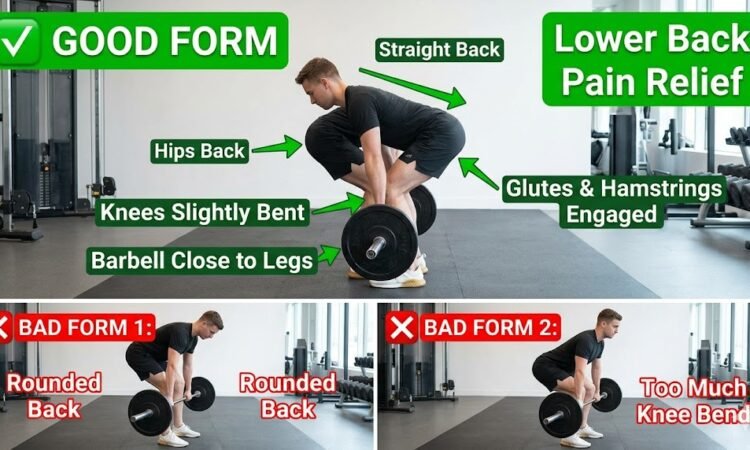
The common mistake during and the primary cause of lower back stress during the RDL is of turning the simple routien lower body hinge workout into a squat-hinge hybrid or wrongly rounding the lower back. When your lower back goes rounds, it loses its base structural integrity and places an immense stress on the intervertebral discs and on the delicate structures of your lumbar spine. Instead of your powerful glutes and hamstrings doing the work, your lower back muscles are forced to stabilize an already unstable spine and under thie immence load it can leads to a pain and potential injury.
Another critical error during RDL is to allowing the bar to drift away from your thighs. When the weight is far from your body’s center of gravity, it creates a much longer lever of arm, placing more stress on your lower back to maintain the position and it creates stress and painlike feeling.
The Solution for a Perfect Romanian Deadlift Form
The core principle of a safe RDL is of maintaining a neutral straight spine during the entire body movement. Here is a breakdown of how to do it and build strong glutes and hamstrings in the process:
- Initial Steps to Success in RDL:
- Stance / Position: Begin with your feet hip-width apart, toes pointing straight ahead or slightly outwards.
- The Grip: Step up to the barbell, which should be resting on your mount. Grip the bar just outside your hips with an overhand grip i.e. Grip with both palms facing towards you.
- Create Tension: This is the most important step. Before you even lift the bar, Engage your rear body (lats). Imagine that you are trying to bend the bar around your mount. This will engages your upper back and core body, creating a strong torso and stabilizing your spine. Squeeze your shoulder blades down and back.
- Set Your Spine: Take a deep breath into your inner body and set your lower back into a neutral position and not bended like a cat, not even rounded like a turtle. Your spine should have a gentle, natural curve, but it should be firm and stable.
- The Ascent (Starting the Lift):
- The initial pull: Instead of just lifting the weight with your arms or back, think about driving your hips forward to lift the bar off the floor. This should feel like a smooth, controlled transition.
- The Descent (The Hinge):
- Initiate from the Hips: This is where the magic starts with safety. Start the body movement by pushing your hips straight back. Imagine there is a button behind you that you need to push with your glutes.
- Maintain a Neutral Spine: As you body bends forward, your chest should remain up and out. Your see that your body should naturally follow the angle of your torso, with keeping your neck neutral ie. not looking straight up at the ceiling or down at your toes. Your lower back must remain perfectly straight.
- Keep the Bar Close: This is very important for protecting your lower back. The barbell should form a line down your body mount, literally gliding your thighs as you does down. This will minimizes the arms lever and keeps the force centered over your strong hips and posterior spine.
- Find your workout intensity range: Go only as low as you can while maintaining perfect spinal position. For many, this will be just below the knees or mid-shin. The goal is not to touch the floor, it is to maximize hamstring stretch and glute engagement. As soon as you feel your lower back as to be round, mark it as your end range of intensity.
- The Tips to Driving Back Up:
- Powerful Hips: To return to the starting position, drive your hips forward forcefully. Focus on squeezing your glutes as hard as you can to pull you back up.
- Engage the Glutes: Your hamstrings should also be working, but the primary driver should be your glutes. Think about pulling through the mid-foot, not pushing off your heels.
- Finish at the Hips: Stand tall at the top of the body movement, but avoid bending your back at the finish point. Your torso should be straight, and your glutes should be fully shrink.
Exploring the Benefits about How the Romanian Deadlift Actually Helps Back Pain?
If you’re doubtful about how a lifting workout can be associated with back pain relief. Importantly the most chronic lower back pain is not caused by weak lower back muscles, but rather by weakness and back dysfunction. In many cases back pain comes from:
- Weak Glutes: If your glutes are weak, your lower back muscles are forced to overload for extending the hip and stabilize the spine. This creates higher fatigue and pain.
- Tight/Weak Hamstrings: Your hamstrings and glutes work together as powerful hip support. When they are not strong and functional, your body will stress the lower back and create pain.
- Poor body movement Mechanics: If you don’t know how to move from your hips with keeping your spine stable, your body will bends at the lower back by causing stress with every lift, squat, or even regular bending motion.
How the RDL helps to Fixes your back pain?:
Lets explore how RDL Workout can help to fix your back pain issue.
- Directly Targets Glutes and Hamstrings: The RDL is one of the single best exercises for specifically strengthening the glute-hamstring area of your body. By building a powerful glutes and strong and balanced hamstrings, you are creating a muscular foundation that supports and protects your lumbar spine.
- Teaches Proper Hinge Mechanics: Mastering the RDL forces you to learn how to lock your spine and safely move your hips. This skill is helpful in your daily life, doing tasks such as bending over to tie your shoes, pick up groceries, or even sitting at a desk with more safer and less impact to back stress.
- Improves Core Body Stability: While the rear body (lats) and upper back are engaged, your core body muscles including the transversus abdominis and obliques, also pressurises to create the bracing tension that protects your spine. Stronger core body stability is a very important component of preventing all such types of back pain.
Doing the Romanian Deadlift workout in Your Routine with Safely:
If you have existing back pain, it is always advisable to consult with a doctor or physiotherapist before starting a new workout routine, especially that one which invoives a weight lifting. They can diagnose the root cause of your body pain and guide you on whether the RDL is appropriate and what modifications you might need to.
A Sample Progressive RDL workout routine:
- Level 1: The Hip Hinge (Bodyweight Only): Stand against a wall with your feet a few inches away. Keep your spine perfectly neutral and push your hips back to touch the wall. Practice this until your body start maintaining a straight and strong spine every single time.
- Level 2: The Goblet RDL: Hold a dumbbell or kettlebell against your chest. This will encourage an upright torso and engagement of the lats and core body. Perform the same hip hinge like body bending movement, keeping the weight close to your body.
- Level 3: The Barbell RDL (Light Weight): Start with an empty barbell or very light weight. Focus entirely on perfect form, by ensuring that shins and your spine is locked.
- Level 4: The Romanian Deadlift (Weighted): Once your form become strong then you can execute more repetitions with perfect body movement control, even with adding more weight. Increase the weight gradually and only as long as you can maintain stable body without any extra stress or pain.
The Romanian Deadlift workout is generally avoided by many due to its possibility to cause weight movement related injury, but, if it is done correctly then actually it is a very powerful tool for building a strong and stable back body.
By prioritizing correct workout form, by understanding the techniques and then progressing gradually, will help you to transform the RDL as a key part of your long-term fitness and pain management strategy. Don’t let your back pain hold you back, master the RDL workout routien and unlock the potential of strong body balance and posture.

Senior Editor, Strength & Conditioning
B.Sc. in Kinesiology, Punjab University | Certified Strength and Conditioning Specialist (NSCA)
Karan Gupta has been a core part of Gymbag4u.com Team since its foundation in 2018. With a background in Fitness, bodybuilding exercise science and a decade of coaching experience, he specializes in functional fitness, injury prevention, and Fitness Routine Guide.