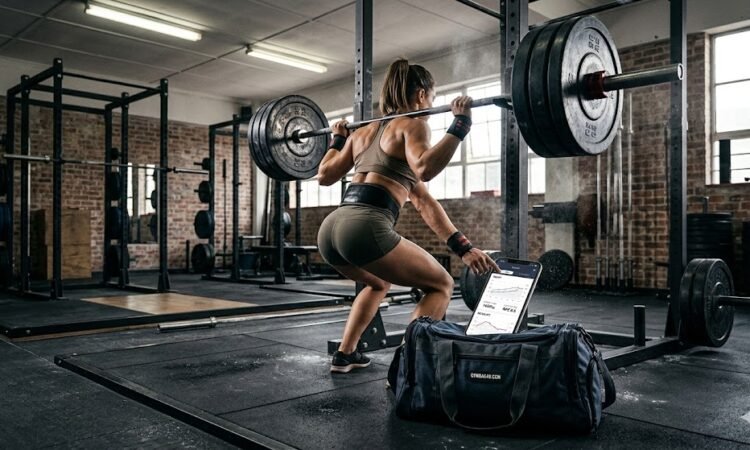
Strength training is a workout which should be done with the strict discipline and precise body movements. If you are serious about transforming your physique and increasing your strength then strength training can be your best companion. For truly mastering the foundation of strength training workout movements such as the squat and the deadlift, you must shift with latest trend of AI data based Tracking devices which are available around you. In this article we are going to guide you on the most trending health quest of How to Use Health Tracking Apps to Optimize Squat & Deadlift?
Modern health and fitness tracking apps works as a sophisticated, digital performance coaches. They provides all the necessary data which needs to implement the progressive workout overload, the undisputed king of muscle hypertrophy and strength gains is a support of data and scientific technology. By tracking your training metrics, you can easily create a feedback trail that transforms every workout set into an actionable information which provides best results.
Lets know the important aspects and Tips on How to Use Health Tracking Apps to Optimize Squat & Deadlift
- Why Data is the Foundation of Your Strength:
The squat and the deadlift are the most intense physical workout movements of an Athletes. They most of the time they has to undergone through a heavy pressure on body central nervous system, which also requires a correct workout form, and pose which upon missing may have highest risk of workout injuries.
When you use a dedicated fitness and movement tracking applications, such as Hevy, JEFIT, Strong, or RepCount, you stop viewing your workout as a single event. Instead, you view starts building on the basis of available data about your health and performance. This further allows you to identify trends that can only tracked with the help of fitness readings. Are you consistently failing with your last set of a deadlifts on Thursdays? Is your squat endurance reduces as the weight increases? A digital log provides the real time data based evidences, which you need to correct before it becomes a permanent obstacle in your daily workout routine.
- The Four Pillars of Workout Performance Tracking:
Monitoring just the body weight is a common mistake that beginners does. To optimize your progression, your digital log must capture more than just the load on the bar.
You should track these following Important four key metrics:
Volume Load (The Metric of Growth):
Volume load is calculated as Total Volume = Weight \ times Reps \ times Sets. This will help you to know the total weight you have moved in a session. If your total volume is trending upward over a four to six week block, your body is being forced to adapt through protein synthesis and muscular hypertrophy.
Rate of Perceived Exertion (RPE):
Record how hard a workout set felt on a scale of 1 to 10. If you hit a 300lb squat at RPE 8 one week and find that same weight feels like an RPE 9.5 the following week, your app provides a signal that your recovery, not your effort are the lower. This prevents the unnecessary higher weight lifting which may leads to injury.
Resting Brakes / Intervals:
Consistency is the silent architect of strength. By utilizing the in-built resting timers in your app, you ensure you are not accidentally turning a high-intensity strength session into a circuit-style cardio workout. For heavy squats, a 3 to 5 minutes of rest period is often required to replenish ATP stores, tracking this will ensures your power output must remains consistent across all workout sets you do routinely.
Workout Form and Techniques Correctness:
Use the tracking data and notes in feature to create a tracking record of your workout routine’s success and failures or injuries, which will help to correct your workout pattern and safeguard you from injuries. Did your heels rise during the squat? Did your back round during the deadlift lockout? Recording these small things can turns your app into an important database of your health.
- Strategizing Your Workout Progression with Precision:
Once you have collected at least four weeks of workout and health traking data, you can stop training randomly and start periodizing your training as well as rest. Use your app’s dashboard to compare your current performance against your historical past best results.
- Progression Strategy 1: Volume Cycling, Implementation: Increase total sets or reps while keeping weight stable, Ideal Objective: Building work capacity and muscular endurance.
- Progression Strategy 2: Linear Progression, Implementation: Increase weight by 2.5lb–5lb per session, Ideal Objective: For early-to-intermediate strength goals.
- Progression Strategy 3: Rest Optimization, Implementation: Decrease rest intervals to increase metabolic stress, Ideal Objective: For hypertrophy phases and improved density.
- Progression Strategy 4: Reduced Load Strategy, Implementation: Intentionally reduce weight by 50% every 4 to 6 weeks, Ideal Objective: Managing CNS fatigue and preventing overtraining.
- The Integration Advantage of Recovery and Wearables:
Optimization is not just about what you do in the gym, but it is also about how you recover in between your workout sessions. The most powerful apps now integrate with wearable devices such as Apple Watch, Whoop, or Garmin to sync your lifting performance with your physiological condition.
- Heart Rate Variability (HRV): This is perhaps the most important reading metric for an athlete. A significant drop in your daily HRV is a known sign that your body central nervous system is stressed. If your app alerts you about a low recovery score on a regular squat day, then you can make an intelligent, data-driven decision to perform a lighter, technique based session rather than doing a heavy and harmful workout set.
- Sleep Efficiency: Your muscles do not grow in the gym, they grow when you are resting and in deep sleep. By syncing your sleep data, you can begin to see a correlation between your 7+ hour nights and your personal records. You will quickly track that a lack of deep sleep is a directly leats to a poor squat session on next day due to lack of energy.
- Overcoming the Odds:
Every strength trained athlete reaches a wall. When that happens, your app is your primary diagnostic tool. Look at your historical graphs:
- Identify the Issues: Has your weight stabalized for two consecutive weeks?
- Review RPEs: Were your RPEs are high during the failed sessions? If yes, then you need a loose weight.
- Analyze Volume: Has your total workout volume decreased due to missed reps? If yes, increase the resting time.
By treating your fitness with the help of useful health data, you will remove the emotional frustration that comes with a bad workout day. You stop seeing the failure as a lack of capability and, start seeing it as a data point that will help you to do adjustment in your routine to achieve more wellness and strength.
Finally, Consistency is the most important thing in a strength training routine. However, consistency without real-time data measurement is just not useful on a longer run. Whether you are a powerlifter chasing a 500lb deadlift or an enthusiast aiming for a perfect squat, your smartphone and health trackers are the most valuable piece of equipment in your gym routine.
Do a strong Commit to the process of wellness. Adopt using a best health and workout patern tracker, input your current working numbers, and log every single rep with consistency. When you look back at your data six months from now, you won’t just see the numbers, you will see the proof of transformation of your health.
Important Note: Always consult with a certified strength and conditioning coach or medical professional before beginning a heavy lifting workouts, especially if you having a history of back or joint injuries.

Senior Editor, Strength & Conditioning
B.Sc. in Kinesiology, Punjab University | Certified Strength and Conditioning Specialist (NSCA)
Karan Gupta has been a core part of Gymbag4u.com Team since its foundation in 2018. With a background in Fitness, bodybuilding exercise science and a decade of coaching experience, he specializes in functional fitness, injury prevention, and Fitness Routine Guide.