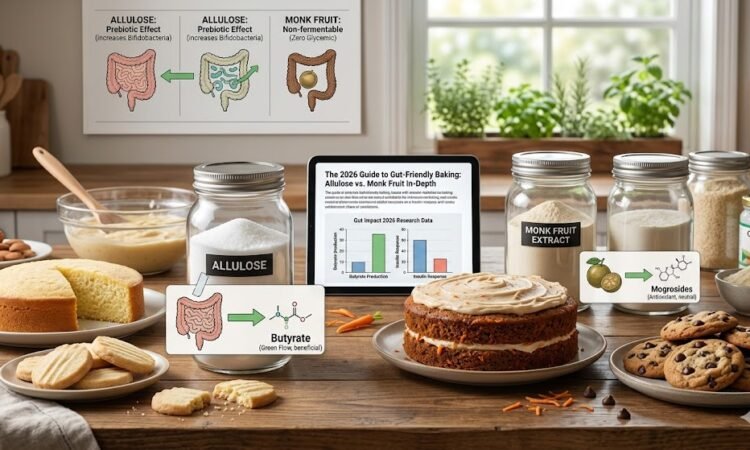
As we are moving towards the technology and research era, the discussions in health world around sugar-free products is at its peak to persuit metabolic health and gut microbiome optimization. For bakers and health-conscious fitness enthusists, the focus is no longer on just reducing calories, but also about choosing sweeteners that support the better gut-brain connection, stimulate hunger satisfaction hormones, and maintain a better digestive comfort.
Today thre are two sweeteners which are known for its benefit to longevity and fibermaxxing trends, Allulose and Monk Fruit. While the both are often grouped together, as per recent 2025-2026 clinical research revealed that, they performs a very different roles in your digestive system as well as in your regular baking practices.
This article is based on the latest expert studies and latest technical information from baking world to help you mastering a gut-friendly, low-glycemic baking.
- Understanding the Elements: Low on Sugars vs. High-Intensity Extracts
To understand why these two are the preferred healthy choice today, we must look at their molecular origin of this items.
Allulose: The Prebiotic Low Sugar
Allulose is a monosaccharide, which is often called as a rare sugar because it is found in low quantities in nature, specifically in figs, raisins, and wheat. Unlike other artificial sweeteners, allulose is chemically a sugar, but its structure prevents our body from metabolizing it for generating body energy.
Recent multi-omic analyses (Brill, 2025) have confirmed that allulose works as more than just a sugar alternative, as it functions as a metabolic modulator. Approximately 70% of consumed allulose is absorbed in the small intestine and removed via urine without ever reaching to the large intestine for final digestion. The remaining 30% that does reach the colon has shown surprising benefits for the gut bacteria nourishment.
Monk Fruit: The Antioxidant Powerhouse:
Monk fruit, or Siraitia grosvenorii, is a small melon native friti from Southeast Asia. Its sweetness doesn’t come from sugar, but from mogrosides, a group of terpene glycosides that are also of antioxidants nature. Monk fruit extract is roughly 100 to 250 times sweeter than sucrose, which means it adds zero fat to a recipe and makes it a metabolically invisible, but it presents unique challenges for its baking usage as a sweatner.
- Gut Health & The Microbiome:
In the many available gut-friendly diets, the laxative effect of sugar alcohols (polyols) like xylitol and erythritol has long been an obstacle. Allulose and monk fruit are changing that narrative.
The Butyrate Revolution (Allulose)
As per the groundbreaking research published in Beneficial Microbes (2025) utilized multi-omic analysis to observe the impact of allulose on the human gut. The study found that allulose significantly increases the quantity of Anaerostipes hadrus. Why does this matter? This specific bacteria is a primary producer of butyrate, a short-chain fatty acid which is essential for:
Fueling the gut lining: Butyrate is the preferred energy source for colonocytes.
Reducing Inflammation: It helps to maintain the intestinal obstacles by preventing leaky gut.
Blood Sugar Regulation: Butyrate plays an important role in insulin sensitivity.
Again further, allulose has also been work to stimulate the secretion of GLP-1 (Glucagon-like peptide-1), the same hormone which is targeted by modern weight-loss medications. Clinical trial protocols in 2026 (JMIR Research Protocols) are currently mapping exactly how allulose-rich GLP-1 release contributes to natural satiety and long-term metabolic health.
The Filler Trap and Digestive Tolerance (Monk Fruit):
Monk fruit is considered as a gut-neutral food. It does not ferment in the colon and generally does not cause bloating. However, because it is so sweet, manufacturers use to mix it with a bulking agent.
Medical reviews from 2026 (Ubie Health) about caution that digestive distress connected to a monk fruit is usually caused by the Inulin (a prebiotic fiber that can cause gas is consumed in a high doses) or Erythritol. For those on a strict gut-healing diet then, consuming pure monk fruit extract or monk fruit-allulose products can be very helpful to avoid the fermentation-related bloating which is associated with polyols.
- The Baking Science of Structure, Moisture, and the Maillard Reaction:
Baking is a chemistry, and replacing sucrose can be more than just replacing sweetness for a bakery product. You must also replace the functional properties of sugar, which including browning, bulking, and moisture retention.
Allulose: The Master of Texture:
Research into cereal matrices (ResearchGate, in year 2026) involving wheat, spelt, and oat flours has proven that allulose works as a best structural binding alternative for sucrose.
Caramelization: Allulose undergoes the Maillard reaction (browning) at a much lower temperature than regular sugar, i.e. roughly 30 to 40°C lower (Icon Foods, 2026). This results in a rich, dark crust on breads and a chewy edge on cookies that other sweeteners cannot replicate.
Hygroscopy: Allulose is highly hygroscopic, which makes it holds the moisture in better manner. This keeps gut-friendly cakes and muffins from becoming dry and crumbly, which is a common complaint with keto or gluten-free baking.
Monk Fruit: The Sweetness Adjuster
Because it lacks bulk, monk fruit cannot provide the crumb or structure of a cake. If you use pure monk fruit in a recipe designed for sugar, the baking good may fail to provide better texture.
Browning: Monk fruit does not caramelize. A cake sweetened solely with monk fruit will remain colorless, even when it is fully cooked.
Cooling Effect: While monk fruit itself doesn’t have a cooling sensation, many monk fruit mixes uses erythritol, which creates a minty or cold mouthfeel that can disturb the taste in warm baked goods such as cinnamon rolls.
- Direct Comparison: Allulose vs. Monk Fruit:
Feature: Sweetness Level, Allulose: 70% of sugar, Monk Fruit (Pure Extract): 150x to 250x of sugar
Feature: Metabolic Impact, Allulose: Low Glycemic, stimulates GLP-1, Monk Fruit (Pure Extract): Zero Glycemic, zero insulin spike
Feature: Gut Impact, Allulose: Prebiotic (increases Butyrate), Monk Fruit (Pure Extract): Neutral (Antioxidant properties)
Feature: Digestive Tolerance, Allulose: High (up to 0.4g/kg body weight), Monk Fruit (Pure Extract): High (but watch for fillers)
Feature: Best For, Allulose: Soft cookies, caramel, moist cakes, Monk Fruit (Pure Extract): Tea, coffee, light sponges
Feature: Browning (Maillard), Allulose: Fast and deep, Monk Fruit (Pure Extract): Non-existent
- Practical Application: How to Bake with the Sweeteners
To achieve a professional baking results while maintaining a gut-friendly ingredient, follow these rules for your baking.
The Golden Ratio Mixture
Modern food science (Mesh Food Labs, 2025) suggests that the most successful sugar replacement is a 50/50 or 60/40 blend of Allulose and Monk Fruit.
Why? The allulose provides the bulk, moisture, and browning texture, while a small amount of monk fruit improves the sweetness to a 1:1 ratio with sugar. This prevents the over-browning that occurs if you use 100% allulose to reach its required sweetness.
Temperature Control
Because allulose browns so quickly (Icon Foods, 2026), you must adjust your oven settings:
Reduce heat by 25°F (15°C).
Increase bake time by 5–10 minutes.
This will allows the interior of baked goods to set without burning the exterior.
Avoiding the Laxative Impact:
While allulose is well-tolerated, ZOE nutrition researchers (2026) recommend to start with low small quantity at the beginning. For many adults, a serving containing 15 to 20 grams of allulose is the comfort ceiling. If a recipe requires 200g of sweetener, mixing of allulose with monk fruit allows you to keep it below this threshold while maintaining a 1:1 sugar sweetness.
- The Trend of Fibermaxxing and Sweeteners:
A major pillar of todays nutrition is known as a Fibermaxxing, the practice of maximizing diverse fiber intake for better gut bacteria health.
Synergy: Allulose bonds exceptionally well with high-fiber flours like almond, coconut, or lupin flour. Because these flours can be dry, the moisture-retention properties of allulose are essential.
Postbiotic Potential: By increasing butyrate-producing bacteria, allulose serves as a postbiotic primer, preparing the gut to better handle the high-fiber food which often found in modern wellness diets.
- Conclusion: Choosing it for Longevity:
Today bakers, have the choice to choose between allulose and monk fruit which isn’t a competition, it’s a partnership.
If your goal is a digestive longevity and better gut bacteria health, then allulose is the scientific winner due to its prebiotic potential and butyrate stimulation. However, for those monitoring every calorie or managing extreme insulin sensitivity, pure monk fruit remains an important tool in your health journey.
By understanding the Maillard reactivity of allulose and the filler traps of monk fruit, you can create baked goods that are as beneficial for your gut and also best for satisfying your taste.
Research References : (Consolidated 2024-2026)
Brill (2025). d-Allulose and Erythritol Increase Butyrate Production: A Multi-Omic Analysis. Beneficial Microbes.
Cayabyab et al. (2024). Metabolic and Endocrine Effects of a 12-Week Allulose-Rich Diet. Nutrients.
Icon Foods (2026). break the Burn: Controlling Allulose’s non-enzymatic browning in Commercial Baking products. Technical White Paper.
JMIR Research Protocols (2026). The Acute and Subacute Effects of Allulose on GLP-1 and the Human Gut Microbiome.
Mesh Food Labs (2025). Functional Properties of Rare Sugars vs. High-Intensity Sweeteners in Gluten-Free Matrices.
ResearchGate (2026). Allulose as an Alternative for Sucrose in Baked Goods: Implications for Cereal based Matrices.
ZOE Nutrition (2026). Clinical Evidence Update: Allulose and Gut Transit Time.

She is a Clinical Health Psychologist & Mindfulness Educator
She has done her Ph.D. in Clinical Psychology, University of Michigan
She is also a licensed psychologist with over 15 years in behavioral health, Dr. Monica Reyes specializes in integrating mental wellness with everyday lifestyle practices. Associated with Gymbag4u.com since its initial days.