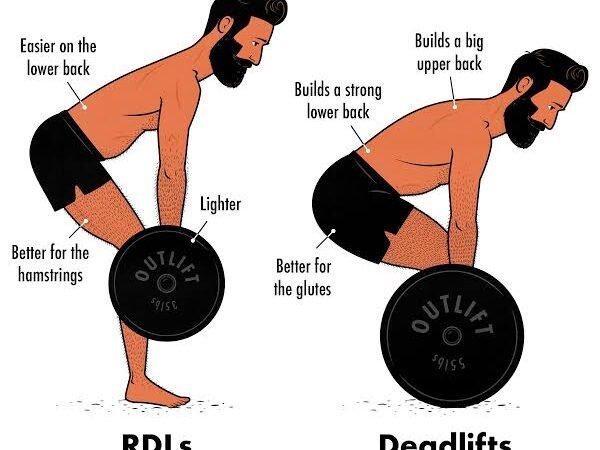
If you want to build a powerful posterior chain (the muscles running along the back of your body), the deadlift family is unmatched. However, step into any gym, and you will likely see two different variations dominating the platforms, the Basic Regular Deadlift and the Romanian Deadlift (RDL).
While they looks similar to the untrained eye, choosing the wrong one can trouble your routine training goals or at worse, may leads to an unwanted lower back stress.
This article will help to explore the structural differences, muscle engagement, and execution mechanics of the Romanian deadlift vs standard deadlift so you can easily add the right lifting routine in your daily exercise schedule.
The Main Difference: Top-Down vs. Bottom-Up
The fundamental difference between the two lifting workouts comes down to your starting position and the structure of the hip hinge.
The Standard Deadlift is a bottom-up lift. Every workout repetition begins completely stationary from the floor (hence the term dead weight). It is a combine movement which requires significant quad drive to push the floor away before transitioning into a hip hinge to lock out the weight.
The Romanian Deadlift is a top-down lift. You begin the workout movement standing fully upright. You lower the weight by pushing your hips backward while maintaining a semi-tied knee angle, reversing the body movement once you feel a maximum stretch in your hamstrings.
Muscles Worked: Primary Biomechanical Differences
Both exercises are powerhouse movements for your body posture, but they distribute the weight pressure load across the different muscle groups of your body.
- Muscle Group: Hamstrings, Standard Conventional Deadlift: Secondary (Assists at lockout), Romanian Deadlift (RDL): Primary (Loaded under deep stretch)
- Muscle Group: Glutes, Standard Conventional Deadlift: Primary (Drive hip extension), Romanian Deadlift (RDL): Primary (Maintains constant tension)
- Muscle Group: Quads, Standard Conventional Deadlift: Primary (Initial floor breakaway), Romanian Deadlift (RDL): Minimal (Knees remain mostly static)
- Muscle Group: Lower Back (Erectors), Standard Conventional Deadlift: High (Stabilizes under heavy load), Romanian Deadlift (RDL): Moderate to High (Isometrically holds posture)
- Muscle Group: Upper Back / Lats, Standard Conventional Deadlift: High (Prevents bar from drifting), Romanian Deadlift (RDL): Moderate (Maintains tight upper spine)
Because the regular deadlift includes knee bending, as your quadriceps plays an important role in breaking the bar off the floor. The RDL minimizes the knee bending, which helps to completely remove the quads and isolating the hamstrings and glutes.
Step-by-Step Technique Comparison
To get the most benefits from these targeted body movements, while keeping your spine safe, proper method is very important.
How to Perform a Standard Deadlift?
- Stand on your feet hip-width apart, with the barbell cutting directly across the middle of your feet.
- Bend at your hips along with bend your knees until your shins touch the bar. Your hips should be higher than your knees, but lower than your shoulders.
- Flatten your spine, pack your lats (imagine squeezing oranges in your armpits), and grip the bar.
- Push through the floor using your legs, keeping the bar touching your shins as you stand upright to full hip lockout.
How to Perform a Romanian Deadlift (RDL)
- Unrack a barbell or deadlift it to the top standing position. Feet should be hip-width apart.
- Soften your knees slightly (a subtle 15 to 20-degree bend) and lock them in that exact position.
- Start the movement by pushing your hips as backward as possible, as if trying to tap a wall behind you with your glutes.
- Slide the bar down your thighs. Stop lowering once your hips stops to go backward (usually just below the knee).
- Drive your hips forward to return to the starting position, squeezing your glutes at the top.
Which One Should You Do?
The right lift depends entirely on what you want to achieve during your training sessions.
Choose the Standard Deadlift if:
- Your Aim should be of absolute maximum strength. You can move significantly more weight than you can with an RDL.
- You train for Powerlifting or CrossFit. The regular deadlift is a base competitive metric in these process.
- You want a total-body power builder. It adds up almost every major muscle group from your calves to your traps.
Choose the Romanian Deadlift if:
If you want to maximize the strength of muscle growth (Hypertrophy) in your hamstrings and glutes then the RDL keeps constant tension on these muscles without letting them rest and improves their strength.
You want to protect a finicky lower back. Because you use lighter weights and do not pull dynamically from a lacking on the floor support, many lifters find the RDL easier on their lumbar spine.
You want to improve athletic performance. The deep hip-hinge system transform directly to sprinting speed and jumping power.
The final question remains, that can we do both regular and RDL Weight Lifting, then the answer is absolutely yes, you do not have to choose just one as doing both are beneficial. A common, highly effective strategy is to use the Regular Deadlift as your primary, heavy mix body movement on your lower-body or pull days, and do the Romanian Deadlift on a separate hypertrophy-focused day to specifically target hamstring growth.
Whichever you choose, prioritize body balance control and a flat spine over the total amount of weight on the bar.
Romanian deadlift vs standard deadlift, RDL vs conventional deadlift, Romanian deadlift form, deadlift muscle groups worked, posterior chain exercises, Romanian deadlift vs standard deadlift

Senior Editor, Functional Fitness & Everyday Strength
Qualified B.S. in Exercise Physiology, University of Colorado Boulder | Certified Personal Trainer (ACE)
Jake has been a founding editor at Gymbag since 2018. With over 12 years of coaching experience and a degree in physiology, he specializes in fitness that fits into real life.