Glucagon such as peptide-1 (GLP-1) medicines such as Ozempic (semaglutide) and Wegovy have completely transformed the modern approach to weight loss, obesity management, and metabolic health. By promoting natural gut hormones to slower the gastric release, regulate blood sugar, and quiet chronic food, these medications can help in achieving a sustained calorie deficit for many of individuals.
However, standard health medical reading data reveals a significant, hidden challenge to rapid weight loss that every patient must address. the regular weighing scale does not tell the full story of health.
Large-scale clinical trials and dual-energy X-ray absorptiometry (DEXA) scans show that anywhere from 25% to 40% of the total weight lost on GLP-1 medications can come from healthy body mass, which prominently includes skeletal muscle tissue. When you lose muscle at this velocity, your metabolic rate (RMR) drops, everyday physical tasks become more exhausting, body immunity can weaken, and your overall structural functional capacity decreases.
The good news is that the muscle wasting is not a mandatory for losing weight. By pairing your medication with a deliberate, evidence-based strategy combining a high-protein diet and a structured progressive resistance training (PRT) protocol, you can override your body’s catabolic tendencies, safeguard your muscle tissue, and achieve an optimal, healthy body composition.
The Perfect Storm: Why GLP-1 Medications Target Muscle Tissue
When you take a Semaglutide injection, your overall appetite drops significantly due to delayed gastric emptying and altered neurological signaling in the brain. Because you are eating significantly less food, your body plunges into a deep energy deficit. To survive, it must break down internal storage to meet its daily metabolic demands.
If you do not give your body an undeniable reason to maintain its muscle tissue, it will eagerly metabolize highly active lean muscle alongside adipose fat tissue for fuel.
Furthermore, because severe appetite suppression often leads individuals to accidentally lowers the consumption of essential macronutrients, the body lacks the important building blocks which are amino acids required to repair normal, daily muscle wear-and-tear. This state of negative nitrogen balance accelerates muscle atrophy. To override this default survival mechanism, you need a dual-action defense system with targeted sports nutrition to feed the muscle, and a progressive mechanical stimulus to defend it.
Pillar 1: The High-Protein Nutrition Process
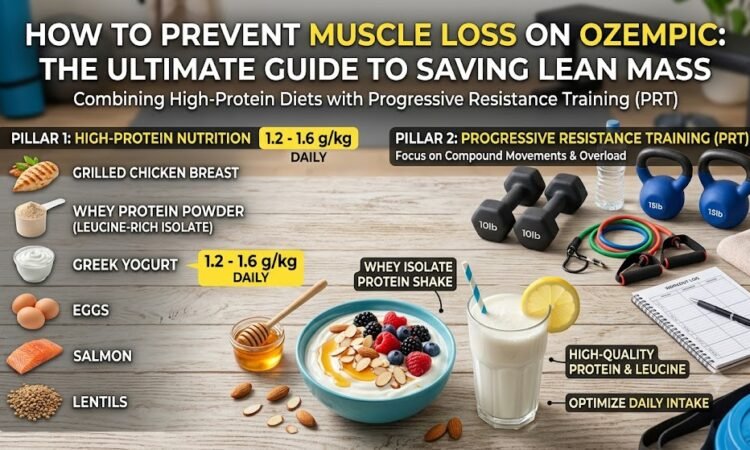
Dietary protein is the single most critical macronutrient for retaining skeletal muscle mass during a prolonged calorie deficit. To counteract the muscle-wasting effects of rapid fat loss, you must hit improved daily limits, prioritize amino acid quality, and structure your meal timing strategically.
- Calculate Your Daily Protein Target
While general standard guidelines recommend a baseline of 0.8 grams of protein per kilogram of body weight for sedentary lifestyle following individuals, sports science and current clinical trials on GLP-1 muscle preservation target 1.2 to 1.6 grams of protein per kilogram of total body weight daily.
Formula for calculation of Body Protein Need: If your current weight is 80 kg (approximately 176 lbs), your target window should range between 96 and 128 grams of pure protein every single day.
If you are tracking via pounds, a simple rule of thumb during active weight loss is to aim for 0.6 to 0.8 grams of protein per pound of current body weight.
- Prioritize Muscle Protein Synthesis (MPS) via Leucine
Not all the proteins offer equal protection when defending body mass during a calorie deficit. To trigger Muscle Protein Synthesis (MPS), the cellular process where your body repairs and builds muscle fibers, you need high-quality, complete proteins rich in essential amino acids, particularly leucine. Leucine acts as the molecular on-switch for the mTOR pathway, which regulates cell growth and protein synthesis.
- Animal-Based Powerhouses: Whey protein isolate, liquid egg whites, chicken or turkey breast, white fish, and non-fat Greek yogurt.
- Plant-Based Alternatives: Soy protein, pea and rice protein mixes, seitan, and low-fat cottage cheese (dairy-based).
- Space Out Consumption to Combat Gastric Side Effects
Because Ozempic makes you feel full incredibly quickly, trying to consume 50 or 60 grams of protein in a single meal can trigger intense nausea, acid reflux, or severe abdominal bloating.
Instead, divide your protein meal throughout different sessions after few hours interval, aiming for 25 to 40 grams every 3 to 4 hours. If solid whole foods may feel unappealing due to medication-born low appetite, liquid options such as whey protein isolates, collagen peptides mixed with amino acids, or low-sugar diet replacements shakes are excellent ways for hitting your macro goals without compromising slower digestive tract.
Pillar 2: Progressive Resistance Training (PRT)
If a high-protein diet provides the raw brick and mortar, Progressive Resistance Training (PRT) is the general contractor that directs the building process. PRT simply means performing targeted physical exercises that challenge your muscles against an external force such as gravity, dumbbells, machines, or resistance bands, and systematically increasing that physical challenge over the time.
Lifting weights sends an unmistakable, urgent chemical and neurological signal to your central nervous system, We are actively using these muscle groups to lift heavy loads. Do not burn them for fuel.
Mechanical Tension from PRT => Triggers Hypertrophy Pathways => Signals Body to Shield Lean Tissue => Fat is Oxidized, Muscle is Preserved
How to Structure a Muscle-Saving PRT Program
To successfully retain muscle tissue without experiencing chronic fatigue or joint pain, keep your resistance training program simple, heavily structured, and consistently executed.
- Training Element: Frequency, Recommendation for GLP-1 Patients: 2 to 3 non-consecutive days per week. Allow a minimum of 48 hours of recovery between sessions targeting identical muscle groups, Ideal Exercises to Include: Full-body workout splits, Upper/Lower splits, or Push/Pull/Legs rotations.
- Training Element: Volume & Sets, Recommendation for GLP-1 Patients: Aim for 2 to 4 working sets per exercise, focusing on 8 to 15 controlled repetitions per set, Ideal Exercises to Include: Total of 4 to 6 exercises per training session to prevent overtraining.
- Training Element: Intensity, Recommendation for GLP-1 Patients: 60% to 85% of your maximum effort, Choose a resistance level where the final 2 to 3 repetitions of a set feel genuinely challenging but safe, Ideal Exercises to Include: Working within an RPE (Rate of Perceived Exertion) of 7 to 9.
- Training Element: Exercise Selection, Recommendation for GLP-1 Patients: Focus heavily on compound movements that recruit multiple joints and large muscle groups simultaneously, Ideal Exercises to Include: Dumbbell goblet squats, leg presses, Romanian deadlifts, chest presses, lat pulldowns, seated cable rows, and functional core planks.
The Progressive Rule: Overload Over Time
Your musculoskeletal system adapts rapidly to stress. If you squat 10-pound dumbbells for 10 repetitions every single week, your muscles will quickly habit themselves, that they do not need to grow or maintain mass to handle the workload. To practice true progressive overload, you must systematically increase the total training volume as your body grows stronger. You can achieve this by:
- Increasing Resistance: Moving from 10-pound weights to 12.5-pound weights.
- Increasing Repetitions: Performing 12 repetitions with the same weight instead of stopping at 10.
- Enhancing Time Under Tension (TUT): Slowing down the lowering (eccentric) portion of the lift to 3 to 4 seconds to force the muscle fibers to work harder.
Pillar 3: Advanced Lifestyle & Supplemental Strategies
To maximize the efficacy of your high-protein diet and PRT protocol, you can implement secondary, clinical-grade habits to further prevent muscle catabolism.
- Track Strength Performance: Not Just check your Weight regularly, but If the number on the scale is moving down but your gym performance is plummeting such as you can no longer complete reps with a weight that used to feel light), you are actively losing precious muscle tissue. Keep a detailed workout log. If strength metrics remain stable or improve, your weight loss is coming almost entirely from fat stores.
- Integrate Creatine Monohydrate: Consuming 3 to 5 grams of pharmaceutical-grade creatine monohydrate daily, which is one of the safest, most effective ways to preserve healthy body mass. Creatine pulls cellular hydration directly into your muscle cells, optimizing cellular swelling, increasing ATP energy production, and improving power output during heavy lifts.
- Prioritize Deep Sleep & Recovery: Your body repairs micro-tears in muscle fibers and results in creating human growth hormone (HGH) primarily during deep, slow-wave sleep stages. Aim for 7 to 9 hours of quality rest nightly. Sleep deprivation spikes cortisol (a highly catabolic hormone), which accelerates muscle breakdown and increases systemic inflammation.
- Monitor via Body Composition Scans: Instead of relying entirely on a standard bathroom scale, ask your bariatric or healthcare provider for a baseline DEXA scan, or utilize a high-quality bioelectrical impedance scale. Monitoring your exact fat-free mass (FFM) every 6 to 8 weeks keeps you accountable and catches muscle loss before it damage your gut metabolism.
Semaglutide is a revolutionary medical tool for reducing visceral fat and reversing metabolic syndrome. However, to ensure that your new body is healthy, vibrant, and biologically younger, you must actively protect your lean tissue. Eat your protein targets, lift progressively, prioritize recovery, and let your healthy lifestyle habits to lock in your body transformation for the long term.
how to prevent muscle loss on ozempic, glp-1 muscle wasting, semaglutide lean mass, progressive resistance training weight loss, high protein diet ozempic side effects, preserve muscle on wegovy.

Senior Editor, Functional Fitness & Everyday Strength
Qualified B.S. in Exercise Physiology, University of Colorado Boulder | Certified Personal Trainer (ACE)
Jake has been a founding editor at Gymbag since 2018. With over 12 years of coaching experience and a degree in physiology, he specializes in fitness that fits into real life.