Losing weight does not require like living on kale smoothies, by extensively reducing your routine diet, or starving yourself through higher calorie reduction. While restrictive diets promise quick results through intense diet restrictions, but they almost fail to provide results over the time because they are impossible to maintain. This article will help you to understanding about the ideal Weight Loss Meal Plan which can help in effective weight controlling.
True, long-term weight loss comes down to a structured, repeatable efforts including creating a controlled calorie deficit while energizing your body with nutrient-rich, high-protein foods that keeps you full, satisfied, and energized.
This article will help to breaks down the science behind effective weight loss, step-by-step macronutrient calculations, a detailed 7-day sample meal plan, and actionable meal preparation tips to help you reach to your health goals.
- The Core Science of Sustainable Weight Loss
Before you plan a single meal, it is very important to understand the two non-negotiable physiological principles that dictate fat loss, calorie balance and proper macronutrient distribution.
Weight Loss = Calorie Deficit (300-500 kcal/day) + High-Protein Intake (0.7-1.0g/lb target) + High-Volume Foods (Fiber & Water) = Sustainable Fat Loss
The Power of a Controlled Calorie Deficit
For effectively losing body fat, you must consistently eat fewer calories which are required for your daily body energy needs and without making you feel tired. This situation is known as a calorie deficit.
- The Safe Target: Aim for a moderate weight loss rate of 1 to 2 pounds per week. Losing weight faster than this may results in muscle loss and severe hormonal metabolic issues.
- The Math: One pound of body fat contains approximately 3,500 calories. Creating a daily calorie deficit of 300 to 500 calories below your required level gains a predictable, sustainable progress without triggering intense hunger carvings and tyredness.
Why Protein Is the Best Fat-Loss Nutrient
Calorie quantity determines how much weight you lose, but calorie quality, specifically protein intake determines what kind of weight you lose.
- Muscle Loss Preservation: During a calorie deficit, your body breaks down tissue for energy. High protein intake signals your body to retain healthy muscle mass and burn stored body fat instead.
- Satiety and Hunger Control: Protein digests slowly, and starts stimulating satiety hormones such as GLP-1 and PYY while suppressing ghrelin (the hunger hormone).
- Thermic Effect of Food (TEF): Your body extracts energy by simply digesting macronutrients. Protein has a thermic effect of 20% to 30%, which means nearly a third of the calories in protein are burned off during digestion, compared to just 5% to 10% for carbohydrates and 0% to 3% for fats.
Target Protein Goal: Eat 0.7 to 1.0 gram of protein per pound of targeted body weight on daily basis such as if a person aiming for 150 lbs then he or she should eat 105g to 150g of protein on daily basis.
- How to Calculate Your Daily Calorie and Macro Targets
To build an accurate weight loss diet plan, you need to calculate your specific baseline targets by following these simple steps:
Step 1: Determine Your Total Daily Energy Expenditure (TDEE)
Your TDEE represents the total number of calories you burn on each day through your Basal Metabolic Rate (BMR), physical activity, and digestion.
For quick estimation:
- Sedentary (Little to no exercise): Body weight in lbs × 13 to 14
- Moderately Active (3 to 4 workouts/week): Body weight in lbs × 15 to 16
- Very Active (5+ heavy workouts/week): Body weight in lbs × 17 to 18
Such as a moderate active 180 lb individual has an estimated TDEE of roughly 2,700 calories (180 \times 15).
Step 2: Subtract Your Deficit Target
Subtract 500 calories from your TDEE to set your daily intake target:
{Daily Calorie Target} = 2,700 – 500 = 2,200 { calories/day}
Step 3: Divide Your Macronutrients
- Protein: Set at 1g per lb of target body weight. (If target weight is 160 lbs = 160g protein = 640 calories).
- Fats: Set at 25% to 30% of total daily calories. (2,200 × 0.25 = 550 calories = 61g fat).
- Carbohydrates: Fill the remaining calories with adding complex carbs rich food in your diet. (2,200 – 640 – 550 = 1,010 calories = 252g carbs).
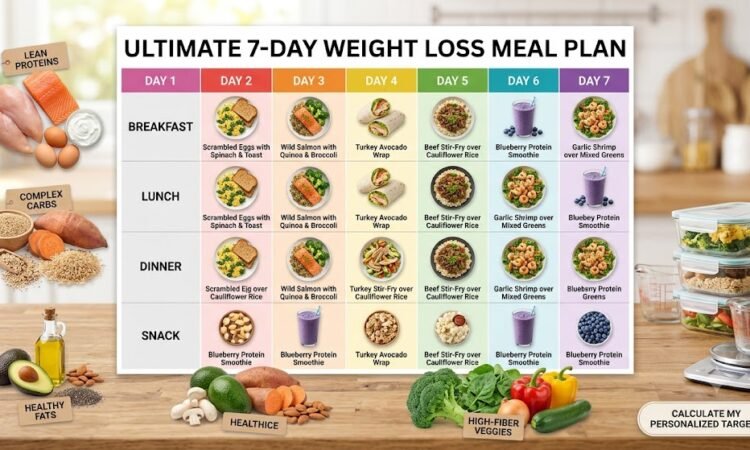
- The 7-Day High-Protein Weight Loss Meal Plan (1,800 to 1,900 Calories/Day)
This structured 7 day meal plan delivers a balanced distribution of high-quality protein, complex carbohydrates, and healthy fats. It focuses on more fiber-rich food ingredients to maintain fullness throughout the day.
Day 1
- Breakfast: 3 large eggs scrambled with 1 cup of fresh spinach and 1/2 cup of diced cherry tomatoes, served alongside 1 slice of toasted sprouted whole-grain bread.
- Lunch: Grilled chicken breast salad made with 6 oz sliced chicken breast, 3 cups of mixed greens, sliced cucumbers, red bell peppers, 2 tablespoons of pumpkin seeds, and 1 tablespoon of extra virgin olive oil and lemon dressing.
- Snack: 1 cup of 2% low fat plain Greek yogurt topped with 1/2 cup of fresh blueberries, 1 tablespoon of chia seeds, and a sprinkle of cinnamon.
- Dinner: Pan-seared wild salmon fillet (6 oz), served with 1 cup of steamed broccoli and 1/2 cup of cooked fluffy quinoa.
Day 2
- Breakfast: Overnight soaked oats prepared with 1/2 cup of rolled oats, 1 scoop of vanilla whey or plant protein powder, 1 cup of unsweetened almond milk, 1 tablespoon of ground flaxseed, and 1/2 sliced banana.
- Lunch: Turkey avocado wrap made of 1 large high-fiber whole-wheat tortilla, 5 oz of deli turkey breast, 1/4 sliced avocado, romaine lettuce leaves, sliced tomatoes, and yellow mustard.
- Snack: 1 medium crisp crisp apple paired with 1.5 tablespoons of natural whole-almond butter.
- Dinner: Low Fat ground beef stir-fry using 6 oz of 90/10 extra-lean beef, mixed stir-fry vegetables such as snap peas, bell peppers, zucchini etc. cooked in 1 teaspoon of sesame oil and low-sodium tamari, served over 1 cup of cauliflower rice.
Day 3
- Breakfast: High-protein cottage cheese bowl featuring 1 cup of low-fat cottage cheese, 1/2 cup of sliced fresh strawberries, 1 tablespoon of hemp seeds, and a sprinkle of chopped walnuts.
- Lunch: Mediterranean tuna salad prepared with 1 can (5 oz) of chunk light tuna in water, 1 tablespoon of light olive oil mayo, diced celery, red onion, served over a bed of baby spinach with 6 whole-grain crackers.
- Snack: Raw red and yellow bell pepper strips served with 4 tablespoons of classic hummus.
- Dinner: Herb-roasted chicken breast (6 oz) served with 1 cup of roasted asparagus spears tossed in olive oil and 1 medium baked sweet potato (approx. 5 oz).
Day 4
- Breakfast: Superfood green smoothie blended with 1 scoop of chocolate or vanilla protein powder, 1 cup of unsweetened almond milk, 1 cup of baby kale, 1/2 cup of frozen dark sweet cherries, and 1 tablespoon of chia seeds.
- Lunch: Fiesta bowl made with 5 oz of shredded chicken breast, 1/2 cup of black beans, 1/4 cup of fresh tomato salsa, chopped cilantro, and 1/4 sliced avocado over 1 cup of shredded romaine lettuce.
- Snack: 2 hard-boiled eggs sprinkled with sea salt and black pepper, plus a small handful (approx. 15) of raw almonds.
- Dinner: Oven-baked Atlantic cod or halibut (6 oz) paired with 1.5 cups of roasted Brussels sprouts and a fresh side green salad with lemon vinaigrette.
Day 5
- Breakfast: Omelet made with 1 whole egg and 3 egg whites, filled with 1/4 cup of diced turkey bacon, sliced button mushrooms, and 1/2 cup of baby spinach.
- Lunch: Meal-prepped made of 6 oz of grilled chicken breast, 1 cup of roasted sweet potato cubes, and 1 cup of steamed green beans.
- Snack: 1 low-sugar protein bar, such as, lower than 200 calories, containing at least 15 to 20g of protein.
- Dinner: Low fat turkey loaf made with 6 oz of ground turkey breast, served with 1 cup of creamy mashed cauliflower mixed with 1 tsp butter and garlic and a mixed greens side salad.
Day 6
- Breakfast: Savory avocado toast made with 1 slice of toasted sourdough or sprouted grain bread, topped with 1/4 mashed avocado, 2 poached eggs, and red pepper flakes.
- Lunch: Garlic shrimp stir-fry with 6 oz of shrimp, 2 cups of mixed stir-fry vegies and greens such as broccoli, carrots, snow peas, sautéed in 1 teaspoon of sesame oil and garlic.
- Snack: 1 part-skim mozzarella string cheese paired with 1 sweet clementine or small orange.
- Dinner: Grilled sirloin steak (6 oz, trimmed of visible fat), served with grilled zucchini slices and 4 oz of oven-roasted baby gold potatoes.
Day 7
- Breakfast: Fluffy protein pancakes made by blending 1 medium banana, 2 whole eggs, 1/2 cup of rolled oats, and 1/2 scoop of protein powder, cooked on a non-stick skillet.
- Lunch: Greek power bowl made with 5 oz of grilled chicken tenders, 1/2 cup of cooked brown rice, sliced cucumbers, kalamata olives, cherry tomatoes, and 2 tablespoons of authentic tzatziki sauce.
- Snack: 1 cup of steamed shelled edamame pods sprinkled with coarse sea salt.
- Dinner: Baked boneless, skinless chicken thighs (6 oz), paired with 1 cup of roasted baby carrots and a large mixed garden salad with light balsamic dressing.
- Key Ingredients for Healthy but, Low-Calorie Eating
When building your healhy diet plan, prioritize high-volume, low-energy foods. These items allow you to eat food in higher quantities while remaining strictly within your calorie budget.
- Category: Low Fat Proteins, Food Source: Chicken breast, turkey breast, white fish (cod, tilapia), shrimp, egg whites, non-fat Greek yogurt, cottage cheese, tofu, Nutrition Benefits: Maximizes muscle retention and satiety while minimizing dietary fat intake.
- Category: Complex Carbohydrates, Food Source: Sweet potatoes, quinoa, rolled oats, brown rice, black beans, lentils, chickpeas, Nutrition Benefits: Slow-digesting carbohydrates that maintains stable blood sugar and body energy levels.
- Category: Healthy Fats, Food Source: Extra virgin olive oil, avocados, almonds, walnuts, chia seeds, flaxseeds, Nutrition Benefits: Supports hormone production, joint health, and nutrient absorption.
- Category: High-Fiber Vegetables, Food Source: Spinach, kale, broccoli, cauliflower, zucchini, bell peppers, asparagus, cucumbers, Nutrition Benefits: Adds substantial physical base to meals with minimal calories which provides better huger fulfils.
- Essential Meal Preparation Strategies for Long-Term Consistency
Planning mdiet may seems easy, but executing it in real life scenario on daily basis requires standard routine habits. Use these four practical strategies to streamline your weekly diet planing:
[1] Batch Protein (Cook 3 to 4 days) –> [2] Pre-Cut Veggies (Ready to Cook)–> [3] Hydrate First (with 8 to 10 glasses per day) –> [4] Track Calory Intakes Accurately (Fatty Oils and Food Portions)
- Batch Cook Your Protein Base
Protein Rich food takes more time to cook. Set aside for 1 to 2 hours twice a week such as on Sunday and Wednesday, to batch-cook large portions of chicken breast, ground turkey, or hard-boiled eggs. Having pre-portioned protein ready in your refrigerator eliminates food stress during busy weekdays.
- Pre-Portion High-Calorie Ingredients
Healthy fats such as olive oil, nuts, seeds, and nut butters are rich in calories. A single tablespoon of olive oil adds 120 calories to your meal. Use digital kitchen weighing scales and measuring spoons to accurately use portion fats and dense carbs before consuming them.
- Hydrate Before You Eat
The brain frequently misinterprets mild dehydration as hunger signals. Aim to drink at least 8 to 10 glasses (64 to 80 oz) of water daily. Drinking a large glass of water 15 to 20 minutes before main meals may expands your stomach, helping you feel full faster.
- Track Your Daily Foods Accurately
Use food-tracking apps such as MyFitnessPal, Cronometer, or Lose It to log your meals. Tracking forces mindfulness and ensures hidden calories, such as cooking sprays, salad dressings, and coffee creamers, do not quietly erase your hard-earned calorie deficit efforts.
Frequently Asked Questions About Weight Loss Meal Diet Plans
How many calories should I eat to lose weight?
Calorie targets are vary and totally depends on your age, gender, height, current weight, and daily activity level. Most adults experience stable weight loss eating between 1,500 and 2,000 calories per day, provided this creates a 300 to 500 calorie deficit lower than their intake.
Can I eat carbs while trying to lose weight?
Yes, Carbohydrates do not cause weight gain, excess calories caused to it. Complex carbohydrates (such as oats, quinoa, sweet potatoes, and whole grains) provide essential fiber and stable energy supply for Intense workouts sessions during a fat-loss phase.
How often should I update my meal plan?
Reassess your calorie and macronutrient goals for every 5 to 10 pounds of weight is lost. As your body mass decreases, your base daily energy expenditure lowers, requiring very small adjustments in your diet and routine to maintain stable progress on your further healthy weight goals.

Senior Editor, Holistic Wellness & Preventive Health
M.Sc. in Public Health Nutrition, Delhi University
Pooja Mehta joined Gymbag in 2018 with a background in public health and community-based wellness education. With over a decade of experience in nutrition strategy and preventive care, she specializes in practical, culturally-aware health tips that empower people to make long-term changes.