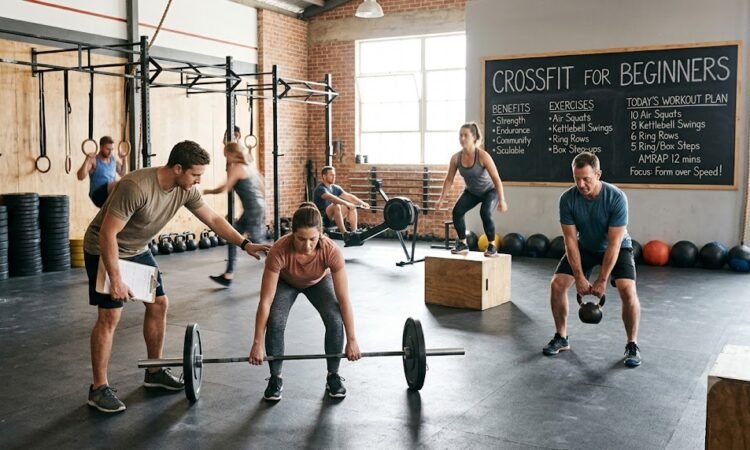
CrossFit is one of the most popular workout practice become popular today, this is a mix of variety of classic and modern workout practices with scientific improvement to meat the desired health goals if followed on regular basis if followed along with enough nutrition and healthy habits.
What Is CrossFit Training?
CrossFit training is a type of functional fitness that combines strength training, cardiovascular exercise, bodyweight movements, and conditioning workouts to develop overall physical fitness. It focuses on movements that are similar to our everyday activities, including squatting, lifting, pushing, pulling, jumping, running, and carrying objects etc.
Unlike the other traditional workout programs, which focuses on one muscle section per session, CrossFit combines different workout movement patterns and fitness components to challenge the entire body muscles. Workouts can include exercises such as squats, push-ups, kettlebell swings, rowing, running, deadlifts, and pull-ups.
CrossFit is become popular among the people who want to improve their body strength, stamina, coordination, mobility, and overall fitness. It can also support weight management when it is combined with a balanced nutrition and consistent exercise routine.
One important advantage is that CrossFit workouts can be scaled to suit different fitness levels. Beginners can start with bodyweight exercises and lighter resistance training, while trainned athletes can progress themselves towards more intense and advanced body movements.
According to the official CrossFit beginner guide, new participants should focus first on learning the proper poses, technique, by working with qualified coaches, and choosing exercises appropriate to their abilities. Source: CrossFit’s beginner guide.
In this article, you will learn how the CrossFit works, its potential health benefits, the best exercises for beginners, a practical four-week training plan, and ways to exercise safely.
What Are the Main Principles of CrossFit?
CrossFit training is commonly organized around three principles, which are constantly doing different workouts, functional movements, and relative intensity.
- Constantly doing various Workouts
CrossFit workouts changes their exercises, repetitions, resistance, and duration. One session might provide more attention to strength, while another focuses on cardiovascular endurance or bodyweight conditioning.
This workout can help to develop multiple fitness abilities and make exercise more engaging. However, doing different types of workouts should not replace structured progress. Beginners still need a regular practice of fundamental workout movements to improve technique and strength.
- Functional Movements
Functional body movements involves several joints and muscle groups working together. They often match with the routine daily tasks which we do in our everyday life such as pushing furniture or carrying grocery bags etc.
Examples include:
- Squats for sitting down and standing up.
- Deadlifts for practicing safe lifting mechanics.
- Push-ups for developing pushing strength.
- Rows and pull-ups for strengthening the back and arms.
- Carries for improving grip and back stability.
Learning these movements with appropriate pose and technique can support in improving our body’s physical capability.
- High-Intensity Exercise
CrossFit often includes challenging workouts performed at a relatively high intensity. However, intensity is individual. A suitable workout for a beginner may involve controlled bodyweight movements, while an experienced athlete may use heavier weights or faster repetitions.
High intensity does not mean to exercising as fast as possible regardless of a bad pose or faulty workout technique. Good body movement quality, appropriate rest, and gradual progression should remain priorities to achieve success.
For a detailed explanation, read the official CrossFit methodology guide.
10 Potential Benefits of CrossFit Training
CrossFit combines various different types of exercise, which may helps to improve different aspects of our fitness. Results depend on training consistency, workout design, recovery, nutrition, and individual health.
- Improves Muscular Strength
Strength training is a central part of CrossFit. Exercises such as squats, deadlifts, presses, rows, and modified push-ups challenge muscles throughout the body.
Regular resistance training can improve muscular strength and helps people to perform their everyday activities with comfort.
Beginners should first learn the proper body movement and posing patterns before increasing the weight or complexity of the exercise.
- Builds Cardiovascular Endurance
Many CrossFit workouts combine resistance exercises with running, cycling, rowing, or other body conditioning activities.
This combination can challenge the cardiovascular and respiratory systems and may improve aerobic fitness over the time.
People new to exercise can begin with brisk walking, easy cycling, or short intervals before progressing to more intense body workout sessions.
- Supports Weight Management
CrossFit can contribute to effective weight management because it combines resistance training and cardiovascular exercise. Training which increases energy expenditure, while resistance exercise helps to develop and maintain healthy muscle.
However, weight loss depends on several factors, particularly long-term energy balance, dietary habits, sleep, and overall activity.
CrossFit alone does not automatically promotes fat loss, and it cannot directly reduce the belly fat. But with a sustainable nutrition plan and consistent exercise it helps more to see the better results.
- Develops Muscular Endurance
Muscular endurance is the ability of muscles to perform repeated body movements over the time.
CrossFit workouts may include repeated squats, step-ups, push-ups, lunges, or kettlebell workouts. When the exercise sessions are programmed appropriately, then these exercises can helps to improve the ability to sustain better physical activity.
Beginners should avoid higher repetitions before developing correct posture and technique and gaining required basic strength.
- Improves Coordination and Balance
Movements such as lunges, step-ups, controlled squats, and light resistance exercises require coordination between different parts of the body.
Practicing these workout movements can help to develop better body feeling and movement control. More advanced exercises should only be attempted only after learning the necessary basic skills for safer workout sessions and avoiding injuries.
- Encourages Consistency Through Community
Many CrossFit gyms offer group classes guided by expert coaches. Exercising along with a group of people may provide motivation, social connection, and better learning.
A supportive training environment can make it easier for some people to maintain a regular exercise routine.
Choose a gym where coaches encourage individual progress rather than pressuring participants to compete or lift beyond their abilities.
- Offers Time-Efficient Workouts
A CrossFit class often includes a warm-up, a strength or skill routine, a workout of the day, and a cool-down.
A session may fit within approximately an hour, although class length varies by gym and program. Combining different fitness components can make training practical for people with busy schedules.
Shorter workouts can also be adapted for home use, provided exercises are selected according to available equipment and skill level.
- Develops Functional Fitness
Functional fitness involves building physical abilities that help with everyday tasks.
Squats, hip hinges, carries, pushing, and pulling movements train for regular routine body movements such as lifting shopping bags, climbing stairs, getting up from a chair, or moving household objects.
The value comes from consistent, well-designed practice rather than performing every exercise at maximum intensity.
- Supports Healthy Aging
Resistance training, balance work, and cardiovascular exercise can be a valuable components of a healthy aging routine.
CrossFit workout movements can be adapted for older adults, but the exercise selection, intensity, and progression should reflect the individual’s strength, mobility, medical history, and training experience.
Beginners may benefit from supported squats, light resistance exercises, step-ups, and controlled conditioning rather than immediately attempting high-impact workouts.
- Helps to Develop Measurable Fitness Goals
CrossFit often tracks set repetitions, workout completion times, resistance, and other performance measures. Tracking progress can help to identify the improvements in strength, endurance, or technique.
Beginners should prioritize consistent attendance, better by movement quality, and gradual progress instead of comparing their scores with those of experienced athletes.
Evidence note: Healthline’s overview of CrossFit discusses potential benefits such as strength and aerobic fitness alongside injury risks and the importance of appropriate coaching. Read CrossFit: Benefits, Risks, and How to Get Started.
10 Best CrossFit Exercises for Beginners
Beginners should concentrate on foundational body movements before progressing to complex and intense Olympic lifts, high-impact jumps, or advanced gymnastics.
The following exercises can be adopted in a beginner CrossFit workout according to individual ability.
- Air Squats
Air squats strengthen the quadriceps, glutes, and other muscles involved in lower-body movement.
How to perform:
- Stand with your feet approximately shoulder-width apart.
- Keep your chest comfortable and your feet firmly on the floor.
- Bend your hips and knees as if sitting on a chair.
- Lower only as far as you can while maintaining control.
- Push through your feet to return to standing.
Beginner target: 2 to 3 sets of 8 to 10 repetitions.
Use a chair or stable box for support if needed.
- Incline Push-Ups
Incline push-ups train the chest, shoulders, and triceps while reducing the body weight which you moves.
How to perform:
- Place your hands on a stable wall, bench, or elevated surface.
- Keep your body aligned from head to heels.
- Bend your elbows to lower your chest toward the surface.
- Push back to the starting position.
Beginner target: 2 to 3 sets of 6 to 10 repetitions.
Choose a height that allows controlled, pain-free body movement.
- Hip Hinges
Hip hinges teach the body movement pattern used in deadlifts and other regular lifting exercises.
How to perform:
- Stand with your feet approximately hip-width apart.
- Keep your knees slightly bent.
- Move your hips backward while keeping your spine in a comfortable, neutral position.
- Stop when you feel a gentle stretch in the back of your thighs.
- Return to standing by extending your hips.
Beginner target: 2 sets of 8 to 10 repetitions.
Practice without weights before progressing to loaded exercises.
- Step-Ups
Step-ups strengthen the legs and glutes while challenging balance and coordination.
How to perform:
- Stand in front of a low, stable step.
- Place one foot fully on the step.
- Push through that foot to step up.
- Step down slowly and repeat on the other side.
Beginner target: 2 sets of 6 to 8 repetitions per leg.
Use a low step and a handrail if balance is a concern.
- Planks
Planks train the trunk muscles that help further to stabilize the body.
How to perform:
- Place your forearms on the floor.
- Extend your legs behind you, or keep your knees down for an ease.
- Maintain a straight, comfortable body position.
- Breathe normally and avoid allowing your lower back to sag.
Beginner target: 2 to 3 holds of 10 to 20 seconds.
Stop when you can no longer maintain a good workout posture and technique to avoid injury.
- Glute Bridges
Glute bridges strengthen the glutes and train controlled hip extension.
How to perform:
- Lie on your back with your knees bent and feet flat.
- Tighten your abdominal muscles gently.
- Raise your hips until your shoulders, hips, and knees form an approximately straight line.
- Pause briefly and lower slowly.
Beginner target: 2 to 3 sets of 10 repetitions.
Avoid bending your lower back excess during workout to avoid injury.
- Kettlebell Deadlifts
Kettlebell deadlifts train the hips, glutes, legs, grip, and trunk.
How to perform:
- Place a light kettlebell between your feet.
- Push your hips backward and bend your knees as needed.
- Grip the handle while keeping your back in a controlled position.
- Stand by extending your hips and knees.
- Lower the kettlebell under control.
Beginner target: 2 sets of 6 to 8 repetitions with a light weight.
Learn the hip-hinge pattern before adding resistance training. Also check with a qualified coach to follow a correct position during your workout.
- Ring Rows or Resistance-Band Rows
Rows train the upper back, arms, and muscles involved in pulling.
How to perform:
- Use securely installed rings or a resistance band designed for exercise.
- Begin in a stable position.
- Pull your hands toward your torso.
- Keep your shoulders controlled and avoid excess shrugging.
- Return slowly to the starting position.
Beginner target: 2 sets of 8 to 10 repetitions.
The difficulty can be adjusted by changing your body angle or using a band resistance for ease in workout.
- Farmer’s Carries
Farmer’s carries workout action develops a grip strength, back control, and the ability to carry more loads.
How to perform:
- Pick up two light dumbbells or other suitable weights.
- Stand tall with your shoulders relaxed.
- Walk slowly while maintaining an upright posture.
- Put the weights down safely when finished.
Beginner target: 2 to 3 walks of 15 to 20 meters, if space allows.
Start with light weights and a clear walking path.
- Walking or Cycling Intervals
Low-impact conditioning is an accessible way to build aerobic fitness.
How to perform:
- Walk briskly or cycle at a comfortable pace.
- Alternate easier and moderately challenging intervals.
- Maintain a pace that allows you to control your breathing.
- Reduce intensity or stop if you feel unwell.
Beginner target: 10 to 15 minutes, adjusted to your fitness level.
These exercises provide a strong foundation for more advanced CrossFit workout movements. Box jumps, heavy Olympic lifts, kipping pull-ups, and handstand movements should be practiced only when appropriate technique and preparation are in place.
Beginner CrossFit Workout Plan
A beginner workout should build consistency, perfect body movement skill, and strength without creating excessive fatigue.
The following is a sample plan for healthy adults who are new to CrossFit. It is not a substitute for an individualized program from a qualified coach.
Sample Weekly Schedule:
- Day: Monday, Training activity: Full-body strength basics, Main goal: Learn squats, hinges, and push-ups
- Day: Tuesday, Training activity: Walking or easy cycling, Main goal: Build aerobic fitness
- Day: Wednesday, Training activity: Rest or gentle mobility, Main goal: Recovery
- Day: Thursday, Training activity: Full-body beginner workout, Main goal: Practice strength and conditioning
- Day: Friday, Training activity: Easy cardio or mobility, Main goal: Active recovery
- Day: Saturday, Training activity: Optional light full-body workout session, Main goal: Technique and consistency
- Day: Sunday, Training activity: Enough Resting, Main goal: Energy and Body Muscles Recovery
Start with two structured strength or CrossFit sessions per week if you are new to exercise. Add improve sessions gradually as your recovery and fitness starts feeling comfortable to you.
Week 1: Learn the Fundamentals
Focus on controlled body movement and proper technique.
- Air squats: 2 sets of 8.
- Incline push-ups: 2 sets of 6.
- Glute bridges: 2 sets of 10.
- Planks: 2 holds of 10 to 15 seconds.
- Easy walking: 10 to 15 minutes.
Rest between two sets as needed. There is no need to race through the exercises.
Week 2: Build Consistency
Repeat the basic body movements again and increase the set of repetitions only if the previous sessions felt perfect and manageable.
- Air squats: 2 sets of 10.
- Incline push-ups: 2 sets of 8.
- Hip hinges: 2 sets of 10.
- Glute bridges: 2 sets of 12.
- Easy cycling or walking: 15 to 20 minutes.
If technique falls short or discomfort develops during the workout, then reduce the difficulty rather than forcing more repetitions.
Week 3: Introduce Simple Conditioning
If you are recovering well, try a short period of workout rounds with perfect and controlled body movements.
Complete two rounds at a comfortable pace:
- 8 air squats.
- 6 incline push-ups.
- 10 glute bridges.
- 30 to 60 seconds of easy walking between exercises as needed.
Rest between two rounds. You should finish feeling challenged but still in control of your technique.
Week 4: Progress Gradually
If the earlier sessions were comfortable, then continue with two or three rounds of the same workout circuit. You can also add light kettlebell deadlifts after learning the correct technique.
Do not increase repetitions, resistance, and workout speed all at one go and increase intensity gradually. Change one workout set at a time and allow adequate recovery.
At the end of four weeks, assess how consistently you trained, whether your technique improved, and how well you recovered. These measures are more useful than judging success only by body weight or workout time.
What Is a CrossFit WOD?
WOD stands for Workout of the Day. It is the main workout programmed for a particular session and may combine strength, conditioning, gymnastics, or other functional body movements.
Three common workout formats are as follows:
AMRAP – As Many Rounds or Repetitions as Possible
Participants complete as many as quality workout sets or perfect repetitions as they can within a set time. Beginners should use a manageable pace and prioritize to following correct technique during every workout set.
EMOM – Every Minute on the Minute
A routine specific exercise or number of repetitions begins at the start of every minute of the workout. There should also be enough gap time for resting in between routine workouts. Beginners should choose a workload that also leaves an adequate rest & recovery time.
For Time
Participants complete a prescribed set of workout and record how long it takes. Beginners should not treat the time limit as a reason to wrong technique, wrong pose or ignoring fatigue.
Example of Beginner WOD
After a warm-up, complete two rounds at a controlled pace:
- 8 air squats.
- 6 incline push-ups.
- 10 glute bridges.
- 1 minute of easy walking.
Take a rest whenever your feel necessary during your workout schedule. The purpose of resting adequately is to practice body movement and build consistency, and not to set a speed record.
How to Warm Up Before CrossFit Training
A warm-up prepares the body for the movements and intensity of the planned session. CrossFit’s warm-up guidance promotes the increasing body temperature, preparing for intense body movement patterns, and practicing techniques before going for more intense workout sets.
Read the CrossFit Warm-Up guide.
A Simple 5 to 10 Minute Warm-Up
- Walk or cycle easily for 2–3 minutes.
- Perform gentle shoulder circles and comfortable hip movements.
- Practice 6 to 8 controlled bodyweight squats.
- Complete several easy hip hinges.
- Rehearse the body movements as planned for the workout at a lower intensity.
Adjust the warm-up to your needs, mobility, and the demands of every session. A warm-up may helps to prepare your body for further intense exercise, but it cannot eliminate injury risk.
How to Scale CrossFit Workouts for Beginners
Scaling means modifying an exercise, weight, repetition count, range of motion, or workout duration to match your current body endurance ability.
- Scaling is not a failure. It is a practical way to learn correct workout movements and progress safely.
- Standard movement: Full push-up, Beginner alternative: Wall or incline push-up
- Standard movement: Pull-up, Beginner alternative: Assisted pull-up or ring row
- Standard movement: Box jump, Beginner alternative: Low step-up
- Standard movement: Heavy barbell deadlift, Beginner alternative: Hip-hinge practice or light kettlebell deadlift
- Standard movement: High-repetition workout, Beginner alternative: Fewer repetitions with more rest
- Standard movement: Running intervals, Beginner alternative: Walking or easy cycling
- Standard movement: Overhead squat, Beginner alternative: Supported squat or bodyweight squat
A qualified coach can helps to determine the correct substitutions and additional set of workouts. If you train at home, choose your body movements which you already know how to perform safely and perfectly it rather than attempting any advanced level or non-regular hard exercises.
CrossFit Nutrition: What Should Beginners Eat?
Nutrition supports more to muscle recovery, and general health then exercise training performance. You do not need an intense diet to begin the CrossFit workout sessions.
- Eat Adequate Protein
Include protein-rich foods such as eggs, dairy products, beans, lentils, tofu, fish, or lean meats in your diet to gain more protein. As, your adequate protein intake helps your body muscle to repair and maintenance.
Your individual needs are depend on your body size, training, health, and dietary preferences.
- Include Carbohydrates for Energy
Carbohydrate-rich foods such as oats, rice, whole grains, potatoes, fruit, and other starchy vegetables can help to fuel your training endurance by providing the required energy to your body.
Avoid unnecessarily reducing healthy food from your diet unless there is a specific medical or dietary reason as advised by Doctor.
- Eat Vegetables and Fruit
Vegetables and fruit supply fiber, vitamins, minerals, and other beneficial nutrients. Aim for eating variety of fruits across meals per day to provide required essential nutrition to your body.
- Stay Hydrated
Drink water and healthy fluids regularly throughout the day. Increase water / healthy drink intake when exercise, heat, or sweating makes additional hydration necessary.
People exercising in hot environments or for long periods may need to follow an individualized hydration strategy.
- Avoid Extreme Weight-Loss Diets
Following very low quantity food diets and excessive fasting can make it harder to recover from exercise and meet essential nutritional needs of our body. If your goal is fat loss, then focus on sustainable eating habits and a manageable overall energy intake.
People with diabetes, kidney disease, eating-disorder concerns, or other medical conditions should seek individualized nutrition guidance by experts.
Is CrossFit Safe for Beginners?
CrossFit can be adapted to different experience levels, but its combination of resistance training, conditioning, and sometimes complex body movements which needs a proper instruction and constant progression.
Potential problems including muscle stress, tendon irritation, joint pain, and injuries are associated with excessive workout or following poor exercise pose and technique.
Tips to reduce avoidable risks:
- Start with manageable resistance and repetitions.
- Learn movement technique before increasing speed.
- Choose a qualified coach who provides individual modifications.
- Rest when fatigued and allow time for recovery.
- Avoid comparing your performance with more experienced athletes.
- Stop exercising if you develop sharp pain, chest pain, faintness, or unusual shortness of breath.
Seek urgent medical care for chest pain, fainting, severe breathing difficulty, or other serious symptoms. Severe muscle pain, swelling, or unusual dark urine after intense exercise also require prompt medical assessment because these can be signs of a serious health condition.
Consult with a healthcare professional before starting any such intense training incase if you are having any significant medical condition, current injury, or concerns about whether intense exercise is suitable for you.
Pregnant women, older adults with health concerns, and people returning from injury may need specific modifications and professional guidance on their routine.
For further knowledge, see Healthline’s discussion of CrossFit benefits and risks.
CrossFit vs. Traditional Gym Training
Both CrossFit and conventional gym training can improve fitness. The better option depends on your preferences, goals, training history, and access to correct workout instruction.
- Feature: Workout structure, CrossFit training: Often combines several fitness components, Traditional gym training: Can focus on specific health goals or muscle groups
- Feature: Exercise variety, CrossFit training: Usually changes across sessions, Traditional gym training: May follow a consistent routine
- Feature: Strength training, CrossFit training: Included alongside the conditioning and skills, Traditional gym training: Can be the primary focus
- Feature: Cardiovascular exercise, CrossFit training: Often added into regular workouts, Traditional gym training: Can be added separately in routine
- Feature: Coaching, CrossFit training: Frequently offered in group classes, Traditional gym training: Depends on gym membership, available equipments and trainer capabilities
- Feature: Workout intensity, CrossFit training: Often includes challenging conditioning, Traditional gym training: Differs according to the chosen programs
- Feature: Best fit, CrossFit training: People who enjoy variety and group workouts, Traditional gym training: People who prefer individualized routines or specialized health goals
Neither option is automatically superior. A well-designed fitness program followed consistently is generally more beneficial than a program that does not match with your routine and needs.
Frequently Asked Questions About CrossFit Training
- Is CrossFit good for beginners?
Yes, CrossFit can be adapted for beginners when workouts use suitable exercises, manageable intensity, and proper instruction. Start with basic workout movements and progress gradually as your technique and fitness improve.
- Can CrossFit help with the weight loss?
CrossFit can support weight loss by increasing physical activity and helping to build and maintain body muscles. Sustainable fat loss also depends on dietary intake, sleep, recovery, and other lifestyle factors. No workout can selectively burn fat from the belly.
- How many days a week should a beginner do CrossFit?
Two structured sessions per week can be a reasonable starting point for many people who are beginners to exercise. Adjust workout frequency according to your recovery time, existing activity, and professional advice wherever needed.
- Can I do CrossFit at home without equipment?
You can perform beginner-friendly functional workouts at home using workout movements such as squats, incline push-ups, glute bridges, and planks. Start with exercises which you can perform safely and avoid intense body movements without appropriate instruction.
- How long does a CrossFit workout last?
Many regular Training classes last for an hour, including warm-up, skill or strength practice, the workout, and a resting time. Individual workouts can be shorter or longer depending on the time period of the routine which they are following on regular basis.
- Does CrossFit build muscle?
CrossFit includes resistance exercises, that can support better muscle development. Results are depend on progressive training, adequate nutrition, recovery, and individual health factors.
- Is CrossFit better than cardio?
CrossFit combines strength and conditioning, whereas traditional cardio often focuses primarily on aerobic exercise, but both of this can improve fitness significantly. The most appropriate routine choice depends on your goals, preferences, and existing health situations.
- What should I eat before a CrossFit workout?
A balanced meal or snack containing carbohydrates and, when practical, some protein can support exercise. Choose foods and timing that suits to your digestion, workout schedule, and individual needs.
- Is CrossFit suitable for older adults?
Some older adults can benefit from properly modified strength and conditioning training programs. Exercise selection and intensity should reflect the individual mobility, health conditions, balance, and training experience.
- How soon will I see results from CrossFit?
Every workout progress is depend on aspects. Some people notice improvements in exercise confidence and consistency within just a few weeks, while measurable changes in strength, endurance, or body composition may take longer period. Results are influenced by training quality, recovery, nutrition, and individual fitness levels at the start of your activities routine.
Finally, now you are aware about that how the CrossFit training combines functional movements, resistance exercises, cardiovascular conditioning, and various other different workouts practices to improve overall fitness. It can help to improve your body strength, endurance, coordination, and physical capability when practiced consistently and appropriately.
For beginners, the most important steps are to learn the basic movements, select suitable resistance, warm up, recover adequately, and increase training demands gradually. You do not need to perform advanced lifts or exhausting workouts to make progress.
A balanced diet, adequate sleep, hydration, and realistic goals can help to support your workout routine. Whether you choose a professionally coached CrossFit training class or a simple home-based routine, focus on consistent effort and good techniques rather than completing more sets or intense workout.
Start at your current fitness level, progress patiently, and make long-term health as your priority inh your daily routine.
References and Further Reading
CrossFit. The Basics of CrossFit.
CrossFit. The CrossFit Warm-Up.
CrossFit. What Is CrossFit?.
CrossFit. CrossFit Methodology.
Healthline. CrossFit: Benefits, Risks, and How to Get Started.
Precautionary Note: This article is for general educational purposes only and it does not a substitute an individualized medical and exercise advice. Consider having consultation by a qualified fitness professional as well as healthcare expert before adopting any of such lifestyle changes, workouts, diets, medications etc.

Senior Editor, Functional Fitness & Everyday Strength
Qualified B.S. in Exercise Physiology, University of Colorado Boulder | Certified Personal Trainer (ACE)
Jake has been a founding editor at Gymbag since 2018. With over 12 years of coaching experience and a degree in physiology, he specializes in fitness that fits into real life.