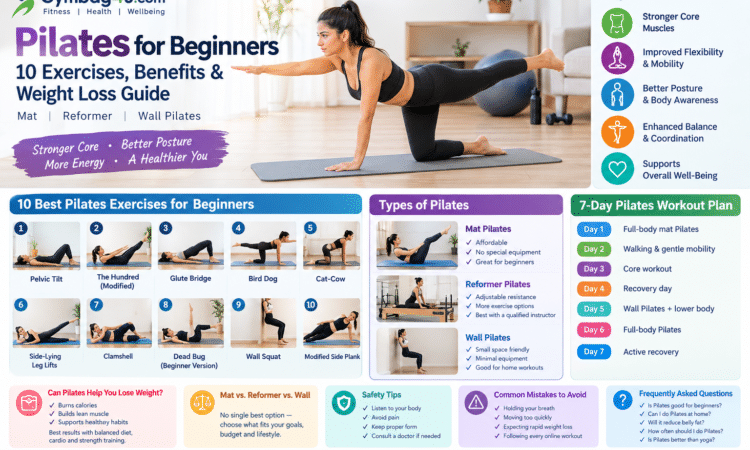
Among all the fitness trends going into todays health world, the Pilates has become a very popular exercise for those people who want to improve core body strength, flexibility, posture, body balance, and their overall fitness through a single but dedicated routine. Unlike many of other high-impact workouts, Pilates focuses on controlled body movements, mindful breathing, proper body alignment, and strengthening muscles through its precise exercise techniques.
One of the biggest advantages of Pilates is of its versatility of different types of workouts. Beginners can start with a simple mat Pilates exercises at home, explore wall Pilates for additional strength support, or join a studio to experience life changing Pilates using specialized spring-resistance Pilates workout equipment.
But can Pilates help you to lose your weight, reduce belly fat, and build a stronger body? The answer depends on how you practice, how you are following consistently on you exercise, your diet, and your overall activity level.
In this article, you will learn about the benefits of Pilates, the 10 best Pilates exercises for beginners, the differences between mat, reformer, and wall Pilates, and how to build a practical Pilates workout routine at home.
What Is Pilates?
Pilates is a low-impact exercise developed by Joseph Pilates in the early 20th century. It emphasizes on controlled body movements, breathing, concentration, alignment, and core body stability.
Unlike other regular workouts that one focuses mainly on lifting heavy weights or increasing cardiovascular endurance, Pilates combines muscular control with coordinated body movement. Exercises can target the abdominal muscles, back, hips, glutes, legs, and shoulders.
Pilates can be performed in several ways:
- Mat Pilates: This is Pilates Exercises performed on an exercise mat, primarily using body weight.
- Reformer Pilates: Exercises performed on a specialized machine with a sliding carriage, straps, and adjustable springs.
- Wall Pilates: Modified exercises that can be done using a wall for better back support, body alignment, or resistance.
- Clinical Pilates: Individually adapted Pilates-based exercise done in physiotherapy center or rehabilitation settings and done under the professional guidance.
Pilates can be adapted to different experience levels. However, people with injuries, significant mobility limitations, or people with specific medical conditions must seek appropriate professional advice before starting.
10 Best Pilates Exercises for Beginners
The following exercises provide a practical starting point for a beginner Pilates workout. Move slowly, breathe naturally, and prioritize the good technique and posture to gain more benefits over the number of repetitions done per set.
- Pelvic Tilt
Pelvic tilts introduce the beginners to a controlled abdominal engagement and pelvic positioning.
How to perform it:
- Lie on your back with your knees bent and feet flat on the floor.
- Keep your arms relaxed beside your body.
- Gently engage your abdominal muscles.
- Slowly tilt your pelvis to flatten your lower back toward the mat.
- Return to a comfortable neutral position.
Suggested repetitions: 8 to 12 repetitions.
Benefits: This exercise Helps to develop body awareness and control of the abdominal and pelvic muscles.
- The Hundred – Modified Pilates Workout Type
The Hundred is a traditional Pilates exercise designed to coordinate better breathing with core body engagement. Beginners should start with a modified workout version for better experience.
How to perform it:
- Lie on your back with your knees bent and feet on the floor.
- Lift your head only if comfortable and keep your neck relaxed.
- Extend your arms alongside your body.
- Make small, controlled arm pulses while breathing steadily.
- Continue for a short period, then rest.
Suggested duration: 20 to 30 seconds initially.
Benefits: Develops breathing coordination and abdominal endurance.
Modification: Keep your head and shoulders on the mat if lifting them causes any neck discomfort to you. Do not force your lower back into an uncomfortable position if you feel any such pain or sensation.
- Glute Bridge
The glute bridge is useful workout for strengthening the glutes and supporting hip control.
How to perform it:
- Lie on your back with knees bent and feet hip-width apart.
- Keep your arms beside your body.
- Engage your abdominal muscles gently.
- Press through your feet and raise your hips.
- Pause briefly, then lower your hips slowly.
Suggested repetitions: 8 to 12.
Benefits: Works the glutes, hamstrings, and muscles that help stabilize the pelvis.
- Bird Dog Position
Bird dog develops coordination and stability while challenging the muscles by supporting the trunk.
How to perform it:
- Start on your hands and knees.
- Keep your spine in a comfortable neutral position.
- Extend your right arm and left leg without rotating your torso.
- Return to the starting position.
- Repeat on the opposite side.
Suggested repetitions: 6 to 8 per side.
Benefits: Helps to Improve body coordination, balance, and trunk stability.
Beginner tip: Extend one arm or one leg at a time if extending both feels difficult.
- Cat-Cow Stretch
Cat-cow is a gentle mobility exercise that introduces controlled spinal movement.
How to perform it:
- Begin on your hands and knees.
- Slowly round your back while gently drawing in your abdomen.
- Return to a neutral position.
- Gently arch your back within a comfortable range while lifting your chest.
- Repeat without rushing.
Suggested repetitions: 6 to 10.
Benefits: Encourages flexible spinal cord mobility and body stretch pain awareness.
- Side-Lying Leg Lifts
This exercise focuses on the muscles around the hips and outer thighs.
How to perform it:
- Lie on your side with your legs extended.
- Support your head with your lower arm.
- Keep your hips stacked.
- Raise your upper leg slowly without rolling your pelvis backward.
- Lower it with control.
Suggested repetitions: 8 to 12 per side.
Benefits: Strengthens the hip muscles and supports lower-body stability.
- Clamshell
Clamshells are a beginner-friendly exercise for the muscles around the hips.
How to perform it:
- Lie on your side with your knees bent and feet together.
- Keep your hips stacked.
- Open your top knee while keeping your feet together.
- Avoid rolling your pelvis backward.
- Lower the knee slowly.
Suggested repetitions: 10 to 12 per side.
Benefits: Targets the gluteal muscles and supports hip control.
- Dead Bug – Beginner Version
The dead bug position develops coordination between the abdominal muscles and the body movement of the arms and legs.
How to perform it:
- Lie on your back with your knees bent and feet lifted, if comfortable.
- Keep your lower back in a comfortable, controlled position.
- Slowly lower one heel toward the floor.
- Return to the starting position.
- Alternate sides while maintaining control.
Suggested repetitions: 6 to 10 per side.
Benefits: Improves trunk stability and movement coordination.
Modification: Keep one foot on the floor and move only the opposite leg if needed.
- Wall Squat
Wall squats can be done along with a wall Pilates routine to work the lower body.
How to perform it:
- Stand with your back against a wall and your feet slightly forward.
- Place your feet approximately hip-width apart.
- Slide down the wall a short distance.
- Keep your knees aligned with your feet.
- Return to standing slowly.
Suggested repetitions: 6 to 10.
Benefits: Works the quadriceps, glutes, and other muscles involved in lower-body movement.
Modification: Bend your knees only slightly if having any difficulty while doing it. Avoid deep squats if they are cause discomfort to you.
- Modified Side Plank
The side plank challenges the muscles that stabilize the trunk and hips.
How to perform it:
- Lie on your side with your knees bent.
- Place your elbow directly below your shoulder.
- Lift your hips gently from the mat.
- Keep your body aligned without twisting.
- Lower yourself slowly and switch sides.
Suggested duration: 10 to 20 seconds per side.
Benefits: Builds lateral core body strength and shoulder stability.
Safety tip: Start with the knees bent. Stop if you experience pain in your shoulder, wrist, back, or neck.
What Are the Main Benefits of Pilates?
Regular Pilates practice can support several aspects of physical fitness. The results vary according to exercise selection, training frequency, technique, and on the basis of current individual circumstances.
- Stronger Core Muscles
Pilates frequently challenges the abdominal muscles, back muscles, and other muscles that stabilize the trunk.
A stronger core can support your everyday body movements such as bending, lifting, walking, and maintaining comfortable posture.
- Improved Flexibility and Mobility
Many Pilates exercises movements promote moving the body through a controlled motions. With doing routine consistent practice, these movements may help to improve your body flexibility and mobility.
Avoid forcing stretches or pushing joints beyond a comfortable range.
- Better Posture and Body Awareness
Pilates emphasizes alignment, controlled body movement, and awareness of how the body moves.
These principles may help people to develop better body movement habits, although Pilates cannot guarantee that every posture problem will be corrected but it eases the body posture upon continuation in future.
- Improved Balance and Coordination
Slow, controlled exercises may challenge body balance and coordination, particularly when the arms, legs, and trunk must work together.
This can be useful for developing general movement confidence and body control.
- Low-Impact Exercise
Many Pilates exercises can be performed without jumping or running. This makes Pilates an option for people who prefer lower-impact exercise.
However, low-impact does not mean that those are suitable for everyone. Some body movements even though of low intensity, can still place major stress on the wrists, shoulders, hips, knees, or back.
- Support for General Well-Being
Physical activity can contribute to better sleep, improved mood, and reduced feelings of anxiety. Pilates may form a part of a healthy activity routine, especially when people enjoy the practice and maintain consistency.
For broader health benefits, Pilates should be done as a complement with other regular physical activities, rather than completely replacing regular workout routine with Pilates.
Can Pilates Help You Lose Weight?
Pilates can contribute to a weight-management program, but it is not a guaranteed or instant weight-loss solution.
Weight loss generally requires a sustained energy deficit, meaning the body uses more energy than it receives from food and drinks which you consumes over the time. Pilates uses energy and can help develop strength, movement control, and exercise consistency.
However, the energy expenditure from a Pilates session varies according to your body size, workout duration, exercise intensity, and individual fitness levels.
For sustainable weight management, consider combining Pilates with:
- A balanced eating pattern that supports your nutritional needs.
- Regular walking or other aerobic activities.
- Strength-training exercises appropriate to your abilities.
- Adequate sleep and recovery.
- Consistent habits that can be maintained over the time.
Does Pilates Reduce Belly Fat?
Pilates strengthens the abdominal muscles, but abdominal exercises do not selectively remove fat from the stomach.
Body fat changes depend on overall energy balance, genetics, hormones, lifestyle, and other individual factors. Some people may notice improvements in their core body strength and muscle control before they see noticeable changes in their body composition.
If your goal is to reduce abdominal fat, combine Pilates with a sustainable nutrition plan and regular aerobic and resistance exercise.
Avoid programs which are promising a flat stomach in seven days or guaranteed fat loss from a particular exercise, as there is nothing like that proven scientifically, as in health world one can’t fit all. As, every health effort should be mix of workout and diet advised by expert can only is a hope for better results.
Mat Pilates vs. Reformer Pilates vs. Wall Pilates
Choosing the right type of Pilates workout to be adopted on routine basis is totally depends on your budget, experience, fitness goals, and available equipment & facilities in your easy reach.
Mat Pilates
Mat Pilates uses an exercise mat and primarily relies on body weight.
Advantages:
Usually it is affordable.
Can be practiced at home.
Requires little equipment.
Helps beginners to learn the foundational Pilates movements.
Limitations:
Some exercises require considerable body control.
There may be less external resistance than in machine-based training.
Beginners may need modifications or instruction to maintain proper technique.
Mat Pilates is a practical starting point for many people who want to exercise at home.
Reformer Pilates
Reformer Pilates uses a machine with a sliding carriage, springs, straps, and adjustable resistance.
Advantages:
Resistance can be adjusted.
Exercises can be modified for different goals and abilities.
The machine provides additional exercise variations.
Supervised sessions can help beginners learn technique.
Limitations:
Studio classes may cost more than home mat workouts.
The machine requires space and specialized equipment.
Correct setup and instruction are important for safe practice.
Reformer Pilates may suit to people who prefer a professionally guided classes, want varied in resistance workout, or have any specific body movement goals. People with injuries or medical conditions should seek individualized advice before using it for rehabilitation.
Wall Pilates
Wall Pilates adapts selected exercises by using a wall for support, alignment, or resistance.
Advantages:
Can be practiced in a small space.
Requires minimal equipment.
Offers accessible exercise variations.
May help beginners practice balance and body positioning.
Limitations:
The wall does not automatically make every movement easier or safer.
Exercise intensity may be limited for people seeking progressive resistance.
Online routines vary in quality and may not suit every fitness level.
Wall Pilates is a convenient home-workout option, but it should not be viewed as a shortcut to rapid fat loss.
Which Type Is Best for Beginners?
For most healthy beginners, starting with simple mat Pilates or a well-designed wall Pilates routine is practical and inexpensive. Reformer Pilates is another option if you have access to a qualified instructor and suitable equipment.
The best method is one you can perform safely, enjoy consistently, and adapt as your fitness improves.
A Simple 7-Day Pilates Workout Plan for Beginners
The following plan combines Pilates with recovery and general physical activity. It is a starting framework rather than a medical prescription.
Day 1: Full-body mat Pilates
Pelvic tilts
Glute bridges
Bird dog
Clamshells
Spend approximately 10 to 15 minutes for learning and perfecting the movements when you are beginner to Pilates.
Day 2: Walking and gentle mobility
Take a comfortable walk and perform a few gentle mobility exercises. Adjust the duration and inensity according to your current fitness endurance & level.
Day 3: Beginner core workout
Modified Hundred
Dead bug
Cat-cow
Modified side plank
Focus on controlled movement rather than speed.
Day 4: Recovery day
Rest or perform gentle body movement if you feel comfortable. Recovery is an important part of a sustainable exercise routine.
Day 5: Wall Pilates and lower-body strength
Wall squats
Glute bridges
Side-lying leg lifts
Gentle mobility exercises
Choose the comfortable ranges of motion during Pilates to avoid excess stress of injury.
Day 6: Full-body Pilates
Repeat a few familiar regular exercises from Days 1 and 3. If you feel ready and bearable to further stress, then gradually add repetitions while maintaining good posture and technique.
Day 7: Active recovery
Choose a comfortable walk, gentle stretching, or rest.
How Often Should You Do Pilates?
Beginners can start with two or three short sessions per week and gradually increase frequency according to their fitness, recovery, and comfort.
Consistency is more important than attempting long or intense workouts sessions immediately. As your technique improves, a qualified instructor can help you progress to learn further more challenging and beneficial movements.
For broader health benefits, adults should also work toward recommended levels of aerobic activity and muscle-strengthening exercise, adapted to their body endurance abilities and any existing medical circumstances.
Common Pilates Mistakes to Avoid
Holding Your Breath for a Longer Time
Breathing is an important part of Pilates. Breathe naturally and coordinate breathing with movement where possible helps a lot.
Moving Too Quickly
Pilates emphasizes a control and precision. Fast repetitions can make it harder to maintain correct body post alignment and recognize discomfort while doing workout.
Forcing Difficult Exercises
Advanced Intense exercises are not necessary to be done by the beginners. Go Use easier variations at first until you become perfect in every body movements comfortably and with control.
Expecting Rapid Weight Loss
Pilates can contribute to fitness and weight management, but visible changes can take time and differ from person to person.
Ignoring Pain
Muscle effort is different from sharp, worsening, or unusual pain. Stop an exercise if it causes any pain or makes you feel unwell.
Following Every Online Workout
Not every popular online workout routine is suitable for every person. Choose beginner-friendly workouts first and seek professional guidance when you are unsure about technique or exercise suitability.
Is Pilates Safe for Everyone?
Pilates is adaptable, but no exercise program is appropriate for every individual in every circumstance.
Before starting, consult with a healthcare professional if you have any significant injury, a medical condition that affects exercise, recent surgery, unexplained symptoms, or a concerns about whether any particular body movement is suitable for you.
Pregnant women and those who have recently given birth should seek appropriate guidance about modifications and exercise suitability.
If you develop chest pain, severe shortness of breath, dizziness, or other concerning symptoms during exercise, stop and seek appropriate medical attention.
When beginning Pilates, use a comfortable surface, maintain enough space to move safely, and progress gradually. A qualified instructor can demonstrate technique and provide appropriate modifications.
Frequently Asked Questions About Pilates
- Is Pilates good for beginners?
Yes, Many Pilates exercises can be adapted for beginners. Start with simple movements, short sessions, and comfortable ranges of motion. Consider instruction if you are unsure about technique.
- Can I do Pilates at home without equipment?
Yes, Mat Pilates can be practiced with an exercise mat or another suitable, non-slip cloth and or surface. Wall Pilates can also be performed with suitable equipment’s. Start with exercises that match your fitness level.
- Is 20 minutes of Pilates a day enough?
A 20 minutes of session can be a useful way to develop an exercise habit and practice body movement control. The benefits depend on your routine, exercise quality, consistency, and overall physical activity.
You do not need to perform Pilates every day to benefit from it.
- Is mat Pilates better than reformer Pilates?
Neither is universally better, Mat Pilates is generally more affordable and accessible, while reformer Pilates provides adjustable spring resistance and additional exercise variations. Choose according to your goals, budget, and preferences.
- Does wall Pilates help with weight loss?
Wall Pilates uses physical activity to work the muscles and can contribute to an active lifestyle. However, weight loss depends on overall energy balance and other lifestyle factors. Wall Pilates alone does not guarantees a weight loss.
- Can Pilates make your waist smaller?
Pilates may strengthen the abdominal muscles and improve body control, but it cannot selectively remove waist fat. Changes in waist size depend on several factors, including overall body-fat changes and individual body composition.
- How long does it take to see results from Pilates?
There is no universal timeline to get results from any single workout. Some people notice improvements in movement confidence, coordination, or exercise control within a few weeks, while changes in strength, flexibility, or body composition may take a longer period.
Results are depend on consistency, training quality, recovery, nutrition, and individual health circumstances.
- Is Pilates better than yoga?
Neither any of the alone workout is universally superior. Pilates generally emphasizes controlled body movement, core stability, and movement precision. Yoga includes a broader range of physical postures, breathing practices, and mindfulness traditions. Both can support flexibility, balance, and general well-being.
Last but not least, Pilates is a versatile exercise method that can help the beginners to develop core body strength, improves better movement control, work on flexibility, and establish a consistent fitness routine.
Mat Pilates offers an affordable way to start at home, reformer Pilates provides adjustable resistance and additional exercise options, and wall Pilates offers convenient variations for smaller spaces.
If weight loss is your goal, combine Pilates with balanced nutrition, regular aerobic activity, suitable strength training, and healthy recovery habits. Focus on gradual progress rather than quick fixes or unrealistic wellness change promises.
Choose exercises that match with your current abilities, learn correct technique, and increase workout intensity gradually. With a sustainable routine, Pilates can become a valuable part of a balanced approach to fitness and long-term health.
Medical disclaimer: This article is for general educational purposes and is not a substitute for any individualized medical advice, diagnosis, or treatment.
You can read our other articles on Gymbag4u.com which supports the benefits of Pilates like workouts and healthy routines, if adopted correctly and followed consistently.
References and Further Reading
NHS: Pilates for beginners – https://www.nhs.uk/live-well/exercise/pilates-and-yoga/pilates-for-beginners/
Centers for Disease Control and Prevention: Physical activity and your weight and health – https://www.cdc.gov/healthy-weight-growth/physical-activity/
Healthline: Reformer vs. mat Pilates – https://www.healthline.com/health/reformer-vs-mat-pilates
Healthline: Beginner wall Pilates practice – https://www.healthline.com/health/beginner-wall-pilates
Australian Government Department of Health: Natural Therapies Review 2024, Pilates evidence evaluation – https://www.health.gov.au/sites/default/files/2025-03/natural-therapies-review-2024-pilates-evidence-evaluation.pdf

Editor
Professional Naturopathy, Holistic Wellness & Preventive Health Specialist
Doctor of Naturopathic Medicine, Bastyr University | Certified in Lifestyle Medicine (ACLM)
Dr. Blake takes a whole-body approach to health, blending medical knowledge with daily wellness practices. She’s worked in integrative clinics and now advises digital health platforms on sustainable self-care routines. on Gymbag4u.com, since 2019, she provides guidance on sleep, energy management, immune health, and how to balance wellness with real-world demands.