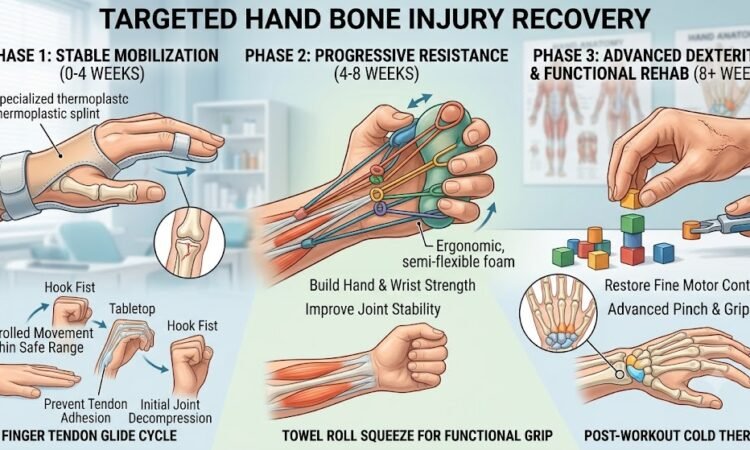
Recovering functionality in your hands and fingers after trauma injury, whether from a accidental fracture, a severe sprain, or chronic, Bone Pain relief requires a strict disciplined, with proper medical and care approach. The hand’s fragile structure of 27 bones and dozens of muscles are vulnerable to severe stiffness if immobilized, but too much sudden stress can lead to chronic inflammation or re-injury.
This article provides a detailed, four-phase rehabilitation process designed for safely transition of your hand from acute stiffness to full functional strength. For visual reference on how to execute these movements, please consult with expert doctor if you really want to recover from the major injuries.
Important Medical Safety Guidelines
Before attempting any movement, you must follow to these basic rules:
Mandatory Clearance: Ensure a medical professional i.e. orthopedic specialist or certified hand therapist has confirmed that any fractures are stable and that soft tissue is ready for stress. Moving too early can displace a healing bone.
Differentiate the Pain: You will feel stretching and mild discomfort. You must stop it immediately if you feel sharp, stabbing, or deep bone pain. The this is a signal of overload.
Use Heat Therapy Wisely: For chronic stiffness, such as not acute, swollen injuries, apply moist heat ie. a warm towel or warm water soaked cloth for 10 minutes before your routine to increase better blood circulation and tissue elasticity.
Detailed Phase-wise Rehabilitation Process for Bone Injury
Follow these phases sequentially. Move to the next phase only when the current exercises are pain-free and easy.
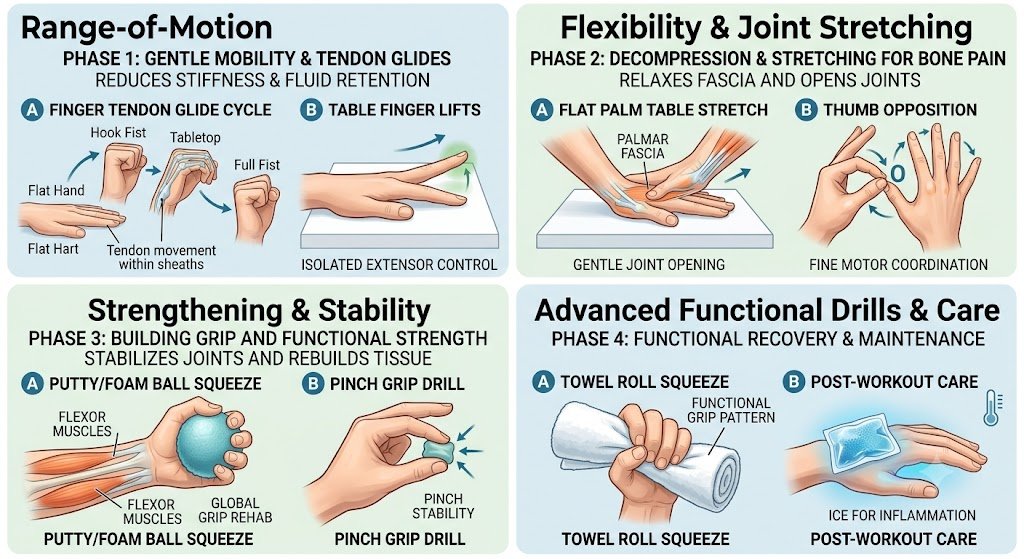
Phase 1: Gentle Mobility & Tendon Glides
for Weeks 1 to 2, or until cleared for light movement
The primary goal here is to reduce acute stiffness, encourage blood circulation, and prevent the delicate tendons from adhering to scar tissue during the healing process. These workout should be performed slowly.
A. Finger Tendon Glide Cycle
This specialized movement pattern is critical. It moves the flexor tendons through their full excursion, reducing fluid retention and prevents the stuck feeling common after casting.
- Start with your hand completely open and flat, fingers tight together.
- Move into a Hook Fist i.e. by bending only the top and middle joints.
- Transition to a Tabletop such as bending only the large knuckles, fingers straight.
- Finish in a soft Full Fist. Perform 10 cycles, for 3 to 4 times per day.
B. Table Finger Lifts such as Isolated Extensor Control
This exercise targets the delicate muscles on the back of the hand that are often weakened by immobilization. It helps rebuild control over individual finger extension.
Place your hand palm-down on a flat, clean table.
Try to keep all other fingers relaxed and touching the table while you slowly lift one finger as high as is comfortable.
Hold it for 2 seconds, then slowly lower. Perform 8 to 10 reps per finger.
Phase 2: Flexibility & Joint Stretching
Weeks 3 to 4, or when acute swelling reduces
In this phase, we target deep flexibility and mild decompression of the joints, which is important for relieving from persistent bone ache and joint stiffness.
A. Flat Palm Table Stretch (Palmar Fascia Focus)
This stretch focuses on the tissues in the palm and the small joints that may be compressed.
Place your affected palm flat against a table.
Slowly and gently bend forward, applying only mild pressure to encourage the palm to flatten and the wrist to extend.
Hold the stretch for 30 to 45 seconds. Do not bounce. Repeat it for 3 times.
B. Thumb Opposition (Fine Motor Coordination)
A key component of hand function is the thumb’s ability to reach each finger ie. opposition. This is very
important for gripping and fine motor tasks.
Bring your thumb tip to touch the tip of your index finger, forming a circle.
Maintain the touch for 2 seconds.
Move sequentially to the middle, ring, and pinky. Complete 10 full passes across the hand.
Phase 3: Strengthening & Stability
Weeks 5+, when basic motion is pain-free
Once the joints are mobile and tendons are gliding, we begin progressive resistance training to stabilize the bones and joints with muscular support.
A. Putty / Foam Ball Squeeze (Global Grip Rehab)
This movement uses resistance to load the entire flexor muscle group in the forearm. A soft foam stress ball is an easy starting point, therapy putty allows you to progress through resistance levels.
- Hold the putty or ball in your palm.
- Squeeze it hard for 5 to 6 seconds, by focusing on a strong, and even palm grip.
- Release slowly. Perform 2 sets of 12 squeezes.
B. Pinch Grip Drill (Pinch Stability)
This exercise isolates the important stabilizer muscles that define your pinch strength, which is necessary for unlocking doors or holding small objects.
Pinch a small amount of therapy putty or a firm foam block between the thumb pad and the index finger pad.
Maintain the pinch for 5 seconds. Repeat with the middle finger. Perform it for 8 to 10 pinches per finger combination.
Phase 4: Functional Drills & Care
Advanced, prior to full return to activity
This final phase transforms the strength into functional patterns required for daily life and maintenance.
A. Towel Roll Squeeze (Functional Grip Pattern)
A larger object changes the biomechanics of the grip, simulating complex holding patterns like using tools.
- Roll a hand towel into a firm cylinder.
- Grip and squeeze the roll intensely for 10 seconds.
- Relax slowly. Perform 10 intense squeezes.
B. Post-Workout Care: Ice for Inflammation
Even in advanced recovery, bone ache and inflammation can occur after an intense session.
After completing your routine, apply a thin towel and an ice pack wrapped around the wrist / affected joints for 12 to 15 minutes.
This will help to manage any micro-swelling and soothes the bone ache by following this bone workout therapy for relief from bone injury.

Senior Editor, Functional Fitness & Everyday Strength
Qualified B.S. in Exercise Physiology, University of Colorado Boulder | Certified Personal Trainer (ACE)
Jake has been a founding editor at Gymbag since 2018. With over 12 years of coaching experience and a degree in physiology, he specializes in fitness that fits into real life.