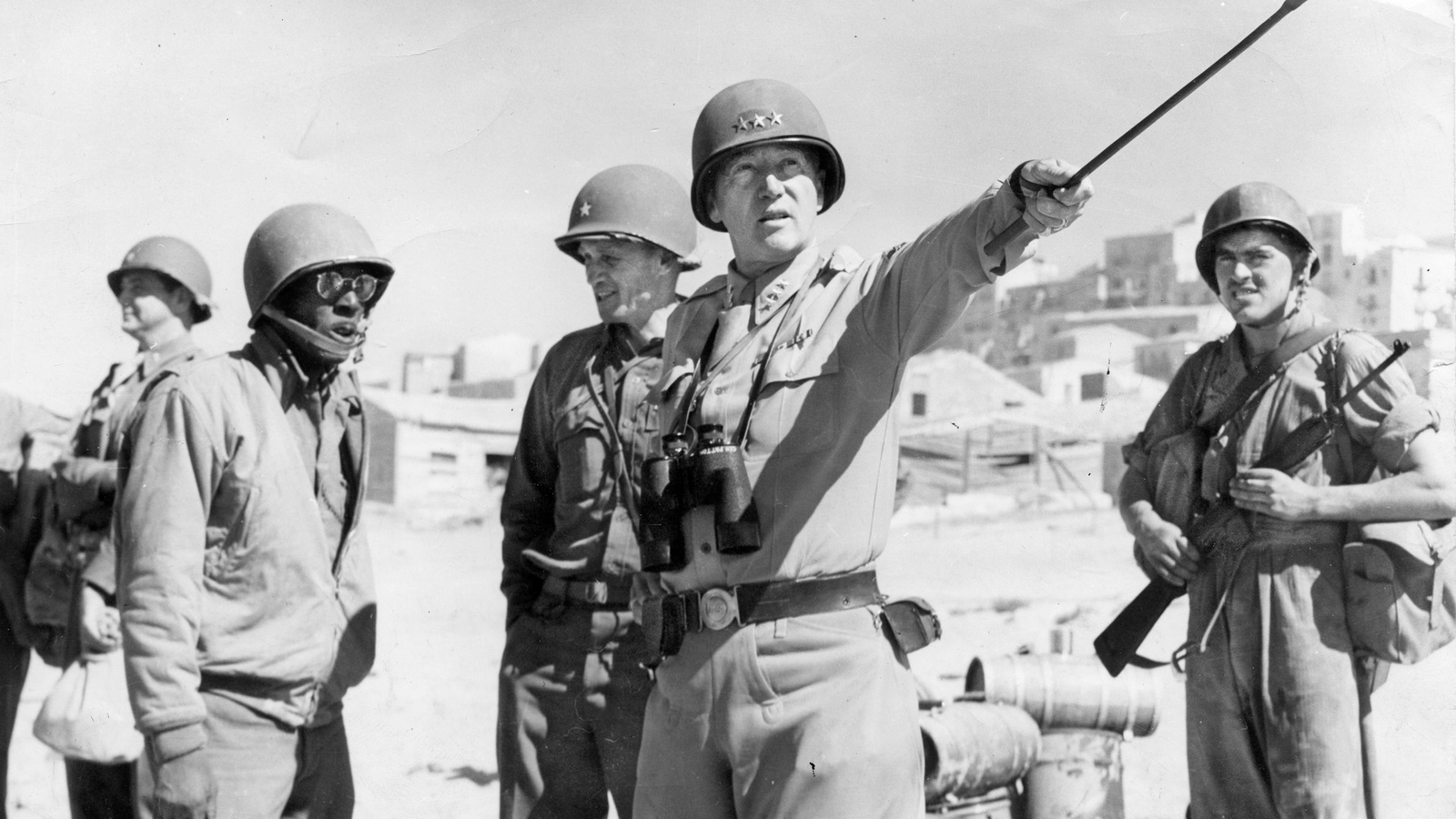

Perhaps no military leader has cast as lasting a shadow over history as General George S. Patton. From his early years as a driven cavalryman to his rise as one of the most respected commanders of World War II, Patton’s life is one of boundless energy, innovation, and unshakeable leadership.

Born into a line with a long military history, he had to earn his way early on in order to make his reputation and cover it up with an insatiable appetite for reading and writing about war. His stint at West Point, followed by instruction at the Mounted Service School at Fort Riley, Kansas, honed both his swordsmanship and his command skills.

Patton’s fascination with weapons was a whim rather than a necessity. His classic ivory-handled sidearms—a Colt Single-Action Army .45 and a Smith & Wesson .357 Magnum—were no more typical of his personality than of his use of war. Asked about them, he just shrugged and said, “They’re ivory,” deflecting their appearance even as he cemented the image of the warrior he cultivated.

The Colt .45 rode with him on his initial combat assignment in 1916, a bold raid against Mexican revolutionary Julio Cardenas, the first deployment of motorized troops by the United States Army into combat. His pistols both bore his initials and became part of Patton’s lore on the battlefield.

He was the “Master of the Sword” at Fort Riley and drew up the M1913 Cavalry Saber. Whereas the curved slashing sabers of the past were replaced by this straight-bladed, thrusting saber, which was patterned after the British M1908 and reflected the Patton motto: strike first, strike hard, the 35.25-inch blade, basket hilt, and weighted handle made it both a weapon of war and an instrument of training, teaching the combat mentality that would later become the pattern for his tank warfare approach.

As cavalry transformed into mechanized infantry, Patton was learning quickly. Having been schooled on the Punitive Expedition and again within the U.S. Army Tank Corps, he was one of the first to believe in armored warfare. He led his tanks into combat personally, managed uniform designs, and even got wounded in battle—testimony to his leading from the front. This aggressive approach to tactics was his trademark for World War II, and it was marked by high-speed attacks and aggressive decision-making.

Patton revitalized stagnant units in Sicily and North Africa and led drives that brought rapid gains. His leadership of the U.S. Seventh Army in Sicily brought rapid captures of Palermo and Messina, frequently scoring winning goals ahead of corresponding allied British troops. His motto was straightforward but excellent: keep moving, never halt, and take each opportunity. That strategy was at its peak as the Third Army advanced through France, racing forward at breakneck paces and outflanking German troops on all sides.

His most high-profile moment was at the Battle of the Bulge. Hitler’s Ardennes winter counterattack in 1944 could divide Allied forces and seize Antwerp. While Bastogne was besieged, Patton pulled off a masterstroke, swinging his Third Army about face north to save the town. Due to Colonel Oscar Koch’s foresight, Patton moved quickly, breaking the siege on the 26th of December, liberating the 101st Airborne Division, and placing the Allies in a new dominance over Germany.

The legend of Patton is not just maintained in books on history but also in museums like the General Patton Museum of Leadership at Fort Knox. There, his bomber jacket, sidearms, and North African campaign vehicles remind us of the man behind the legend. His replica dog Willie and legendary guns remind us of the man in him.

Patton died in December 1945 as a result of injuries sustained in a car accident while driving in Germany. He was buried in Hamm, Luxembourg, across from the graves of his men—a gesture of his lifelong commitment to troops he commanded for the rest of his life. As historian Kevin M. Hymel noted, this gesture is consistent with Patton’s lifelong commitment to the troops he commanded.

Today, Patton’s legacy is still heard in armored warfare methods, conserved relics, and training given to generations of future military commanders. His aggressive strategies, creative vision, and high standards still motivate soldiers and historians alike, solidifying his position among the greatest and most researched commanders of the modern era.