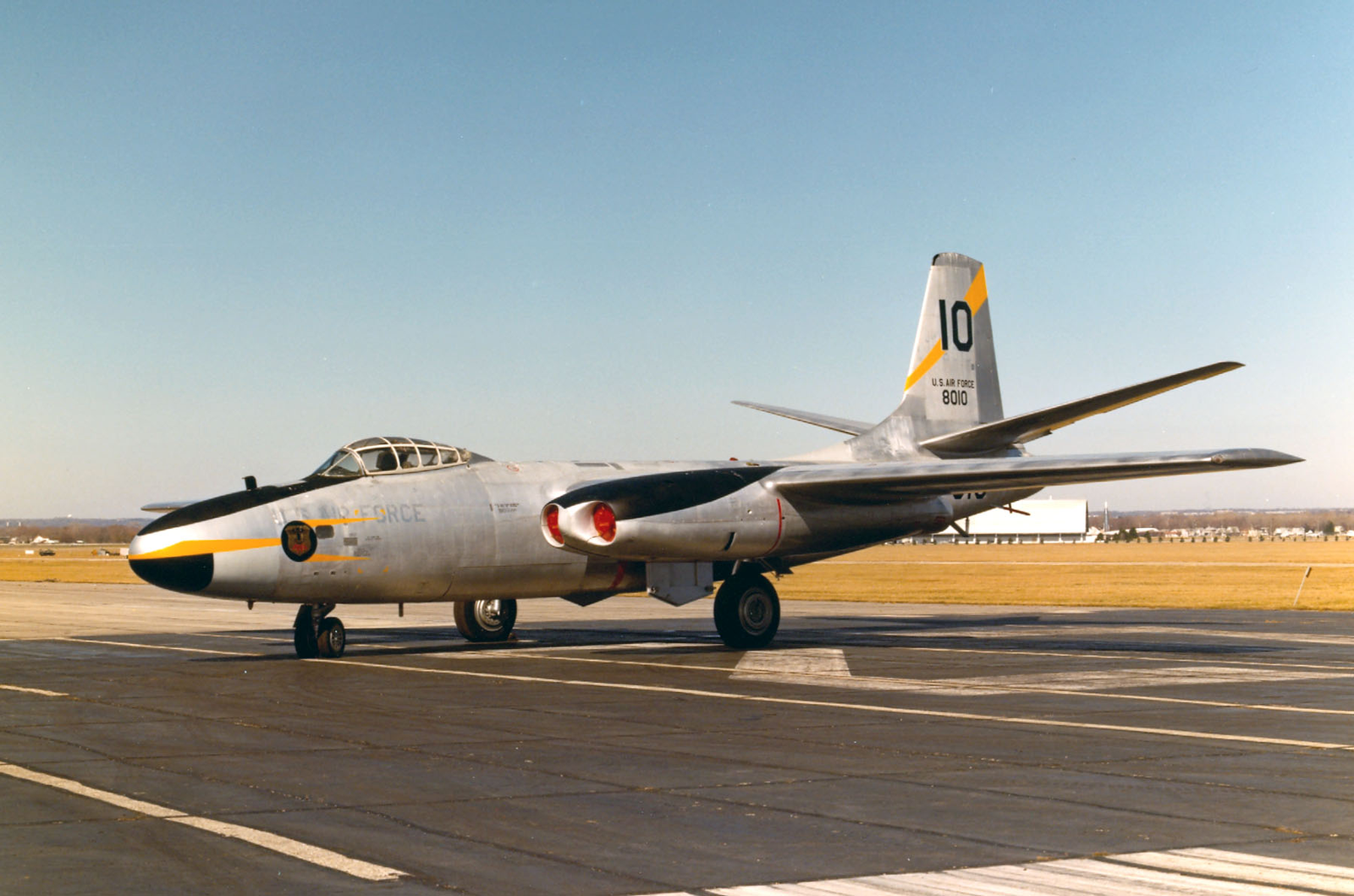

The North American B-45 Tornado was a groundbreaking feat in the history of the U.S. Air Force, leading the Air Force into the jet bomber era. Its origins trace back as far as the latter end of World War II, when American strategists were worried about how quickly the Germans were advancing with jet aircraft—namely the Arado Ar 234 Blitz—when they made a 1944 solicitation for a turbojet bomber to surpass or equal whatever was being created by the Germans.

North American Aviation responded with the NA-130 design, and three prototypes were well along in September 1944. The goal was evident: take a jump to the jet age, not simply for status, but to enhance the nation’s defense.

It was not easy to convert blueprints into a functional flying machine. Postwar budget limitations sidetracked progress, and the program was further plagued by a string of engineering problems. The prototype flew on February 24, 1947, but earlier prototypes had experienced faulty engines and structural malfunctions.

With four General Electric J47 turbojets, an aircrew of four airmen, and a payload capacity of up to 22,000 pounds of ordnance, on paper, the Tornado was a good idea—but to fly it was plagued by failure of the instruments in the cockpit and periodic engine fires. From then onwards, early production aircraft were extensively employed for training and testing rather than combat missions.

Everything changed with the outbreak of the Korean War in 1950. The Air Force required a jet bomber for conventional as well as nuclear operations, and the rebuilt B-45, in its modified form, saw service. Tornado pilots flew bombing missions and photo-recon sorties, usually under the cover of darkness to outrun the MiG-15s.

Its RB-45C reconnaissance model was particularly its money’s worth, replacing the slower piston-engine RB-29, which was the main target for enemy jet combat planes.

Its conversion to nuclear service created new challenges. Its initial bomb bay was not spacious enough to accommodate the first atomic bombs. The airframe was strengthened, additional defense systems were installed, and fuel capacity was enhanced. Forty B-45s were converted for tactical nuclear service in the “Backbreaker” program. In 1952, the aircraft were deployed in the United Kingdom and constituted a credible nuclear threat to NATO.

Besides bombing, the Tornado also had an undercover intelligence operation of its own. Bombs-free but camera-filled, the RB-45C made aggressive reconnaissance flights deep within the Soviet frontiers. To sidestep political analogical obstacles, the aircraft occasionally sported RAF markings, and British crews flew them under Operation Ju-ju.

Carried out by Sculthorpe Base’s Squadron Leader John Crampton, these deep penetration raids gained crucial under-radar and night-fighter-free detection intelligence. Classified until declassified in 1994.

The Tornado was phased out by the mid-1950s. It was replaced by the more powerful, faster bombers B-47 Stratojet and B-58 Hustler. The B-45 lost operational life and was formally retired in 1959 due to short range, persistent engine problems, and susceptibility to the latest fighters, but a few remained in test service until deep into the early 1970s.

Three B-45s remain today in California, Ohio, and Nebraska museums. Tornado’s combat life was probably short, but its legacy endures. It was America’s first production tactical jet bomber, and this was a testament to genius in adversity, wartime austerity, and determination for air supremacy.