We have are aware about the the modern lifestyle associated health warning derived from the todays corporate office buildings and remote home offices, and “sitting for longer hours is become the new smoking” For anyone working a 9 to 5 desk job are under the threat of chronic diseases. You spend eight to ten hours staring at a high-definition monitor, drive home in a seated position, and realize that your step counter hasn’t even crossed the 2,000 step mark during the entire day. This article will help you to explore about How to Stay Active with a 9 to 5 Job.
But here is the basic truth, is that you do not need to quit your corporate career, drop your professional responsibilities, or spend two hours at the gym every single day or night to reverse the physiological effects of a sedentary lifestyle. The secret of maintaining better physical fitness, protecting your joints, and keeping your metabolic rate high, is lying in a well researched scientific concept which is known as NEAT (Non-Exercise Activity Thermogenesis). NEAT consumes all the energy of our bodies to burn doing every action in our daily routine, which is not a specific workout or a intense gym workouts. It is the movement of daily life walking, standing, stretching, and pacing.
By strategically aligning strategic daily movement which triggers directly in your routine workday, you can improve your afternoon energy levels, permanently eliminate lower back stiffness, and optimize your physical health without missing a single professional deadline. This article guide you on an actionable, step by step information to staying highly active while effectively managing your professional career goals.
- The Physiology of the Desk: Why Sitting Restricts Your Health and wellness
To understand why micro-movements are so important, we must first look at what happens to the human body during prolonged periods of physical inactivity. Within just 30 minutes of continuous sitting, your body’s metabolic machinery begins to slow down. The production of lipoprotein lipase, which is a very important enzyme which breaks down fats and clears lipids from your blood by up to 90%.
Simultaneously, sitting forces your musculoskeletal system into an unnatural shape. Your hip flexors remain in a permanently shortened and tight state, which pulls your pelvis forward and places a higher stress on your lumbar spine. Your gluteal muscles completely switch off, a phenomenon physical therapists refer to as a glute amnesia. Over many months and years, this muscular imbalance leads to chronic lower back pain, rounded shoulders, forward-head posture, and severe neck pain.
The solution is not just a single action, but an intense workout at 6:00 PM. While an evening gym session is excellent for cardiovascular and muscular health, studies show it cannot completely undo the metabolic damage caused by eight continuous hours of sitting. Instead, you must change your sedentary time with small actions or purposefully walking, taking stair or stretching your body etc. throughout the day.
- Master the 50/10 Micro-Movement:
The most sustainable way to integrate physical activityies into a routine work schedule is to use a time-blocking system which is designed for your body. Implement the 50/10 Rule throughout your workday.
Set a silent desktop timer or smart watch alert for 50 minutes. During this block, give your absolute focus to your projects, emails, and meetings. However, the exact second that timer goes off, you must stand up immediately. Your 10-minute body movement block is mendatory to follow.
50 Minutes: High-Focus Work = [10 Minutes: Micro-Movement Break]
Turn off distractions Reactivate metabolic enzymes
Deep cognitive workflow Flush out built-up joint stiffness
During these 10 minutes, your goal is not to break a sweat or change into achieving a difficult athletic performance. The goal is to be very simply of better circulation and muscular activation.
You can try a various quick body movement habits which includes:
- Walk down to different floor of the building.
- Perform 10 slow, controlled bodyweight squats right next to your desk.
- Step outside the front doors to get fresh air and expose your eyes to natural sunlight.
As, these micro-dose of physical activity acts as a reset switch for your metabolism, flushing your brain with fresh oxygenated blood and immediately reducing the 2:00 PM afternoon laziness.
- Upgrade to an Active Workspace Setup:
If your corporate office environment allows for it, or if you manage your own remote work environment, by changing the physical design of your workspace is the easiest way to automate your daily activity. Instead of relying purely on willpower, let your environment do the heavy lifting.
The Ergonomic Sit-Stand-Walk Ratio:
You should never aim to stand for eight hours straight, as prolonged standing on hard surfaces can creates static pressure on your veins and can cause lower body fatigue and varicose veins. Instead, the ultimate health goal is to keep continuous postural fluid movement. Aim to structure your 8-hour workday using this precise ergonomic workouts:
- Daily Setup Percentage: Ergonomic Sitting (50%), Ideal Time Commitment: 4 Hours, Primary Health Benefit: Allows for deep, high-focus mental tasks and maximum upper body stability.
- Daily Setup Percentage: Active Standing (30%), Ideal Time Commitment: 2.5 Hours, Primary Health Benefit: Relieves compression on the lower spine, improves posture, and burns 30% more calories than sitting idle.
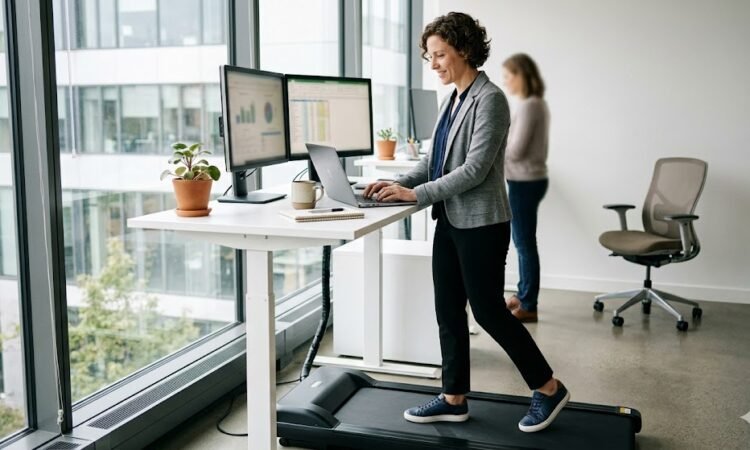
- Daily Setup Percentage: Under-Desk Walking (20%), Ideal Time Commitment: 1.5 Hours, Primary Health Benefit: Effortlessly adds 4,000 to 7,000 steps in your daily routine.
Investing in a high-quality adjustable standing desk attached with a compact under-desk walking treadmill is a game-changer for corporate professionals. You can easily set the treadmill to a slow, gentle pace of 1.5 mph (2.4{km/h}) and walk while reading reports, replying to emails, or attending long hours webinars.
If a standing desk setup is not feasible within your current office environment, replace your standard executive office chair with a high-density stability exercise ball for just one to two hours per day. Because a stability ball is unstable, your body must constantly engage your deep core, transverse abdominis, and spinal stabilizers to keep you upright. This turns passive sitting into an active core-strengthening activity session.
- 5 Silent Desk Exercises to Do Discreetly at Work:
If you work in an open-concept corporate office, you might feel self-conscious doing full workouts in front of your colleagues. Fortunately, you can perform these five highly effective, stretches and mobility movements completely unnoticed.
The Seated Figure-Four Stretch:
This exercise targets the piriformis and deep glute muscles which become incredibly tight from daily sitting. While sitting upright in your office chair, cross your right ankle over your left knee, creating a 4 shape with your legs. Keeping your spine long and straight, gently bend forward from your hips. Hold for 30 seconds, breathe deeply, and switch to the left side.
The Stealth Desk Incline Pushup:
Whenever you return to your cubicle from a restroom break or a walk to the copy machine, stop at the edge of a sturdy desk, filing cabinet, or breakroom counter. Place your hands slightly wider than shoulder-width apart on the surface, step your feet backward until your body forms a straight line, and perform 10 to 15 controlled tilt pushups. This opens up the chest muscles that get tight from typing work and strengthens the upper body.
Hands on desk edge = Head aligned
/
Feet stepped back = Straight spine line
Standing Calf Raises workout:
Whenever you find yourself waiting for the office printer to finish a large printing job, standing on a phone call, or waiting for your lunch to heat up in the microwave, perform rhythmic calf raises workouts. Lift your heels off the ground, driving your weight onto the balls of your feet. Hold the contraction at the top for one second, then lower down slowly. This muscle contraction acts as a secondary pump for your circulatory system, pushing circulated blood back up to your heart.
Seated Spinal Twists:
Sit forward on the edge of your chair with keeping your feet flat on the floor. Place your left hand on your right knee, and gently rotate your torso to the right, gripping the back of your chair for a slight assist. Rotate until you feel a comfortable stretch along your thoracic spine. Hold for 15 seconds, then reverse the movement to the left. This preserves spinal mobility and prevents stiffness.
Shoulder Blade Squeezes (The Posture Corrector):
To counteract the classic hunchback PC Working posture, sit up tall, drop your shoulders away from your ears, and bend your elbows at 90 degrees. Pull your elbows backward and focus on squeezing your shoulder blades together as hard as possible, as if you are trying to hold a pencil between them. Hold for 5 seconds, release, and repeat this action for atleast 10 times.
- Habit Stacking: Transform Routine Tasks into Body Movement Triggers:
The true secret to long-term health success is a psychological strategy which is also called as strict habit following. Instead of trying to remember to move, attach a new physical activity to an administrative habits which you already perform every single day without fail.
Trigger 1: The Audio-Only Phone Call
Look at your daily meeting schedule. Identify any internal schedules, status updates, or catch-up calls that do not require you to share your computer screen or attend live. Put on your wireless Bluetooth earbuds, slip your phone into your pocket, and start walking during meeting. Pace around your office room, walk up and down the building hallways, or step outside into the courtyard. A single 30-minute walking meeting can add nearly 3,500 steps to your daily log.
Trigger 2: The Distant Parking Spot
Stop spending five minutes driving around the front parking rows trying to find the absolute closest spot to the office entrance. Intentionally park your car in the farthest possible corner of the parking lot. If you commute via public transit, get off one stop or station before your actual destination and walk to reach your stop. This minor adjustment guarantees an extra 10 to 15 minutes of brisk walking at both the start and the conclusion of your workday.
Trigger 3: The Half-Floor Rule
If you work or live in a multi-story building, stop using the elevator for short trips. Implement the half-floor walk rule, if your destination is fewer than three floors away, you must take stairs for most of the time. If you work on a high floor, like the 10th floor, take the elevator up to the 7th floor and challenge yourself to walk up the remaining three flights of stairs. Stair climbing is an incredible lower-body workout that burns more calories per minute than jogging.
Summary: Designing Your Best Active Workday
Overcoming a sedentary desk job lifestyle does not require a strict lifestyle changes as change should be ok if it is done gradually. It requires a mindset shift that views your workday not as an eight-hour block of physical immobility, but as an opportunity for continuous, low-intensity movement.
By parking your car a little further away, standing up and walk during phone calls, performing desk mobility stretches between spreadsheets, and using the 50/10 rule, you will completely transform how your body feels, moves, and performs. Pick just one single strategy for your routine from this article to implement immediately. Once that movement habit becomes completely automatic, start doing another one along with it. Your health, your joints, and your workplace productivity will strengthen and help you to achieve your wellness with small lifestyle changes without impacting your professional life.

Editor
Professional Naturopathy, Holistic Wellness & Preventive Health Specialist
Doctor of Naturopathic Medicine, Bastyr University | Certified in Lifestyle Medicine (ACLM)
Dr. Blake takes a whole-body approach to health, blending medical knowledge with daily wellness practices. She’s worked in integrative clinics and now advises digital health platforms on sustainable self-care routines. on Gymbag4u.com, since 2019, she provides guidance on sleep, energy management, immune health, and how to balance wellness with real-world demands.