
Few guns have made as lasting an impact on military history as the M60 machine gun. “The pig” was its colloquial name among soldiers, and it soon symbolized American determination, adaptability, and plain brute power. Since the late 1950s, the M60 has fought around the world, establishing itself in scores of wars and establishing a legend that would last generations.

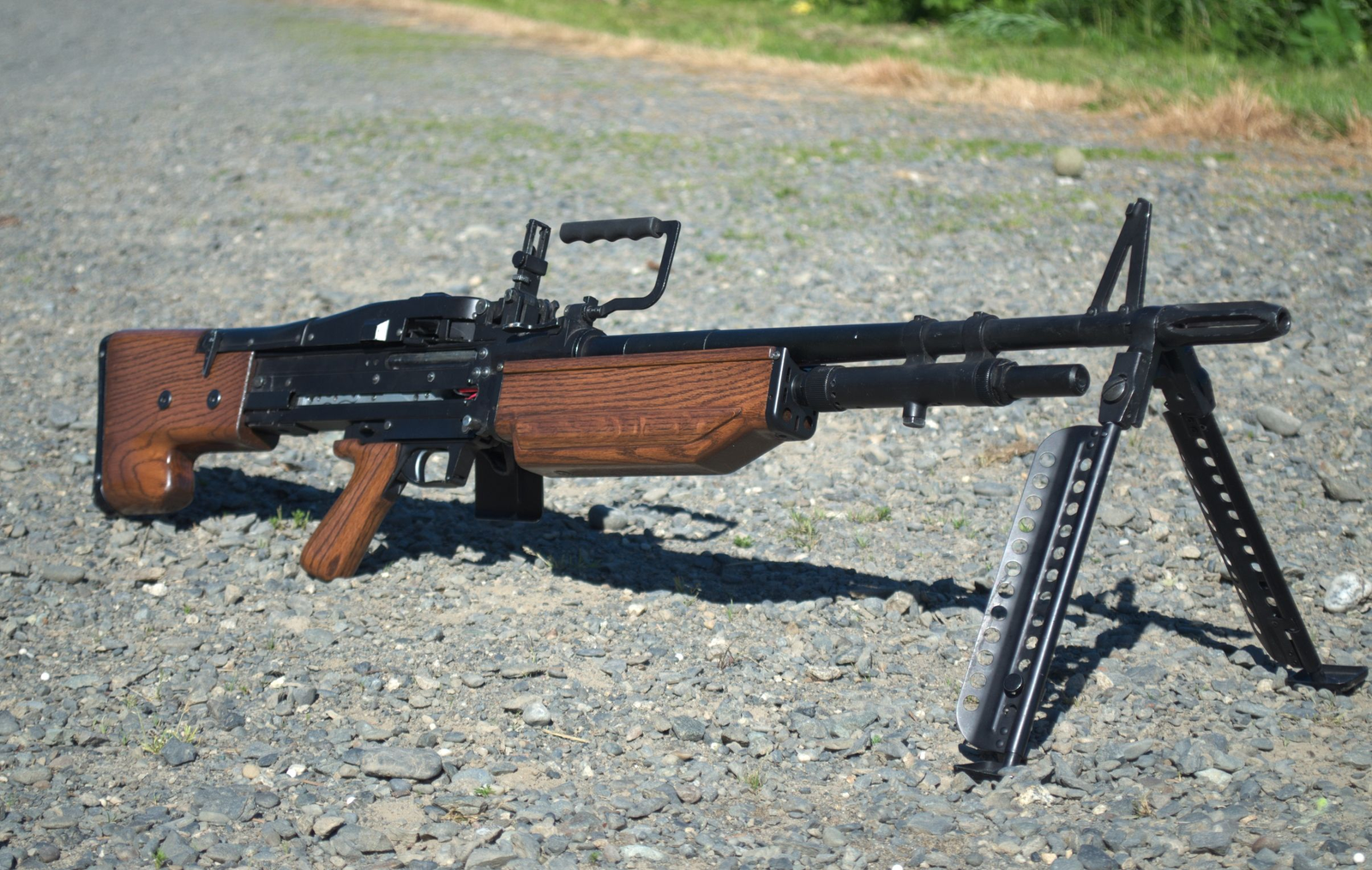
The M60 was created as a response to the necessity for a lighter and more adaptable replacement for the cumbersome Browning M1919. The designers took a cue from the German MG42’s streamlined belt-fed mechanism and married it with the FG42’s gas-powered, rotating bolt system.

The result was a universal machine gun that weighed only 23 pounds, with a rapid-fire barrel change capability that made it useful for infantry, armored vehicles, and even aircraft—a versatility that few other weapons of the era could hope to emulate.

Chambered for the 7.62×51mm NATO cartridge, the M60 had a considerable amount of firepower. With optics, it could reach out and kill targets to 1,200 meters, or 800 meters with open sights. Its gas-powered, belt-firing system provided 500 to 650 rounds per minute continuous fire, making it an intimidating force on any battlefield.

While it featured a folding bipod, it could also be mounted on vehicles or tripods. Weighing about 10.5 kilograms when empty, it was less heavy than its predecessor but remained cumbersome for troops to transport long distances.

The M60 was soon put to test in combat, especially during the Vietnam War, where it was issued standard to infantry, helicopters, and armor units. Its firepower was awe-inspiring, and its reliability was often the difference between victory and defeat. 4th Infantry Division’s Victor Renza remembered, “The M60 was a terror weapon—enemy soldiers targeted the gunners first.” Soldiers became intimately familiar with the weapon, capable of blindfolding themselves and reassembling it while carrying hundreds of rounds into the field.

Though excellent in its strength points, the M60 did have weak points. Sustained use wore out internal components, and though the quick-change barrel was a brilliant innovation, it also created problems with performance during prolonged firing. The gun was cumbersome to carry, especially with the barrel and bipod attached, and sustained firing loosened parts in the gas system; troops had to make do with field improvisations for repairs.

The versatility of the M60 also led to specialized models. The standard rifle model featured a rubber-coated handguard and folding shoulder stock. The M60C was optimized for helicopter mounts with hydraulic charging and electrically fired, and the M60D was optimized for aerial pintle mounts with spade grips and ring sights.

These adaptations enabled it to serve as both a squad automatic and a suppressive fires platform, either in transport or air environments, and it entrenched itself as one of the most versatile weapons of its era.

Later, the FN MAG, which was used as the M240, became more reliable and easier to maintain than the M60, but the M60’s role flexibility was unparalleled for decades. Its influence permeated beyond the field of battle, making appearances in films, TV shows, and video games, and was famously carried by Sylvester Stallone’s John Rambo in First Blood. To this day, reconfigured M60E6 models are still used in limited numbers, a testament to the enduring value of the design.

The M60 still stands as something greater than a machine gun—it is living history. Feted by collectors and military buffs, it still stands as a testament to American ingenuity and strength. Its legacy continues through the tales of the troops who carried it, the fights that it helped to win, and the indelible imprimatur that it left on the face of warfare today.