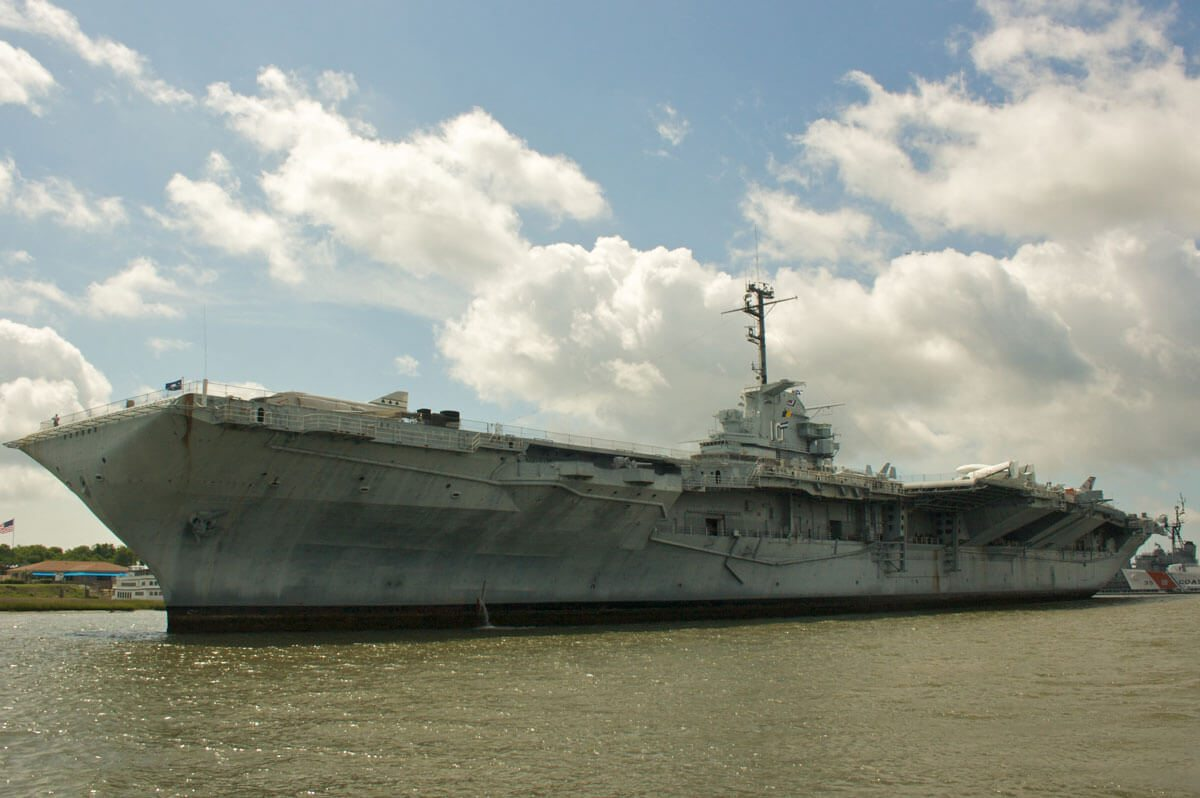

From the intense battles of the Pacific in World War II to the Cold War standoff, American aircraft carriers have been symbols of naval power for decades. While all but a few were ultimately retired and scrapped, a few were saved as museum ships, where their decks could be walked upon, their hangars visited, and the sailors’ lives on board imagined. These five are among the best and five of the most amazing carriers you can currently visit.

5. USS Yorktown (CV-10) – Patriots Point, South Carolina
Commissioned in 1943, the USS Yorktown was originally going to be named Bonhomme Richard. Due to the loss of the previous Yorktown at Midway, the name was taken to memorialize that ship’s sacrifice. In World War II, she was awarded 11 battle stars and went on to serve during both the Korean and Vietnam Wars.

Decommissioned in 1970, Yorktown currently remains at Patriots Point in Mount Pleasant, South Carolina. Guests can board to discover interactive exhibits such as a replica Apollo capsule mimicking a flight to the moon or the “Engine Room Experience,” a re-creation of World War II technicians’ daily activities. The vessel has appeared in movies as well, introducing her rich history to an even broader audience.

4. USS Midway (CV-41) – San Diego, California
Commissioned in the immediate post-war period, the USS Midway was the world’s biggest ship at that time, too large to fit through the Panama Canal. She spent an incredible 47-year career in service, serving during the Vietnam War, Operation Desert Storm, and many peacetime deployments before retirement in 1992.

Currently in port in San Diego, the USS Midway Museum transports visitors back in time in naval history. Visitors can view reenactments in the Battle of Midway Theater, experience flight simulators, and go on guided tours of the hangar and flight deck, where vintage aircraft wait to share their histories. The museum holds decades of naval aviation history under one roof.

3. USS Hornet (CV-12) – Alameda, California
Commissioned in 1943, the USS Hornet was assigned to the Fast Carrier Task Force in the Pacific and was engaged in pivotal battles such as the Mariana and Philippine Sea campaigns. Her aircraft was instrumental in sinking the Japanese super-battleship Yamato.

Following the war, the Hornet was upgraded and utilized again in the Korean War and the Vietnam War. She also gained notoriety as an Apollo recovery ship for astronauts returning from the moon. Now, the USS Hornet Sea, Air & Space Museum in Alameda contains World War II aviation, Apollo, and Cold War aircraft exhibits. Tourists get to take tours of control centers, engine rooms, and flight decks packed with airplanes that are a quarter-century old.

2. USS Intrepid (CV-11) – New York City, New York
Hence known as “The Fighting I,” the USS Intrepid was commissioned in 1943 and encountered intense combat within the Pacific, including the Battle of Leyte Gulf. After withstanding numerous kamikaze attacks, she went back into action time and time again, gaining a reputation as a tough, resilient ship.

She was later an attack and anti-submarine carrier, saw action in the Vietnam War, and even aided NASA’s Mercury and Gemini programs. Today, she moors the Intrepid Sea, Air & Space Museum in New York City, which contains the Space Shuttle Enterprise, the Cold War Lockheed A-12 spy plane, the USS Growler submarine, and a comprehensive collection of naval aircraft.

1. USS Lexington (CV-16) – Corpus Christi, Texas
Ordered in 1943 as Cabot but eventually renamed Lexington, the Essex-class carrier was the Pacific Fleet’s Fast Carrier Task Force flagship. She was awarded 11 World War II battle stars and, following a major overhaul in the 1950s, remained in service in attack and anti-submarine roles until 1991.

Currently moored in Corpus Christi, Texas, “The Blue Ghost” is a giant museum covering many decks. One can take flight simulators, ride through an escape room, or witness the 3D Mega Theater. Eleven decks are accessible to the public, featuring everything from World War II Dauntless dive bombers to up-to-date FA-18 Hornets. The ship has also gained a reputation for having ghost stories, providing a fascinating addition to her already mythological history.

These five ships are more than mere museum exhibits. They are living memorials, engineering miracles, and testaments to sailors and airmen who served on them. Stepping onto their decks provides a unique opportunity to step into history and touch the heritage of American naval dominance.