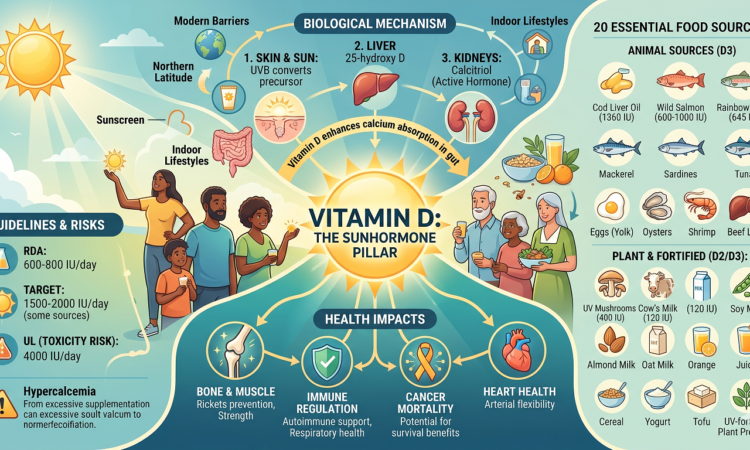
Vitamin D holds a very important position in human health. Unlike most other vitamins, Vitamin D is must be obtained strictly through diet. Vitamin D functions as a pro-hormone, by which our body can synthesize it internally through exposure of our body to morning sunlight. vitamin D is also referred to as the sunshine vitamin, which plays a foundational role in skeletal strength, immunity regulation, and cellular health. As research evolves, the scientific community continues to explore the influence of Vitamin D foods, rich with fat-soluble nutrient benefiting to prevent various chronic disease and helps in long-term wellness.
The Biological Mechanism: How Vitamin D Works
Vitamin D is a very important supplement for our bines, it is having two primary types, ie. Vitamin D2 (ergocalciferol) and Vitamin D3 (cholecalciferol). D2 is a primarily we get from a food based on plants and fungi (such as mushrooms) and D3 is the form produced in the skin of humans and animals when their skin is exposed to ultraviolet solar light.
Vitamin D must undergo by two hydroxylation processes in the body to become active. First, it travels to the liver, where it is converted into calcidiol, 25-hydroxyvitamin D. This is the form which typically measured in blood tests to determine a person’s vitamin D sufficiency. From there, it moves towards the kidneys, where it is converted into its active hormonal condition, calcitriol ie. 1,25-dihydroxyvitamin D.
The main role of calcitriol is to maintain a strict control over presence of calcium and phosphorus at adequate level in our blood. It can be achieved by increasing the efficiency of the small intestine’s ability to absorb these minerals from the routine diet. Without sufficient Vitamin D, our body can only absorb about 10% to 15% of dietary calcium, which forces the body to take calcium from the skeleton structure to maintain the important heart and nervous system functions, and it eventually leads to bone degradation.
The Sunshine Factor and Modern Barriers:
The synthesis of Vitamin D in the skin via solar Ultraviolet-B (UVB) radiation is the most natural way to acquire this important nutrient. However, modern lifestyles and geographical realities in few continents have created a global Vitamin D scarcity for many people.
- Latitude and Season: For those living in northern regions ie. at latitudes above $37 circ N, such as Boston, London, or Edmonton, the sun’s angle during winter season is too low for UVB rays to penetrate the atmosphere effectively. In these locations, skin synthesis of Vitamin D is impossible from November through March months which is a major time period.
- Melanin and Skin Pigmentation: Melanin acts as a natural filter for solar uv rays. Individuals with darker skin tones require significantly more sun exposure, around three to five times more to produce the same amount of Vitamin D as those with lighter skin. This explains why Vitamin D deficiency is high in Black and Brown skin people even when they are actually living in high temperate climates is just due to their unabsorbant skin color.
- The Indoor Lifestyle: Use of sunscreen ie. SPF 30 reduces synthesis by about 95%, protective clothing, and the shift toward indoor work environments have contributed to an estimated 1 billion people worldwide with having deficiency of the D vitamin.
Vitamin D and Chronic Disease:
- Bone Health and Fracture Prevention:
The most established link is between Vitamin D and bone density. In children, severe deficiency causes Rickets, a disease which results in soft and curved bones. In adults, it leads to Osteomalacia ie. softening of the bones and exacerbates Osteoporosis ie. thinning of the bones.
Clinical trials, such as the meta-analysis of 12 randomized controlled trials involving 42,000 elderly individuals, suggest that higher daily doses estimated around 800 IU can reduce the risk of hip and non-spine fractures by roughly 20%. However, as per the recent clinical trial shown that, in a healthy adults with sufficient presence of vitamin D, taking high-dose of vitamin D supplement can’t avoid accidental bone fracture. These trials suggests that the goal should be sufficient rather than having it in excess.
- Cancer Prevention and Progression:
As per the Observational studies which have long noted that people living in sunny climate, the equatorial climates have lower rates of colon, prostate, and breast cancers. While clinical trials did not find that Vitamin D prevents cancer, but, it did show a significant reduction in cancer cells mortality. But, a general analysis confirmed that a 13% have lower risk of cancer death among people taking Vitamin D supplements. It is suggesting that Vitamin D may stop the tumor progression and improve survival rates once a diagnosis is made.
- Autoimmune Health:
One of the most exciting breakthrough studies come out in recent years, which involves the impact of Vitamin D on our body immunity system. Vitamin D helps to strengthen T-cells and B-cells to differentiate between foreign invader bacteria and the body’s own tissues. The recent study reported that 2,000 IU per day reduces the risk of developing autoimmune diseases such as rheumatoid arthritis, psoriasis, and thyroid issues by 22% with regular vitamin D Intake.
- Heart Disease and Respiratory Health:
The heart is a muscle with Vitamin D receptors, and the nutrient helps to regulate blood pressure and arterial flexibility. Even, During the COVID-19 pandemic, research highlighted Vitamin D’s role in the cytokine storm. While Vitamin D is not a permanent cure, but maintaining its adequate levels helps in betterment during acute respiratory infections and the flu.
20 Dietary Sources of Vitamin D Foods:
Because it is difficult to get enough sun exposure sometimes, and it is also dangerous to get too high sun heat, as it may risks to skin cancer. The diet rich in Vitamin D and supplements can help to fill the required gap with a more safer way.
Following are the 20 important Vitamin D Foods sources:
Naturally Found Animal Sources:
- Cod Liver Oil: It is one of the most concentrated sources of Vitamin D. A single tablespoon contains approximately 1,360 IU.
- Wild Salmon: A powerhouse of Vitamin D3, providing between 600 and 1,000 IU per 3.5 oz serving.
- Rainbow Trout: Cooked trout is highly beneficial source of D Vitamin, as it is offering about 645 IU per serving.
- Canned Mackerel: An affordable and sustainable food option with roughly 390 IU per 3 oz.
- Canned Sardines: Two small sardines provides about 46 IU and are also rich in calcium.
- Fresh Herring: In an Atlantic diet it is an essential staple food, with providing about 215 IU per 3.5 oz.
- Canned Light Tuna: While lower than fatty fish, it still provides about 40 IU per 3 oz.
- Oysters: These shellfish are nutrient rich food item, as six medium oysters containing roughly 270 IU.
- Shrimp: A Standard Bowl serving provides about 130 IU along with omega-3 fatty acids.
- Egg Yolks: The Vitamin D is found in the fat of the yolk, one large egg provides about 40 IU.
- Beef Liver: A traditional nutrient rich meat based food, which provides about 42 IU per 3 oz serving.
Plant-Based and Fortified Vitamin D Foods Sources:
- UV-Exposed Mushrooms: The only plant based major source of D2. If the grower uses UV lamps, 1/2 cup serving of these mushrooms can provide 400 IU or more.
- Fortified Cow’s Milk: Most of the packaged milk in the U.S. is fortified, which provides 120 IU per cup.
- Fortified Soy Milk: A primary option for vegans, usually containing 100 to 120 IU per cup.
- Fortified Almond Milk: Nut milks are typically rich enough to provide 100 IU per cup.
- Fortified Oat Milk: Now a popular dairy alternative, which is providing roughly 100 IU per serving.
- Fortified Orange Juice: For those who don’t eat dairy products, one cup of orange juice provides around 100 IU.
- Fortified Breakfast Cereals: Check labels, most of the cereals provide between 40 and 100 IU per serving.
- Fortified Yogurt: Many brands add Vitamin D to their yogurt, offering 80 to 120 IU per cup.
- Fortified Tofu: Some tofu brands are rich with Vitamin D, with providing about 80 IU per 3 oz.
Recommended Vitamin D Intakes and Safety:
The Institute of Medicine (IOM) Recommended Dietary Allowance (RDA) of Vitamin D based on age and bone health:
Ages 1 to 70: 600 IU (15 mcg) daily.
Ages 70+: 800 IU (20 mcg) daily.
However, many health organizations, including the Endocrine Society, suggest that 1,500 to 2,000 IU of Vitamin D, may be necessary for most of the adults to maintain optimal blood levels which is defined as >30 ng/mL.
The Risk of Toxicity:
Because Vitamin D is fat-soluble, it is stored in the body’s fat tissues and can stack up at higher levels. Vitamin D Toxicity i.e. hypervitaminosis D is almost never happens from food or sun, but with taking high amount of the supplements. The Tolerable Upper Intake Level (UL) is set at 4,000 IU per day for adults. Exceeding this for longer periods can cause hypercalcemia ie. excess calcium in the blood, which may further results into feeling of nausea, heart arrhythmias, and kidney stones.
Finally, Vitamin D is a base of we human’s health. While our ancestors relied on the sun exposure only, the modern scientifically evolved world requires a more strategic approach, which, includes routinely having Vitamin D & other essential nutrient rich foods such as fatty fish and fortified products. For those who are living in high latitudes or with limited sun exposure, a daily supplement of 1,000 to 2,000 IU is a safe and effective way to ensure this essential vitamin which helps to protect our body skeleton and support our body immune system throughout our life.

Lead Editor, Mental Health & Mindful Living
M.A. in Clinical Psychology, University of Mumbai | Certified Mindfulness Instructor (CMI)
Priya Patel joined Gymbag in 2019 and brings more than 12 years of experience as a therapist and wellness educator. Her content are mix of psychology with daily-life practices, covering topics from emotional regulation to body damage and energy loss recovery.