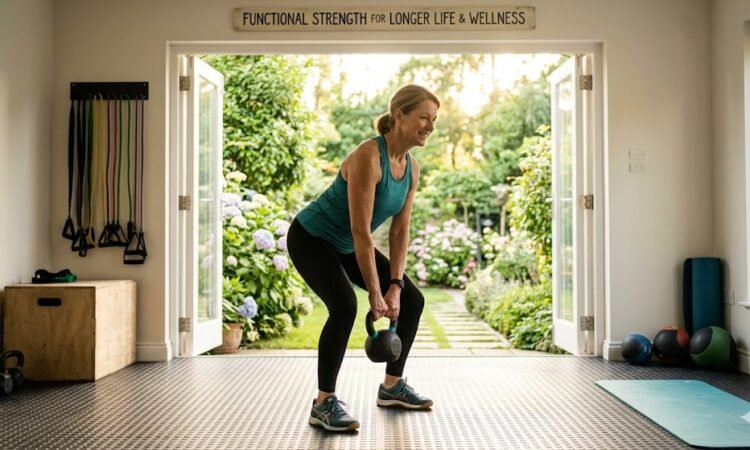
Today, the global fitness world is shifted towards more data and tech driven workout routines. Many people who follows fitness for chasing a specific health goal through repetitive gym movements, are rapidly shifting towards the more longevity-focused strength training. In this article we will Explore the Functional Strength Training for achieving a long term fitness.
Today, people are not just asking, about How can I look better? They are also asking on, How can I stay strong, mobile, and pain-free for the next forty years or maximum of their health span? This is where the Functional Strength Training comes into the picture. It is the most effective, science supported halthy routine, for ensuring your body remains a reliable and mobile for your entire life.
What is Functional Strength Training?
Functional training is about doing a purposeful body movement to achieve muscle strength. The traditional bodybuilding only concentrates on a specific muscles and body parts strengthening and toning such as a bicep, abdomins etc. whereas, functional training focuses on perfect body movement patterns that stimulates your body’s multiple muscle groups simultaneously to perform workouts that represents real-life activity.
- Think about your day: you do lift heavy boxes, you squat to pick up your child, you twist to reach for your seatbelt, and you also push doors open which are strength work. Functional training provide strength and conditioning to your musculoskeletal system to handle the daily activity loads with safely, effectively, and efficiently.
Why Longevity Matters in Todays lifestyle:
Medical Research published recently promotes that functional body movement capacity is the main damager to your health, the number of years you spend in good health, rather than just the number of years you are alive. By prioritizing functional strength, you not only build your muscle, but also you gains natural body strength against sarcopenia i.e. age-related muscle loss, bone density loss, and joint deterioration.
The Big 4 Foundational Patterns:
To build a robust body, you do not need a complex workout machinery or. You need to master the human body’s essential four foundational body movements. Mastering these movements will ensures that every muscle of your internal body to your joints stabilizer muscles will work altogether.
- The Squat – Knee-Dominant Workout:
The squat is considered as one of the best functional exercises to strengthen your legs and knee muscles. It replicates the action of sitting down and standing up.
- Why it matters: It builds very important lower-body strength such as quads, glutes etc. and promotes better mobility for ankle and hips.
- Process: Start with box squats, where you sit on a chair and then stand up with ensuring your knees track over your toes.
- The Hinge – Hip strengthening workout:
This pattern is important for picking up heavy objects from the ground without stressing your lower back.
- Why it matters: It strengthens the posterior chain, the hamstrings, glutes, and lower back muscles.
- Process Tip: Imagine that you are closing a car door with your glutes. Push your hips backward while keeping a flat spine while doing this workout.
- The Push – Upper Body strength workout:
This pattern covers everything from pushing yourself up from the floor just as like you are moving any furniture.
- Why it matters: It builds chest, shoulder, and triceps strength, as well as core stability.
- Workout Tips: If a standard pushup is difficult for you then take support of an stable objects such as steady table or bench. The goal of this workout is better body movement, not just a speed.
- The Pulling – Upper Body:
Often ignored, the pulling movement is very important for bette body posture, especially for those who spend many hours at a desk with long hours of sedentary lifestyle.
- Why it matters: It counteracts tech neck and rounded shoulders by strengthening the lats, rhomboids, and traps.
- Workout Tips: Using a resistance band strongly anchored with a door, focus on pulling your shoulder blades together for better impact.
The Role of Data in Monitoring Your workout Recovery:
Today in this modern age, Thre are many wearable technology gadgets are available to track our body movement. However, many working professionals are not using these tools just to count steps, they are using them to monitor body Recovery Optimization.
Heart Rate Variability (HRV):
HRV is one of the best standard measure for assessing your body’s nervous system’s. If your HRV drops significantly, then your body is telling you that it is under stress, whether it may be from poor sleep, work pressure anxiety, or an intense physical stress workout.
The Rule: On days when your HRV is low, prioritize to adopt active recovery measures including taking rest. Instead of doing a high-intensity workout, perform low-impact body movement such as walking, yoga, or body movement work.
Structuring Your Workout Routine for Success:
Consistency beats intensity by every single time. Here is a sample weekly structure designed for someone who is aiming for a long-term health:
A Basic Daily activity plan of strength training:
- Day: Monday, Focus: Strength, Activity: Full-body functional circuit i.e. major 4 body movements
- Day: Tuesday, Focus: Mobility, Activity: 20 minutes of dynamic stretching or yoga
- Day: Wednesday, Focus: Strength, Activity: Full-body functional workut
- Day: Thursday, Focus: Active Recovery, Activity: 30 minutes of brisk walk or light swimming session
- Day: Friday, Focus: Strength, Activity: Full-body functional circuit
- Day: Saturday, Focus: Adventure, Activity: A long hike, sport, or outdoor activity
- Day: Sunday, Focus: Rest, Activity: Complete rest with body relaxing actions
Common Misconceptions About Functional Fitness:
- It’s only for athletes?
Fact: It is actually most important for non-athletes. As, Athletes are already training routinely, the rest of us needs to train their body regularly for ensuring we can move without pain in our daily lives. - I need a gym membership?
Fact: Your body weight is the best tool available, Once you master the body movement pattern, you can add external resistance such as dumbbells, kettlebells, or bands. - It doesn’t build muscle?
Facts: Functional training builds healthy muscle mass very effectively. Because it adds multiple body Joints together, it often leads to a more athletic, toned physical body appearance than the regular workout practices.
The Psychology of Sustainable Health:
The biggest hurdle to health is not the workout itself, it’s the owns decision. If you treat exercise just as a rotuine work then it will lead you to eventually quit.
Instead, consider your routine workout session as a lifetime health generator, to keep your body not just in shape but active for a longer time. When you see training as the cost, then the price you pay for the ability to travel, play with your children, or work without back pain, it becomes an act of self-care rather than just spending money on non essential things.
Key Takeaways for Strength workout:
- Movement Quality over Quantity: Never sacrifice the comfortable and periodically increasing workout routine, dopnt try of doing more reps or add more weight at the beginning only, do incrase it gradually over the period of time.
- Prioritize Mobility: A strong muscle is useless if the body joint is stressed and immobile.
Track Patterns, Not Just Show Offs: Focus on getting better in perfecting the body movement, not just adding more sessions or weight to your routine workout to show off.
By committing to these principles, you are making yourself a level up to gain better health on a longer run. The goal of todays wellness is simple, Stay strong, move regularly, and invest in the wellness and strength building of your body.
Functional strength training for life and longevity, how to stay mobile, beginner functional fitness guide 2026, health span vs lifespan, what is functional training, how to start a healthy routine, while maintaining high engagement through actionable advice and structure, What aspect of your current fitness routine do you find most difficult to maintain consistently?

Senior Editor, Functional Fitness & Everyday Strength
Qualified B.S. in Exercise Physiology, University of Colorado Boulder | Certified Personal Trainer (ACE)
Jake has been a founding editor at Gymbag since 2018. With over 12 years of coaching experience and a degree in physiology, he specializes in fitness that fits into real life.