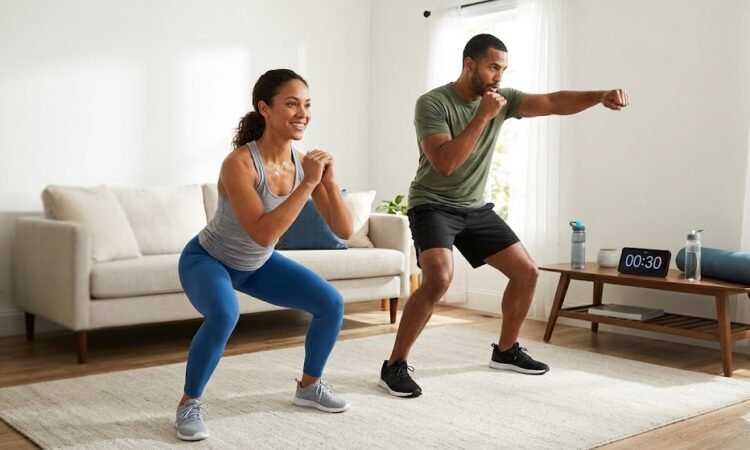
We, all wont to become fit, burn the sticky fat, and boost our cardiovascular health without spending a penny on a hard to follow gym membership or heavy fitness equipment?, then welcome to the ultimate home fitness routine solution, which is High-Intensity Interval workout for beginers at home, which is also better known as HIIT.
If you are just a fitness lifestyle beginner, then the phrase high-intensity might sounds you like an intense and incredibly intimidating. But, Most of the online staff availablee such as HIIT Youtube Videos showcase the well trained athletes, performing high-impact, joint-stressing body movements such as burpees and tuck jumps. However, the secret of HIIT worout is that HIIT is 100% progressive workout, and one can start it with low intensity and gradually increse the intensity as your body adopts the movement changes without stressing your muscles or joints.
This article will helps you to know the science, safety mechanics, and step-by-step structures of the best HIIT workout routine for beginners which can be performed even at home and no need to visit the gym. You will learn exactly how to achieve maximum metabolic results in the minimum available time, and with completely safely of your body.
- The Science Behind HIIT: Why It Beats the Long hours of Cardio
To understand why interval training is so effective for a home workout routine, the first we have to look at how your metabolism responds to stress. Traditional cardio such as doing jogging just for 45 minutes, is known as LISS (Low-Intensity Steady-State) cardio. While LISS is great for beginning body endurance building, but it only burns calories when you are doing the workout, once you stop the workout the caloric burning also halts.
HIIT turns this dynamic upside down by triggering a physiological phenomenon, which is known as EPOC (Excess Post-Exercise Oxygen Consumption), which is also referred to as the afterburn effect of workout.
When you push your body through short, intense sessions of workout movement, your muscles gives on with an oxygen loss. During your post-workout recovery phase, your body has to work overtime to restore its muscle oxygen levels, balance hormones, and repair cellular tissue.
As, due to the EPOC, a properly structured 15-minute home HIIT session can make your body to continuously burning calories at a higher rate for up to 24 hours even after your workout is done many hours before. This makes it an incredibly powerful tool for anyone who is looking for a sustainable body calorie burn.
Primary Health and Fitness Benefits of HIIT Workout:
- Maximum Time Efficiency: Most beginner of interval training circuits take less than 20 minutes from start to finish, which is perfect fit for a busy professional lifestyle.
- Zero Cost & No Equipment: Your own body weight provides all the required resistance and mechanical tension you need to stimulate muscle groups during HIIT which needs no expensive equipment, and it even can be done from the comfort of your home.
- Enhanced Insulin Sensitivity: Studies have shown that regular interval training improves how your muscles burns glucose, helping in better blood sugar management.
- Dual Cardiovascular Conditioning: HIIT simultaneously trains your aerobic system (endurance) and anaerobic system (power and speed).
- The Golden Rules of HIIT workout for Beginners:
Before adopting any exercises routine, ensuring safe training guidelines is very important for avoiding sudden energy loss burnout or injury.
- Prioritize Form Over Speed: Never sacrifice proper body mechanics just to squeeze out a few extra repetitions. If your posture collapses, slow down or pause early.
- Master Your Breathing: Inhale deeply through your nose during the workout breaks and exhale forcefully through your mouth. Never hold your breath under tension.
- Honor the Rest Intervals: The resting part of a daily HIIT workout routine is also as important as the workout portion. Use this resting time to lower your heart rate so you can attack the next movement with maximum effort.
- Protect Your Joints: If you have historical knee, hip, or ankle pain, always utilize low-impact modifications (such as stepping instead of jumping).
- The Best 15-Minute Home HIIT Workout for Beginners:
This popular routine includes basic, low-impact body movements designed to increase your breathing and heart pumping while protecting your lower back and joints.
The Protocol: The 30/30 Interval Structure:
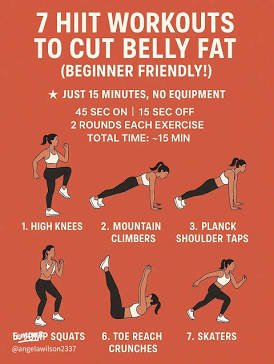
You will perform every exercise workout for 30 seconds with focus, followed immediately by a 30 seconds of resting. Once you complete all 5 exercises with rest, you have finished one full set. Rest for 2 full minutes, grab a sip of water, and repeat the set for a second round.
- Jumping Jacks (or Low-Impact Step Jacks): Interval 1: Total Body Cardio Warm-up.
A regular cardiovascular body movement that opens up the hips and shoulders while steadily raising your heart rate. Stand tall with your feet together, jump your feet out past shoulder-width while bringing your hands together overhead, and return smoothly.
Low-Impact Modification: If jumping creates a stress or pain feeling in your joints, then in that case, switch to a Step Jacks. Keep one foot planted while stepping the other out to the side, alternating leg movement while maintaining continuous arm movements is process of it.
- Bodyweight Air Squats: Interval 2: Lower Body Power & Strength.
This movement targets the glutes, quadriceps, and hamstrings to burn maximum energy. Stand with feet little wider than hip-width apart, toes pointed subtly outward. Initiate the movement by sending your hips back and down, as if sitting into an invisible chair. Keep your chest proud, spine neutral, and drive forcefully through your heels to return to a standing position. Ensure your knees track should be in line with your toes and do not let them cave inward for safety during this workout.
- Elevated Incline or Knee Push-Ups: Interval 3, Upper Body Push & Core Integration.
Push-ups are considered as one of the best upper-body builder, but standard floor push ups can be more intense for the HIIT beginners. Instead, drop your knees on a comfortable exercise mat, or place your hands firmly on an upward, stable surface such as stable couch, bench, or kitchen counter. Lower your chest down smoothly, keeping your elbows tucked at a safe 45-degree angle rather than spread out. Press the surface away to return to the top.
- Floor Glute Bridges: Interval 4, Posterior Chain Activation & Active Recovery.
Lie flat on your back on a mat with your knees bent at a 90-degree angle and your feet flat on the floor, roughly at a hip-distance apart. Drive through your heels, squeeze your glutes tightly, and lift your hips toward the ceiling until your body forms a straight line from your shoulders to your knees. Hold for one second at the high before lowering slowly. This movement builds core and hip strength while giving your lungs an active rest.
- Shadow Boxing (Jab-Cross-Weave): Interval 5, Core Rotation & Speed End.
Adopt a comfortable, athletic position with your knees slightly bent and hands guarding your face. Punch the air directly in front of you, alternating hands in a rapid, controlled rhythm. Rotate your torso and match your back foot slightly with every punch. This movement fully engages the obliques and transverse abdominis without placing any flexion stress on your spine.
- Tracking and Measuring Your Cardiovascular Progress
How do you know if your home fitness routine is actually working? Instead of depending entirely on a inhouse tracking app or device, which can fluctuate wildly based on water retention, monitor these three tangible fitness trackers over for a 4 to 6 week period:
- Metric Tracker: Recovery Heart Rate, Baseline (Week 1): Gasping for air for 3+ minutes after a round, Progression Goal (Week 4): Breathing settles within 45–60 seconds of rest, The Science Behind It: Your heart is becoming a more efficient pump, dropping your resting heart rate over time.
- Metric Tracker: Repetition Capacity, Baseline (Week 1): Achieving 8 slow squats in a 30-second window, Progression Goal (Week 4): Achieving 15+ crisp, controlled squats in 30 seconds, The Science Behind It: Your muscular endurance and neurological output are optimizing.
- Metric Tracker: Sustained Stamina, Baseline (Week 1): Completely exhausted after a single 5-minute round, Progression Goal (Week 4): Feeling energized and capable of executing 3 full rounds, The Science Behind It: Your body’s anaerobic threshold has increased significantly.
- The 4-Week HIIT Progression Blueprint
To prevent a sudden weight loss and lower body energy, you must adopt progressive workout overload technique during your workout, and such gradual increase stress placed upon the body during exercise helps in strengthening your body muscle and joints. Use this simple 4-week progression framework to scale your home HIIT routine as your first step of endurance increases:
- Week 1: 2 sessions per week. 2 rounds per session. Interval: 30s work / 30s rest.
- Week 2: 2 sessions per week. 3 rounds per session. Interval: 30s work / 30s rest.
- Week 3: 3 sessions per week. 3 rounds per session. Interval: 35s work / 25s rest (Increasing work time).
- Week 4: 3 sessions per week. 4 rounds per session. Interval: 40s work / 20s rest (Advanced interval challenge).
- Frequently Asked Questions (FAQ)
How many times a week should a beginner do HIIT at home?
For beginners, 2 to 3 times per week is the sweet spot. Because HIIT is stressing to your central nervous system and muscle tissue, your body requires adequate recovery time to rebuild. Always leave at least 24 to 48 hours of rest or light activity between intensive HIIT sessions.
Can you lose belly fat with home HIIT workouts?
Fat loss happens systemically when your body is in a calorie deficit (burning more calories than it consumes). HIIT accelerates this process by burning a high volume of calories in a short timeframe and sustaining that burn via EPOC. While you cannot spot-reduce fat specifically from your stomach, regular HIIT combined with a balanced diet is one of the most effective ways to reduce overall body fat percentage.
Should I do HIIT no equipment home HIIT on an empty stomach?
This comes down to personal preference. Some individuals thrive on fasted cardio, while others feel dizzy or sluggish. If you prefer to eat before working out, try having a small, easily digestible carbohydrate snack (like a banana or a slice of toast) 45 to 60 minutes before your session to optimize your energy levels.
What should I do if a movement hurts my lower back?
Stop the movement immediately. Lower back pain during bodyweight exercises usually indicates that your core muscles are fatigued, causing your lower spine to arch or collapse. Re-engage your abs by drawing your belly button toward your spine, or swap the exercise out for a simpler variation like the Glute Bridge.
Start Small, Stay Consistent with HIIT And achieve your desired health goals
You do not need an expensive gym membership, complex fitness equipment, or hours of spare time to completely revolutionize your health. By starting with this foundational, 15-minute home HIIT routine just twice a week, you lay the baseline strength, metabolic endurance, and confidence needed to unlock advanced fitness levels. Remember: the best workout routine is the one you can consistently show up for.
best hiit workouts for beginners at home, no-equipment home HIIT, beginner interval training, home fitness routine, low-impact modifications, calorie deficit, afterburn effect, cardiovascular health, Well-distributed throughout headings, subheadings, intro paragraphs, and image/table alt descriptions without keyword stuffing.
Meta Description: Ready to get fit without a gym? Discover the best HIIT workouts for beginners at home. This complete, no-equipment 15-minute guide features low-impact steps, progression charts, and expert safety tips to maximize fat burn.

Senior Editor, Functional Fitness & Everyday Strength
Qualified B.S. in Exercise Physiology, University of Colorado Boulder | Certified Personal Trainer (ACE)
Jake has been a founding editor at Gymbag since 2018. With over 12 years of coaching experience and a degree in physiology, he specializes in fitness that fits into real life.