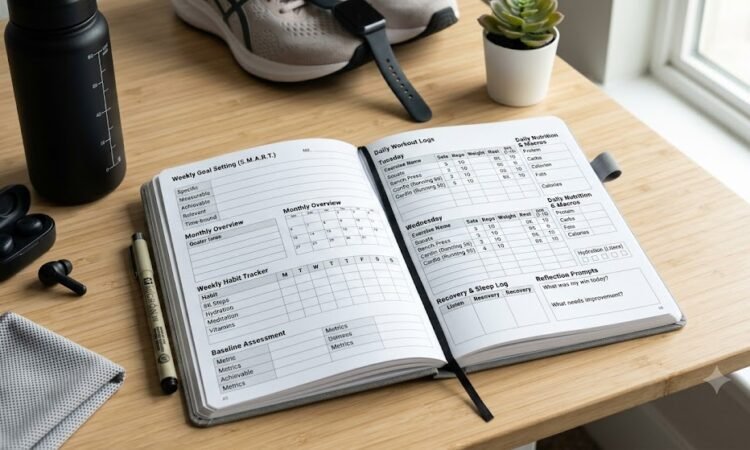
Starting a fitness journey without a plan is just as like doing a treasure hunt without a single clue. You must have a plan to succeed in your health goals, to save wastage of time, cost and energy by adopting unhealthy routine which may end up in loosing the fitness. A fitness planner works as your personalized guide for transforming essential healthy practices into achievable health goals with fix daily actionable routines.
Whether you prefer a printed diary of your daily health plan, a digital tracking app, or a structured guide given by an expert, a truly effective fitness planner needs specific elements which can help to keep you accountable, safe, and progressing.
Here are the 9 essential components which every fitness planner must consist of.
- Clear, Measurable Health Goal Setting:
A successfull fitness plan begins with clear achievable fitness goal. aspirations such as get fit or lose weight instantly, don’t build sustainable habits to achieve healthy body.
Your health plan should consists of a dedicated goal setting made around the following S.M.A.R.T. which means Specific, Measurable, Achievable and Relevant Targets:
- Specific: Target for a strong outcome such as “Run for a 5k without stopping” instead of “Getting better at running”.
- Measurable: Include exact numbere of your health goals and keep note4 of the periodic achievements of that desired number.
- Achievable: Set realistic targets based on your current requirements, as nothing can be achieved instantly, but, steady wins the race.
- Relevant: Align goals according to your existing health and desired fitness goals.
Time-Bound: Set clear deadlines such as by week or by Months or six monthly in your plan and track he periodic achievements.
Go with a fitness plan that divide long-term health goals into quarterly, monthly, and weekly action items.
- Comprehensive Base of Fitness Assessment
You cannot measure progress without knowing where you started. A detailed fitness plan includes an initial assessment section to record existing health numbers to compare the future progress:
- Category of Measurement: Body Measurements, What to Record: Weight, chest, waist, hips, arms, and thighs
- Category of Measurement: Performance Benchmarks, What to Record: Max push-ups, plank hold time, mile run time, or main lift weights
- Category of Measurement: Baseline Health Data, What to Record: heart rate during resting time, energy levels, and sleep quality
- Weekly & Monthly Workout Schedules
Workout schedule consistency maintaining is a very critical aspect of fitness planning. A functional fitness planner provides clear structural layouts for planning workouts schedules in advance.
- Monthly Overviews: Ideal for plotting major training sessions, resting weeks, or scheduled intense workout and nutrition sessions.
- Weekly Spreads: Essential for detailing day by day workout splits such as Upper Body / Lower Body / Active Recovery / Resting period etc.
Planning your Intense routine on Sunday followed by a good rest on the same day may drastically reduces the fatigue which comes on Monday morning.
- Detailed Daily Workout Logs
The base of any workout tracker is the daily log. A simple blank page is not enough, structured tracking fields ensure you to apply progressive increasing of workout intensity and weight, the principle of gradually increasing workout intensity helps to build better strength and endurance over the time.
A complete daily log must contain space for:
- Exercise Name: Grouped by target muscle group or training movement.
- Sets, Reps, and Weight: Specific tracking for each working set.
- Rest Intervals: Recording downtime between two sets to monitor workout impact.
- Cardio Measurements: Distance, speed, heart rate, and duration.
- Rate of Perceived Exertion (RPE): at a 1 to 10 scale rating can provide the information about how challenging the session felt.
- Daily Nutrition & Macro Tracking
Fitness and nutrition goes hand in hand. A planner that does not consider exercise without the required nutrition, as this may damage your health more.
Your fitness planner should include dedicated space to mention below important readings:
- Macronutrient Targets: Daily goals for intake of enough proteins, carbohydrates, and fats in grams.
- Caloric Intake: Tracking total daily calories against energy spending.
- Meal Schedules: Pre-workout fuel and post-workout energy recovery meals.
- Hydration Tracker: A quick checkbox or water intake tracker of going with drinking of 2 to 3+ liters of water daily depending on your daily workout activity level.
- Recovery & Sleep time entry
Progress doesn’t happen in the gym, it happens while your body cells recover themselves during your sleeping time. Neglecting rest may leads to burnout, tiredness, and body cells damage.
An effective fitness planner includes a daily sleep time and body energy recovery tracker to monitor:
- Sleep Duration & Quality: Hours of slept and how refreshed you feel upon waking up.
- Muscle Soreness & Fatigue: Logging on the feeling of delayed onset muscle soreness (DOMS) to signal when an active recovery day is needed.
- Mobility & Stretching: Tracking dedicated mobility work or foam rolling workout sessions.
- Habit Trackers for Behavioral Consistency
Fitness is the byproduct of our daily habits. Integrating habit trackers in your routine planner strengthens positive impact even after the workout sessions.
Track daily micro-habits such as:
- Taking daily vitamins or supplements Intake
- Hitting daily step count goals such as 8,000 to 10,000 steps per day
- Avoiding processed & sugar rich food products and late-night snacking
- Spending daily 10 minutes on mindfulness and stress management activities
- Reflection Prompts & Mental Check-Ins
A purely mechanical workout log misses the psychological component of health. Mindset often rules on long-term adherence.
Weekly or monthly reflection sections should prompt you with questions like below:
- What was my biggest fitness win this week?
- What obstacles prevented me from completing planned workouts, and how can I adjust?
- How are my energy levels and mood performing overall?
Such Regular check-ins help to identify the fitness impact patterns, celebrate small health achievements, and prevent frustration with more positive attitude.
- Record of Fitness Progress & Milestones Achievements
Visual feedback such as before and after body photos, may provides a powerful motivation on your health journey.
A well-designed Fitness planner includes:
- Milestone Checkpoints: Check points must be designated as review pages at regular intervals of weeks 4, 8, and 12.
- Measurement Comparison Charts: Side by side numbers to be updates to track the actual body composition changes over time.
Final Thoughts: Choosing the Right Fitness Planner
A high-performing fitness planner acts as both a blueprint for future health needs and a record of past fitness achievements. When designing a fitness planner, ensure that it maintains a balance between structured tracking such as sets, reps, nutrition and holistic wellness including sleep, recovery, mindset etc.
By consistently tracking these above 9 essential components, you can eliminate the confusion, optimize early energy recovery, and ensure a steady progress in your desired health ad fitness goals.

Senior Editor, Functional Fitness & Everyday Strength
Qualified B.S. in Exercise Physiology, University of Colorado Boulder | Certified Personal Trainer (ACE)
Jake has been a founding editor at Gymbag since 2018. With over 12 years of coaching experience and a degree in physiology, he specializes in fitness that fits into real life.