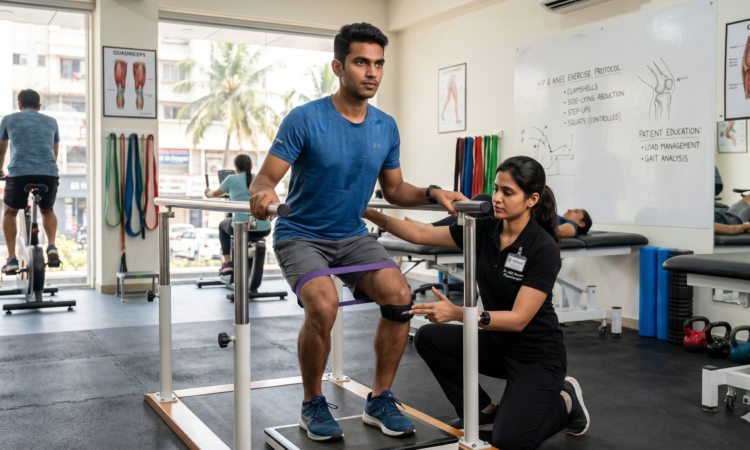
If you are a runner, then sometimes you may feel a sharp pain around your kneecap with causing your training session halt. This siatution is known commonly as Runner’s Knee, or medically by name Patellofemoral Pain Syndrome (PFPS), this condition is one of the most frequent injuries found among runner athletes. It manifests as a dull, aching pain behind or around the patella, which often stressed by running, squatting, climbing stairs, or sitting for long hours. The good news? is that by adopting specific Rehab Exercises for Runners with Knee Pain, you can address the issue of weak hips, lack of gluteal control, and muscle imbalances, and get back to the stronger, more efficient athletic performance.
Understanding the Mechanics of Runner’s Knee:
To heal your paining knee, you must first stop viewing it as an separate broken part.As, the knee is a hinge joint trapped between the hip and the ankle. When it hurts, it is often because it is being stressed by its neighboring joints which are failing to manage the stress together.
When your hip muscles are weak, your femur (thigh bone) rotates inward during your stride. This causes the kneecap to missed track against the groove of the femur, which leads to the irritation and inflammation, which is known as a runner’s knee. This requires a systemic approach to address the pain and strengthening the body movement.
The Essential Rehab Exercises for Runners with Knee Pain:
These exercises are designed to stabilize the pelvis and strengthen the muscles which are surrounding the knee without the joint to high-impact stress. Perform these for 3 to 4 times per week to get better results.
- Gluteal Activation: The Clamshell
The gluteus medius is the primary stabilizer of the pelvis. If this is weak, your knee will cave in every time your foot hit to the the ground.
- The Movement: Lie on your side with knees bent at 90 degrees and ankles touching. Keep your pelvis perfectly vertical and don’t roll backward by lifting your top knee as high as you can.
- Progression: Once you are able to do 3 sets of 15 of this comfortably, the add a resistance band around your knees to increase the load.
- Quad Strengthening: Straight Leg Raises:
High-impact loading can irritate an inflamed patella. Routine Straight leg raising workout allows you to build quadriceps strength without the grinding motion of a traditional squat workout.
- The Movement: Lie on your back, Bend one leg with your foot flat on the floor for support. Straighten the other leg, lock your knee, and lift your foot to about 12 inches off the ground. Hold for 3 seconds and the lower it slowly.
- Focus: Control the lowering phase, that is where the muscle strengthening work truly happens.
- Lateral Stability: Side-Lying Leg Lifts:
Running is a very popular athletic sport, in which it is important activity of hopping your body stress from one leg to the other. Side-lying leg lifts build the hip stability which is required to keep your body balanced during that transition.
- The Movement: Lie on your side, legs completely straight. Lift your top leg toward the ceiling while keeping your toe pointed slightly forward. Avoid letting your hip rotate toward the ceiling.
- Posterior Chain: The Glute Bridge:
The glutes are the engines of your steps. A weak posterior chain forces the quads to take too much load, which puts excessive pressure on the knee.
- The Movement: Lie on your back, knees bent, feet flat on the floor. Drive through your heels to lift your hips toward the ceiling. Squeeze your glutes at the top.
- Progression: Transition to a single-leg bridge once you have mastered it then start doing the double-leg workout.
Mobility and Flexibility: Why They Matter:
Strengthening is only half of the battle and hardwork. If your calves or hamstrings are hyper-tight, then they will restrict your ankle and hip range of motion, forcing your knee to stressed out more.
- Calf Rolling: Use a foam roller or lacrosse ball to address tightness in the calves. Restricted ankle dorsiflexion is a massive contributor to knee pain.
- Hamstring Lengthening: Add specific stretches such as leg swings before runs and static holds such as a towel-assisted hamstring stretch after your daily rehab session.
Returning to the Road: The Smart Progression:
The biggest mistake the injured runners do is the all or nothing approach, as either the take a complete rest or keep jumping back with the pre-injury leg. both approached does not work.
The 10% Rule & Cadence:
When you return to running, follow these strict guidelines:
- Start with Walk-Runs: Begin with 2 minutes of running followed by 1 minute of walking. Increase the running intervals by not more than 10% per week.
- Increase Your Cadence: A lower cadence means your foot lands further in front of your body i.e. overstriding, which acts as a brake and sends a massive shockwave through your knees. Go with 170 to 180 steps per minute. Shorter, quicker sessions distribute stress impact more evenly.
- Surface Matters: If possible, transition back to running on flat, softer surfaces such as a synthetic fabric made tracks or groomed soft dirt trails rather than a concrete floor.
Nutrition and Recovery Hygiene:
Recovery is not just physical work, it is a natural bodily process.
- Anti-Inflammatory Nutrition: Add Omega-3 fatty acids which is usually found in salmon, walnuts, and flaxseeds and antioxidants eich foods including berries, leafy greens to help your body mto effectively anage the systemic inflammation which is caused by the injury.
- Hydration and Sleep: Tissue repair happens primarily during a deep sleep. If you are training with high intensity, then, you must prioritize 7 to 9 hours of quality restful sleep every day.
When to Consult with a Professional:
While these rehab exercises for runners with knee pain are highly effective, they are not a substitute for a medical diagnosis. You should seek out a sports physical therapist or an orthopedic specialist if:
- Mechanical Symptoms: You feel clicking, popping sounds, or a sensation that feels you like your knee is locking or giving way its balance.
- Persistent Effusion: Significant swelling that does not go down with a quality sleep or even after a soothing ice therapy.
- Night Pain: If the pain is severe enough to wake you up in the middle of night and prevent you from falling asleep.
The Long-Term Perspective:
Developing an injury is not a failure, it is a signal. It is thatg your body telling you about that the current training load is exceeding your current body structure capacity. By adopting these rehab exercises as a permanent part of your workout routine, you aren’t just fixing a knee, but you are making them more robust, durable, and faster fopr better athletic performance.
Consistency is the secret to achieve strength and perfection. You don’t need a perfect plan, you need a sustainable habit. Start today, keep your body movements controlled, and trust the process of building back your knee with athletic strength.
4-Week Back to the Road Recovery Schedule:
This plan will help you control and mitigate the acute inflammatory phase which including a sharp pain while resting.
- Week 1, Focus: Begineers, Running Protocol: Walk 5 min, Run 1 min, Walk 4 min (Repeat 4x). Total: 20 min. Strengthening Frequency: 3x per week
- Week 2, Focus: Progression, Running Protocol: Walk 3 min, Run 2 min, Walk 3 min (Repeat 4x). Total: 24 min., Strengthening Frequency: 3x per week
- Week 3, Focus: Consistency, Running Protocol: Run 5 min, Walk 2 min (Repeat 3x). Total: 21 min., Strengthening Frequency: 4x per week
- Week 4, Focus: Adaptation, Running Protocol: Run 10 min, Walk 2 min (Repeat 2x). Total: 24 min., Strengthening Frequency: 4x per week
Important Guidelines for Success
- The 24-Hour Rule: After your run/workout, monitor your knee for the next 24 hours. If the pain increases and doesn’t reduce with the rest, scale back to the previous week’s volume.
- Warm-Up is Important: Never start a run with high intensity and without worm-ups. Perform 5 minutes of dynamic body worm-up movements such as leg swings, butt kicks, and high knees etc., to increase synovial fluid in the knee joint before you start your run.
- Don’t Ignore the Strength Days: The running sessions in this plan are intentionally short. The real recovery happens during your dedicated strengthening days using the exercises reps in the previous session.
Always Listen to the Bad Pain:
- Good Pain: General muscle soreness in the quads or glutes which reduces once you take a good restful sleep.
- Bad Pain: Sharp, stabbing pain behind the kneecap or pain that causes you to limp. If you feel bad pain, stop immediately and revert to a milk walking sesion only for net 3 days to gain the endurance.
Tips for Analyzing Your Running Form:
Since the form is als important during workoutm hence we are providing the three high-impact adjustments which you can make during your running session:
- The Silent Landing: Focus on landing as softly as possible. Audibly thumping sound of your legs on the ground is a sign of excessive vertical oscillation ie. bouncing and higher impact force.
- Shorten Your Stride: Focus on taking shorter, quicker steps. This naturally keeps your foot landing under your hips rather than out in front of you, which dramatically reduces the braking force on the knee.
- Check Your Pelvis: During your run, try to keep your torso tall and your hips at level. If you feel yourself dropping or swaying side-to-side, then it is a sign of your gluteus medius is at fatiguing, so it’s time to walk slowly!
We hope above article on Rehab Exercises for Runners with Knee Pain with help not only athletes but also to people who are experiencing kneecap pain after their routine workout session.
Note: This content is just for informational purposes only and does not constitute professional medical advice, diagnosis, or treatment. Always seek the advice of your physician or other qualified health provider with any questions you may have regarding a medical condition.

Senior Editor, Functional Fitness & Everyday Strength
Qualified B.S. in Exercise Physiology, University of Colorado Boulder | Certified Personal Trainer (ACE)
Jake has been a founding editor at Gymbag since 2018. With over 12 years of coaching experience and a degree in physiology, he specializes in fitness that fits into real life.